

Psoriasis isn’t just a rash. It’s a lifelong condition that changes how your body works - inside and out. For millions of people, it’s not about occasional dry patches. It’s about flares that come without warning, itching that keeps you up at night, and the weight of knowing your immune system is attacking your own skin. The plaques - thick, red, scaly patches - show up on elbows, knees, scalp, or even your nails. But what most people don’t see is the deeper toll: higher risk of heart disease, joint pain, depression, and the daily grind of managing something no cure can fully erase.
What’s Really Happening Under Your Skin?
Your skin normally renews itself every 28 to 30 days. In psoriasis, that process speeds up to just 3 or 4 days. Too many skin cells pile up, forming those raised, scaly plaques. But why? It’s not dirt, not allergy, not stress alone. It’s your immune system gone rogue. T-cells, meant to fight infection, turn on healthy skin cells. They trigger inflammation and ramp up cell production. This isn’t something you caught - it’s genetic. If a parent has psoriasis, your chance of getting it jumps to 60-90%.Not All Psoriasis Looks the Same
There are different types, and they demand different approaches. Plaque psoriasis is the most common - about 8 out of 10 people with psoriasis have it. Those raised, silvery scales on elbows and knees are the classic sign. But inverse psoriasis hides in skin folds - under the breasts, in the groin, or near the buttocks. It’s smooth, red, and worsens with sweat and friction. Then there’s guttate - small, drop-like spots often triggered by strep throat. Pustular psoriasis brings sterile pus-filled bumps, sometimes all over the body. And erythrodermic psoriasis? That’s rare but dangerous. It covers most of your skin, disrupts body temperature, and can be life-threatening. If your skin turns bright red and starts peeling off in sheets, get help immediately.How Doctors Measure Severity - And Why It Matters
Doctors don’t just guess how bad your psoriasis is. They use tools. PASI (Psoriasis Area and Severity Index) measures how much skin is affected and how thick, red, and scaled the plaques are. DLQI (Dermatology Life Quality Index) asks how much it impacts your life - can you wear shorts? Sleep through the night? Go to work without feeling judged? A score above 10 on DLQI means your condition is severely affecting your daily life. And here’s something many primary care doctors miss: up to 30% of people with psoriasis develop psoriatic arthritis. Joint pain, stiffness, swollen fingers - these aren’t just aging. They’re part of the same disease. Screening for joint issues is now part of standard care.Topical Treatments: The First Line of Defense
Most people start with creams and ointments. For mild cases, this can be enough. Calcipotriol (a vitamin D analog) slows skin cell growth. Betamethasone (a steroid) reduces inflammation. Many doctors combine them - one product, one application. But guidelines differ. In the U.S., the American Academy of Dermatology says to use them separately to avoid side effects. In Europe, combination products are first-line because they improve adherence. The problem? Steroids can thin skin if used too long - especially on the face, eyelids, or genitals. That’s why they’re not meant for daily use beyond 12 weeks. For scalp psoriasis, foams and solutions work better than thick creams. For nails, you need special formulations that can penetrate. And for sensitive areas like the groin? Avoid steroids entirely. Use calcineurin inhibitors like tacrolimus instead.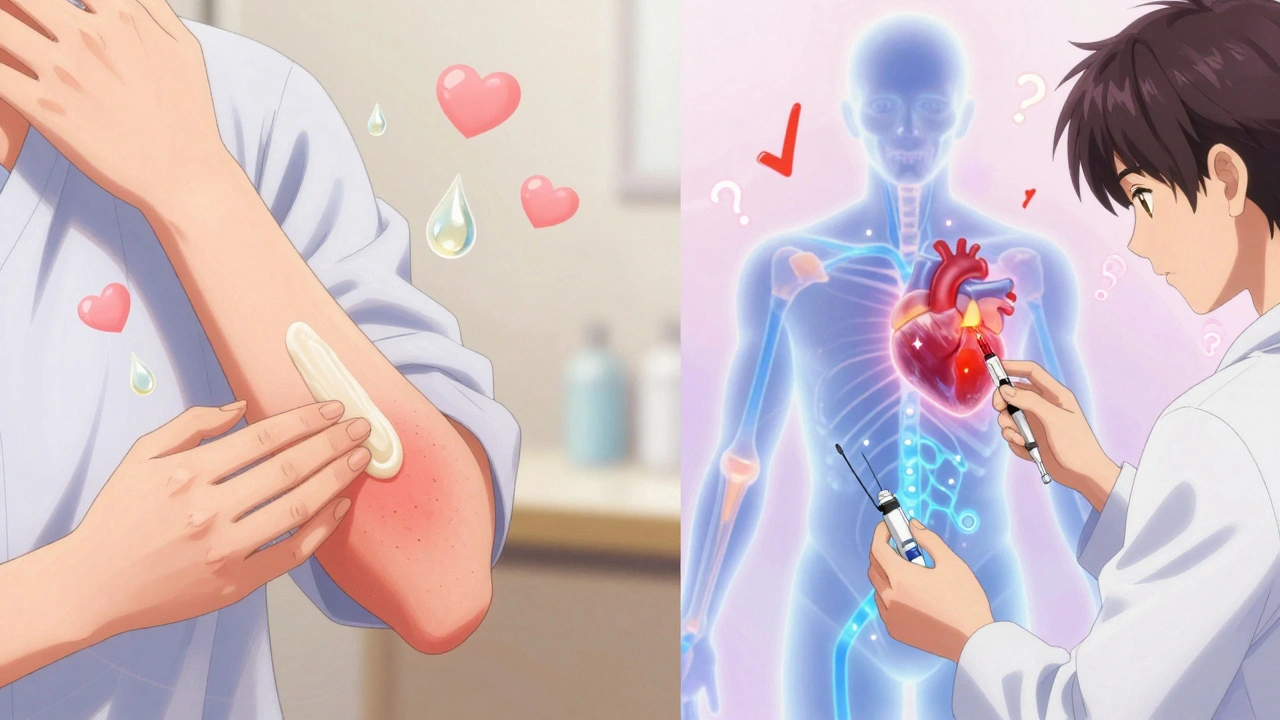
Phototherapy: Light as Medicine
If topicals don’t cut it, light therapy is the next step. Narrowband UVB is the most common. You go to a clinic 2-3 times a week for 8-12 weeks. Each session lasts a few minutes. It’s not tanning - it’s controlled, targeted exposure that calms the immune response in your skin. About 75% of people see at least 75% improvement. Home units exist but cost $2,500-$5,000 upfront. Maintenance is $100 a month. PUVA (psoralen plus UVA) is older and more powerful but carries higher skin cancer risk. It’s rarely used now unless other options fail. Phototherapy doesn’t cure psoriasis - it buys you time. Flares return if you stop.Systemic Therapies: When the Problem Is Inside
When psoriasis covers more than 10% of your body, or when joints are involved, you need more than creams. Oral medications like methotrexate, acitretin, or cyclosporine work by suppressing the immune system. Methotrexate is common - taken once a week. But it can hurt your liver and lower blood counts. You need regular blood tests. Cyclosporine works fast but can damage kidneys. It’s usually used for short bursts during severe flares. Acitretin is good for pustular psoriasis but causes dry skin and can’t be used by women planning pregnancy - it stays in the body for years.Biologics: The Game Changers
These are injectable or IV drugs that target specific parts of the immune system. They’re not broad immunosuppressants - they’re precision tools. TNF inhibitors like adalimumab (Humira) and etanercept (Enbrel) were the first. Then came IL-17 inhibitors like secukinumab (Cosentyx) and ixekizumab (Taltz). Now, IL-23 inhibitors like guselkumab (Tremfya) and tildrakizumab (Ilumya) are leading the pack. Why? They get you to PASI 90 - 90% skin clearance - more often than anything before. In trials, nearly 60% of people on guselkumab reached near-complete clearance in 16 weeks. Side effects? Mostly mild: injection site reactions, colds, headaches. But you must be tested for TB and hepatitis before starting. These drugs aren’t cheap. Monthly costs range from $1,200 to $5,500. Insurance helps, but 41% of patients still skip doses or delay treatment because of cost.The Hidden Burden: Comorbidities You Can’t Ignore
Psoriasis doesn’t live in isolation. People with it have a 58% higher risk of heart attack before age 50. They’re more likely to have high blood pressure, diabetes, obesity, and high cholesterol - together called metabolic syndrome. One in two psoriasis patients has it. Depression and anxiety are twice as common as in the general population. The stigma of visible skin can be crushing. That’s why treatment now includes screening for these conditions. Every visit should include checking your blood pressure, weight, cholesterol, and mood. The American Academy of Dermatology and the American College of Cardiology just launched a joint initiative to make this standard practice. Your skin doctor should be talking to your heart doctor - and your therapist.
Real-Life Challenges: Why People Stop Treatment
Even the best treatments fail if people can’t stick with them. A Reddit survey of 247 people found 67% struggled with topical adherence. Creams are messy. Foams leak. Ointments stain clothes. Applying them twice a day is hard when you’re tired or busy. Biologics require injections - some weekly, some monthly. Learning to self-inject takes time. And then there’s cost. One man in Halifax told me he chose between his biologic and his daughter’s piano lessons. That’s real. Treatment discontinuation hits 30-50% within a year. Side effects like nausea (methotrexate) or fatigue (apremilast) push people away. But those who stick with biologics report 82% satisfaction. Secukinumab gets 4.3 out of 5 stars for clearing skin - but only 3.1 for price.Self-Care That Actually Works
You can’t treat psoriasis with creams alone. Daily habits matter. Use thick, petrolatum-based moisturizers right after showering. Keep showers short and lukewarm - hot water dries you out. Skip harsh soaps. Use fragrance-free cleansers. Avoid scratching - it triggers more plaques. Identify triggers: stress, alcohol, smoking, infections, certain medications like beta-blockers. Keep a symptom journal. UCLA Health found that simplifying regimens - switching from twice-daily to once-daily - boosts adherence by 40%. Apps like MyPsoriasisTeam let you track flares, treatments, and triggers. Join a support group. The National Psoriasis Foundation runs free virtual meetings with 12,000+ monthly participants. You’re not alone.The Future: Where Psoriasis Treatment Is Headed
New drugs are coming. Deucravacitinib (Sotyktu), a once-daily pill approved in 2022, targets a different immune pathway (TYK2). In trials, 58% of users hit PASI 90. Oral RORγt inhibitors are in Phase 2 - they could replace injections entirely. But the biggest shift is personalization. Researchers are starting to match genetic profiles to treatments. One person might respond best to an IL-17 inhibitor. Another to an IL-23 blocker. The goal? No more trial and error. Right drug, right patient, right from the start. The treatment gap is still huge - only 25-30% of moderate-to-severe cases get proper systemic therapy. Rural areas have fewer specialists. But awareness is growing. And with PASI 90 now accepted as a regulatory endpoint by the FDA, the bar for success is rising.What Success Looks Like Now
Success isn’t just clearing your skin. It’s getting your DLQI score below 4 - meaning psoriasis barely affects your life. It’s having no joint pain. It’s sleeping through the night. It’s being able to wear a swimsuit without shame. It’s knowing your heart is protected. The new standard isn’t “better.” It’s “nearly clear.” And with today’s tools - from targeted biologics to better self-care - that’s possible for more people than ever before. The key? Don’t wait until it’s severe. Talk to your doctor early. Push for screening. Ask about biologics if topicals aren’t enough. Your skin is part of a bigger picture - and treating it that way changes everything.Is psoriasis contagious?
No, psoriasis is not contagious. You cannot catch it from touching someone’s skin, sharing towels, or being near them. It’s an autoimmune condition driven by genetics and immune system dysfunction, not bacteria or viruses. Even open plaques or flaking skin pose no risk of transmission.
Can diet cure psoriasis?
No diet can cure psoriasis. But some people find that reducing alcohol, processed foods, and sugar helps reduce flares. Losing weight if you’re overweight can improve symptoms - metabolic health and psoriasis are closely linked. There’s no single “psoriasis diet,” but anti-inflammatory eating patterns (like Mediterranean) may support overall management.
Do biologics weaken the immune system too much?
Biologics target specific parts of the immune system, not the whole system like older drugs. That means they’re safer than methotrexate or cyclosporine for long-term use. But you’re still at slightly higher risk for infections like colds, flu, or TB. That’s why screening before starting is required. Most people tolerate them well, and the benefits - clear skin, less joint pain, lower heart risk - usually outweigh the risks.
How long does it take for psoriasis treatments to work?
Topical treatments may show improvement in 2-4 weeks. Phototherapy usually takes 8-12 weeks of 2-3 sessions per week. Biologics work faster - some see results in 2-4 weeks, with peak results at 12-16 weeks. Oral systemics like methotrexate can take 6-12 weeks. Patience is key, but if nothing changes after 3 months, talk to your doctor about switching.
Can psoriasis go away permanently?
There is no permanent cure for psoriasis today. But with modern treatments, many people achieve long-term remission - months or even years without flares. Some stay clear for years on biologics. Stopping treatment usually leads to return of symptoms. The goal now is not just control, but sustained, near-complete clearance.
Is it safe to use steroids long-term for psoriasis?
Long-term use of potent topical steroids (beyond 12 weeks) can cause skin thinning, stretch marks, and visible blood vessels - especially on the face, armpits, or groin. They’re best used short-term to bring flares under control, then switched to non-steroid options like calcipotriol or calcineurin inhibitors. Always follow your doctor’s guidance - don’t use them daily without supervision.
Should I avoid sunlight if I have psoriasis?
Moderate sunlight can help psoriasis - it’s why many people improve in summer. But sunburns can trigger flares. Never use tanning beds. If you’re using photosensitizing treatments like PUVA or certain oral meds, sun exposure must be carefully managed. Always talk to your doctor before using sunlight as therapy. Controlled UVB phototherapy in a clinic is safer and more effective than natural sun.






9 Comments
Scott van Haastrecht
December 5, 2025 AT 09:19Let’s be real - this post reads like a pharmaceutical sales pitch wrapped in a medical textbook. Biologics cost more than my car payment, and half the people I know who started them ended up with shingles or worse. The system is rigged to keep people dependent on $5k/month drugs while ignoring root causes like gut health or chronic stress. They call it ‘autoimmune’ like it’s some mystery - it’s not. It’s inflammation from a lifetime of processed food, toxins, and emotional suppression. But hey, at least we’ve got a pill for that now, right?
Chase Brittingham
December 6, 2025 AT 23:51I’ve had plaque psoriasis since I was 19. I’m 34 now. I tried everything - steroids, phototherapy, methotrexate. The only thing that gave me real relief was switching to a whole-food, plant-based diet and cutting out alcohol. Not a cure, but my DLQI dropped from 18 to 3. I still use a little calcipotriol on my elbows, but I don’t feel like I’m being pumped full of chemicals anymore. It’s not magic, but it’s real. And yeah, I know diet doesn’t ‘cure’ it - but it sure as hell helps you live with it.
Bill Wolfe
December 8, 2025 AT 13:47How utterly predictable that the medical-industrial complex would reduce a profound autoimmune phenomenon to a series of expensive, patent-protected biologics while ignoring the epigenetic, spiritual, and environmental dimensions of disease. 🧠🩺 The fact that you need a PhD to understand PASI scores while your insurance denies coverage for functional medicine consultations speaks volumes about our civilization’s descent into mechanistic reductionism. The skin is merely the messenger - the true pathology lies in the soul’s disconnection from nature, community, and ancestral wisdom. I’ve seen patients reverse their psoriasis through breathwork, forest bathing, and ancestral nutrition. But no - let’s just inject IL-23 inhibitors and call it progress. 🤡
Ollie Newland
December 9, 2025 AT 23:39One thing this post misses is the role of the microbiome in psoriatic flares. Recent studies show dysbiosis in both gut and skin microbiota correlates with disease severity. Fecal microbiota transplants in murine models reduced IL-17 production significantly. Human trials are still early, but probiotics like L. rhamnosus GG and prebiotic fiber intake show promise as adjuncts. Also, don’t overlook the impact of oral antibiotics - even short courses for strep can trigger guttate flares. It’s not just immune dysregulation - it’s ecosystem collapse. We need to treat the whole terrain, not just the lesion.
Rebecca Braatz
December 11, 2025 AT 12:33STOP waiting for the perfect treatment. Start today. Moisturize after every shower. Drink water. Sleep 7+ hours. Cut out sugar. Walk outside. You don’t need to be a superhero - just consistent. I used to hide in hoodies. Now I wear tank tops. It took two years, but I got here. You’re not broken. You’re not a burden. You’re someone who deserves to feel comfortable in your own skin. And yes - biologics can help. But they’re not the only path. You’ve got this.
Michael Feldstein
December 12, 2025 AT 06:42Interesting how this post spends 1,000 words on biologics but barely mentions the fact that psoriasis flares often coincide with emotional trauma. I had a flare that lasted 18 months after my dad died. No one told me grief could manifest as scaly skin. I went to a dermatologist, got a steroid cream, and cried in the parking lot. Maybe we need more therapists on the dermatology team. Or at least a damn question on the intake form: ‘Have you lost someone recently?’
jagdish kumar
December 13, 2025 AT 10:39Skin is mirror. Mind is root. Pain is message. Silence is disease.
Benjamin Sedler
December 14, 2025 AT 18:00So let me get this straight - you’re telling me that injecting $5,000/month drugs into my arm is the only way to get my skin ‘clear’? Meanwhile, my cousin in rural Tennessee clears his plaques every summer by swimming in sulfur springs and eating raw garlic. No insurance. No prescriptions. Just dirt, sun, and old-school stubbornness. Who’s really ‘treating’ the disease here - the doctors or the corporations? And why is it that the only people who can afford ‘PASI 90’ are the ones who already have health insurance, a trust fund, or both? This isn’t medicine. It’s a luxury service with a white coat.
zac grant
December 15, 2025 AT 07:31For anyone feeling overwhelmed: you’re not alone. I’ve been on Tremfya for 3 years. My PASI went from 16 to 2. My joints don’t ache anymore. Yeah, it’s expensive. Yeah, I get a shot every 8 weeks. But I sleep. I wear shorts. I travel. I don’t flinch when someone says ‘your skin looks great.’ The science here is legit - it’s not hype. And if you’re on topicals and it’s not working after 3 months? Don’t wait. Push for a referral. Ask for biologics. You deserve to live without shame. This isn’t just skin deep - it’s life deep. And you’re worth the fight.