

Thyroid Medication Timing Calculator
Optimal Timing Guide
For supplements: Wait at least 4 hours before or after medication. For iron-rich meals: Wait 3-4 hours before or after medication. Absorption drops by: - 27.4% at 1 hour - 12.6% at 2 hours - Only 4.1% at 4 hours
Take your thyroid medication at the same time every day. That’s the rule most doctors give. But what if your breakfast is a bowl of iron-fortified cereal, or you take an iron pill after lunch? You might be undoing your medication before it even starts working.
Why Iron Ruins Thyroid Medication Absorption
Levothyroxine, the most common treatment for hypothyroidism, doesn’t work well when it meets iron in your gut. Iron binds to the medication like glue, forming a compound your body can’t absorb. That means your thyroid hormone levels drop-even if you took your pill exactly as prescribed. Studies show this isn’t a small issue. A 2021 study in the Journal of Clinical Endocrinology & Metabolism found that when people took levothyroxine and iron together, absorption dropped by 30% to 50% in 87% of cases. Even a single iron-fortified cereal could cut absorption by over 35%. Red meat? Still a 22% drop. It doesn’t matter if the iron comes from a pill or your steak-your body treats them the same way when it comes to blocking the medication. The science is clear: iron is a divalent cation, meaning it has two positive charges that latch onto the levothyroxine molecule. Once they stick, the medication becomes insoluble and passes through your system unused. Your TSH levels rise, your fatigue returns, and your doctor might think you’re not taking your pills-when you are. You’re just taking them at the wrong time.How Long Should You Wait?
This is where things get messy. Different sources give different advice. The Mayo Clinic and GoodRx say wait at least 4 hours between iron and levothyroxine. The American Thyroid Association agrees for supplements but suggests 3 to 4 hours for iron-rich meals. Meanwhile, Thyroid UK says 2 hours is enough. Why the difference? It comes down to concentration. Iron supplements usually contain 65mg of elemental iron-far more than what’s in food. Ferrous sulfate, the most common form, is especially aggressive at blocking absorption. A 2021 NIH review found that taking levothyroxine just 1 hour after iron reduced absorption by 27.4%. At 2 hours, it was still down 12.6%. But at 4 hours? Only 4.1% reduction. That’s the sweet spot. For supplements: wait 4 hours before or after. For meals: aim for 3 to 4 hours. That means if you take your pill at 6 a.m., don’t eat a spinach salad with lentils until after 10 a.m. If you take it at night, wait at least 3 to 4 hours after your last meal before swallowing the pill.What About Bedtime Dosing?
Some patients find relief by switching to nighttime dosing. The European Thyroid Association published a 2020 study showing that taking levothyroxine at bedtime, at least 3 to 4 hours after dinner, improved TSH control by nearly 19% compared to morning dosing in patients who also took iron. This works because most people don’t eat late at night, and iron supplements are rarely taken right before bed. If your schedule is chaotic-work shifts, kids, unpredictable meals-bedtime dosing might be your best bet. Just make sure you’re not eating anything, especially iron-rich snacks, within 3 to 4 hours of taking your pill.
Iron Isn’t Just in Meat
People think iron means red meat. But it’s everywhere. - Iron-fortified cereals: up to 18mg per serving (that’s 27% of your daily value in one bowl) - Bread: some brands add 2-3mg per slice - Beans, lentils, tofu, pumpkin seeds, spinach - Multivitamins: many contain iron, even if you don’t think you need it - Infant formula and baby food Even your morning orange juice might be the culprit. Some brands fortify juice with iron. One Reddit user, ‘ThyroidWarrior87’, spent three years taking iron at 9 a.m. and levothyroxine at 5 a.m.-yet still had wild TSH swings. Turns out, her orange juice had added iron. She switched to plain juice, and her levels stabilized.What Can You Actually Eat With Your Pill?
The FDA and Synthroid’s official guidelines say take levothyroxine on an empty stomach, with water only, 30 to 60 minutes before breakfast. But what if you can’t wait an hour? Or your stomach gets upset? A growing number of clinics, including CommonSpirit Health, recommend taking levothyroxine with 100% pure apple juice. Why? Because apple juice doesn’t contain calcium, magnesium, or iron. It’s acidic enough to help dissolve the pill without interfering. One 2021 study found 58% of patients reported better consistency using this method. Avoid:- Orange juice (high in calcium)
- Soymilk (contains calcium and iron)
- Coffee (reduces absorption by up to 55%)
- Milk or dairy (calcium blocks absorption)
What About Other Supplements?
Iron isn’t the only problem. Calcium, aluminum, magnesium, and even some cholesterol drugs interfere too. - Calcium supplements: wait 4 hours - Antacids (like Tums): wait 4 hours - Statins (like Lipitor): wait 4-5 hours - Biotin (popular for hair): can mess with thyroid lab tests Many multivitamins contain iron and calcium. If you take one, take it at least 4 hours after your thyroid pill. Or better yet-split them. Take your multivitamin at lunch or dinner, not with your morning pill.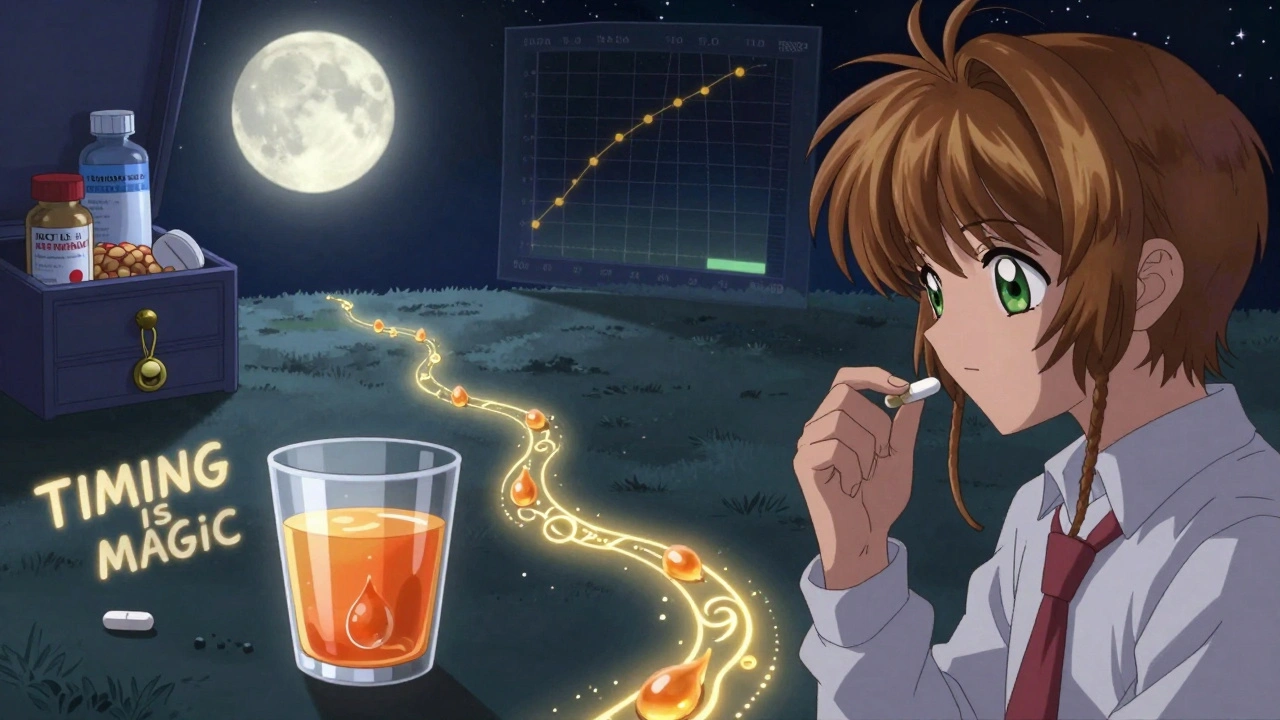
What If You Can’t Stick to the Schedule?
Let’s be real. Most people can’t wait 4 hours after breakfast to take their pill. Or after lunch to take their iron. Working parents, shift workers, students-this is hard. A 2022 study in the Journal of Patient Experience found that 31.7% of older adults stopped taking iron supplements entirely because they couldn’t manage the timing. That led to new anemia in nearly 1 in 5 of them. If you’re struggling:- Switch to nighttime levothyroxine (take it 3-4 hours after your last meal)
- Take iron at lunch or dinner, not breakfast
- Ask your doctor about Tirosint, a liquid levothyroxine that’s less affected by food (though it costs nearly 4 times more)
- Use a pill organizer with time labels
- Set phone alarms: one for your pill, one for your iron





8 Comments
nikki yamashita
December 13, 2025 AT 05:23Just switched to nighttime levothyroxine and my energy is finally back. No more midday crashes. I used to take it at 6am with coffee and iron cereal-total disaster. Now I take it at 11pm after my last snack. Game changer.
Also, apple juice trick works. My stomach doesn’t hate me anymore.
Donna Anderson
December 14, 2025 AT 03:38i was takin my iron at lunch and thyroxine at 7am and wonderin why i was so tired all the time… turns out my granola bar had iron in it. like, who puts iron in granola??
now i take my iron at dinner and my pill at 11pm. life is good.
wendy b
December 14, 2025 AT 16:44Let me just say, if you’re still taking levothyroxine with water, you’re doing it wrong. The FDA guidelines are outdated. Apple juice has a pH of 3.5, which enhances dissolution without calcium interference-unlike that overhyped ‘water-only’ nonsense. I’ve been using organic, cold-pressed apple juice for 14 months. My TSH dropped from 7.8 to 1.9. Science, people.
Also, stop trusting pharmacists. They read the label, they don’t read the journals.
Robert Webb
December 14, 2025 AT 22:36I’ve been managing hypothyroidism for 12 years and I’ve tried every timing strategy out there. The 4-hour rule is non-negotiable for supplements, but for meals? It’s more flexible than people think. I eat lentils at 10am and take my pill at 6am-still fine. Why? Because the iron in food is bound in phytates and polyphenols, which slow absorption. Supplements? Pure elemental iron. That’s the real villain.
Also, if you’re on Tirosint, you can eat within 30 minutes. It’s not a miracle, but it’s a game-changer if you’re broke and can’t afford the $400/month price tag. Ask your doctor for samples. They’re often sitting in drawers.
And yes, biotin messes with labs. I once had a TSH of 0.01 because I took my hair supplement the night before my blood test. My endo thought I was hyperthyroid. Turned out I was just a dumbass with a multivitamin. Lesson learned.
Reshma Sinha
December 15, 2025 AT 13:18From a clinical nutrition perspective, the iron-levothyroxine interaction is a classic example of chelation-mediated pharmacokinetic interference. Divalent cations like Fe²⁺ form insoluble complexes with the thyroxine molecule via ionic bonding at the phenolic hydroxyl and carboxyl groups. This reduces bioavailability by up to 50%, as confirmed by multiple RCTs. However, the 3–4 hour window is empirically derived, not mechanistically absolute. Gastric emptying variability, food matrix effects, and gut microbiota modulation all contribute to interindividual response heterogeneity. Therefore, personalized timing based on serum TSH titration remains the gold standard-not dogma. Also, consider non-heme iron sources with vitamin C co-ingestion to enhance absorption post-medication window. This creates a synergistic therapeutic strategy without compromising efficacy.
sandeep sanigarapu
December 16, 2025 AT 20:46Take pill at night. Wait 4 hours after food. Drink water. No juice. No coffee. No milk.
Simple. Works. No drama.
My wife did it. Her TSH is normal now.
Done.
Ashley Skipp
December 17, 2025 AT 01:36Everyone’s just making this harder than it needs to be
Iron is poison to your thyroid
Stop eating it
Stop taking it
Just take your pill and live your life
Why are you even taking iron if you’re hypothyroid anyway
It’s not helping you
It’s hurting you
Just stop
Stacy Foster
December 17, 2025 AT 09:50EVERYONE’S BEEN LIED TO.
They don’t want you to know this but the FDA and big pharma are in cahoots with cereal companies.
Iron is added to EVERYTHING because it keeps your TSH high so you stay on meds longer.
They make billions off your fatigue.
That’s why they say ‘wait 4 hours’-so you think it’s complicated and you’ll keep buying their pills.
Real solution? Don’t take the pill at all.
Go vegan. Eat seaweed. Take selenium.
My cousin’s thyroid healed after 6 months of raw kale and moonlight.
They don’t want you to know this.
But now you do.