
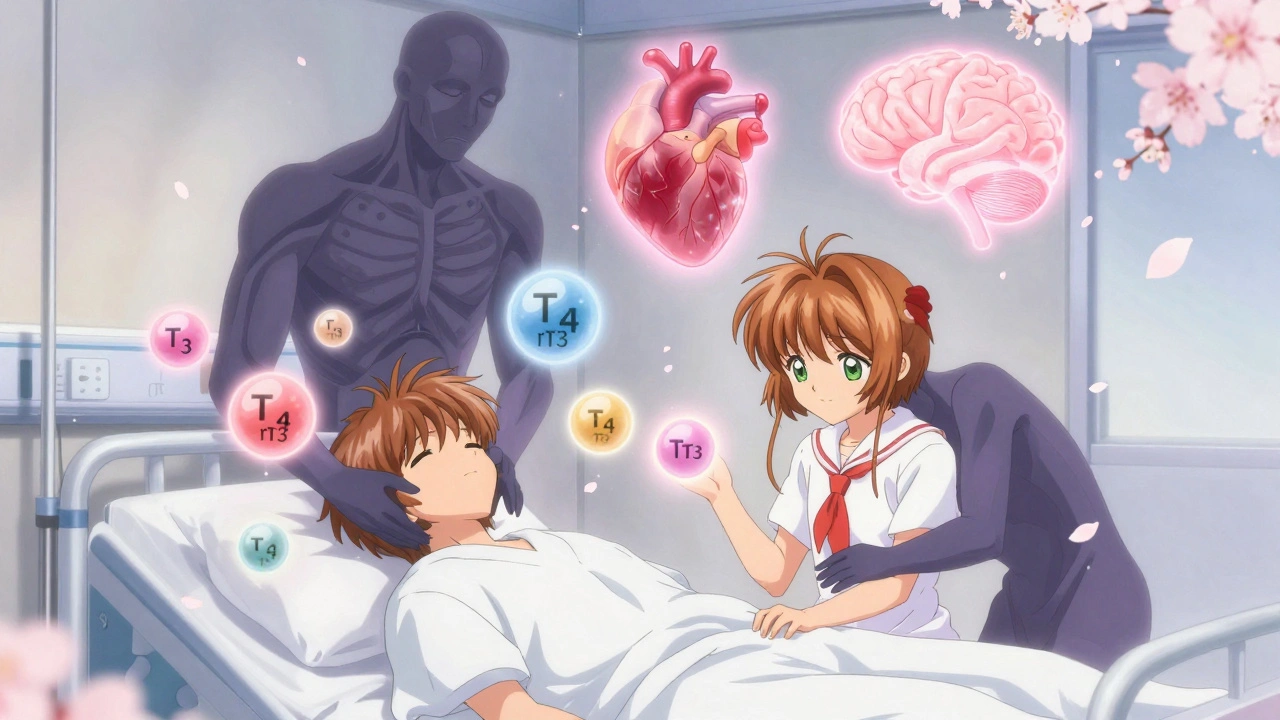
When you're seriously ill, your body doesn't just feel tired-it changes how your hormones work. One of the most misunderstood changes happens in your thyroid tests. You might see low T3, low T4, and a weirdly normal or slightly off TSH. It looks like hypothyroidism. But it's not. This is sick euthyroid syndrome, and it’s happening in up to 75% of people in the ICU with severe infections, trauma, or major surgery.
What Sick Euthyroid Syndrome Really Is
Sick euthyroid syndrome, also called nonthyroidal illness syndrome (NTIS), isn’t a disease of the thyroid gland. Your thyroid is working fine. The problem is your body’s response to severe stress. When you’re fighting sepsis, recovering from heart attack, or healing from major burns, your body shifts into survival mode. One way it does that? It slows down your metabolism. And it uses your thyroid hormone system to do it. This isn’t a glitch. It’s a built-in adaptation. Studies show that lowering active thyroid hormone (T3) reduces energy use by 15-20%. That means more resources go to healing, fighting infection, and keeping your heart and brain running. In the 1970s, doctors first noticed this pattern in critically ill patients. Back then, many mistook it for thyroid failure and gave patients thyroid hormone pills. It didn’t help. Sometimes, it made things worse. Today, the American Thyroid Association and the Endocrine Society agree: don’t treat it. Not with levothyroxine. Not with T3 supplements. The only treatment is fixing the illness behind it.What Thyroid Tests Show in Sick Euthyroid Syndrome
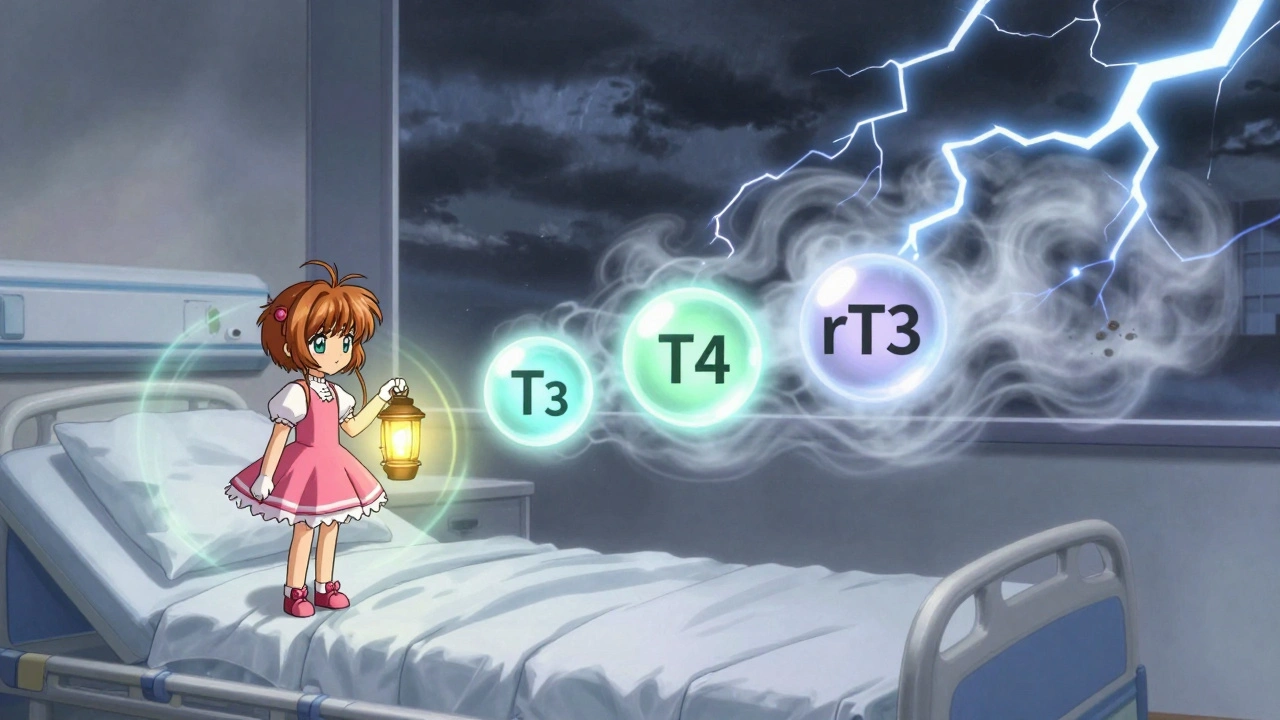
Here’s what your lab results typically look like when you have this condition:- Low T3 - Seen in 95% of cases. This is the most consistent sign. Your body stops converting T4 into active T3.
- Low T4 - Appears in 40-50% of severe or long-term illness. Not always present early on.
- High reverse T3 (rT3) - Found in 85-90% of cases. This inactive form of T3 builds up because your body stops clearing it.
- Normal or slightly abnormal TSH - Usually stays between 0.4 and 4.0 mIU/L. In acute illness, it might dip below 0.4. In recovery, it might creep up to 5-10 mIU/L. But it rarely stays low like in true hyperthyroidism.
Why This Happens: The Science Behind the Numbers
Your thyroid hormones don’t drop because your thyroid is broken. They drop because your body’s enzymes and binding proteins change under stress. Three main things happen:- Deiodinase enzymes slow down. Your body uses these enzymes to turn T4 into T3. In illness, type 1 deiodinase activity drops by 30-50%. That means less active hormone is made.
- Reverse T3 builds up. Your liver and kidneys stop breaking down rT3. So it piles up, blocking what little T3 you have left.
- Thyroid hormone binding drops. Proteins like TBG that carry thyroid hormones in your blood decrease by 15-20%. That means more hormone floats freely-but it’s quickly cleared or broken down.
Who Gets Sick Euthyroid Syndrome?
It’s not rare. It’s common in serious illness:- Sepsis: 80-85% of patients
- Major surgery: 65-70%
- Severe burns: 75-80%
- Heart attack: 50-55%
- Diabetic ketoacidosis: 60-65%
- Anorexia nervosa: 90% of severe cases
- Cirrhosis: 70-75%
- Chronic kidney disease: 60-65%
What It Feels Like: Symptoms That Mimic Hypothyroidism
If you’re sick and your labs show low thyroid hormones, you might feel like you have hypothyroidism:- Fatigue (85% of cases)
- Weakness (78%)
- Feeling cold (65%)
- Constipation (55%)
- Body temperature below 35°C (in 30% of severe cases)
- Slow breathing (under 10 breaths per minute in 25%)
- Low blood pressure (systolic under 90 in 20%)
- Confusion or coma (in 10-15% of ICU patients)
Why Treating It Can Hurt You
In the 1990s and early 2000s, some doctors tried giving thyroid hormone to ICU patients with low T3. They thought it would boost metabolism and help recovery. It didn’t. A 2022 randomized trial in the New England Journal of Medicine followed 450 critically ill patients with sick euthyroid syndrome. Half got levothyroxine. Half got placebo. The results? Identical 30-day death rates: 28% in both groups. Identical ICU stays: 14.2 days vs. 14.5 days. Worse, other studies show that giving thyroid hormone to these patients may increase death risk by 8-10%. Why? Because your body isn’t trying to fix a thyroid problem. It’s trying to survive. Forcing it to burn more energy when it’s already strained can overload your heart, liver, and kidneys. Dr. Anne R. Cappola, a leading endocrinologist at UPenn, found that 12% of ICU patients were incorrectly treated for hypothyroidism because their labs looked wrong. Many of them had no symptoms of thyroid disease. Their only “sign” was a lab result.How Doctors Diagnose It Right
The trick is looking at the whole picture, not just one number. If you have:- Low T3 and/or low T4
- Normal or mildly abnormal TSH
- High reverse T3
- And a known severe illness (sepsis, trauma, heart failure, etc.)
What Happens After You Recover?
Good news: once the illness heals, your thyroid hormones usually bounce back. In most cases, T3 and T4 levels return to normal within 2-6 weeks. Reverse T3 drops. TSH stabilizes. But if your thyroid numbers stay abnormal after recovery? That’s a signal. It could mean you have an underlying thyroid problem you didn’t know about. That’s why doctors recommend repeating thyroid tests 4-6 weeks after you’re out of the hospital.What’s Next in Research?
Scientists are now asking: can we use these hormone changes to predict who will survive? The EUTHYROID-ICU study, running from 2023 to 2025, is tracking 2,500 ICU patients to see if specific patterns in T3, T4, and rT3 can predict recovery speed, organ failure, or death. Early data suggests that the deeper and longer the T3 drop, the higher the risk. Some researchers are even exploring whether certain patients-like those with long-term critical illness-might benefit from very targeted, short-term hormone support. But so far, no solid proof. The consensus remains: treat the illness, not the labs.Bottom Line
Sick euthyroid syndrome isn’t a thyroid problem. It’s your body’s smart way of slowing down during crisis. The abnormal lab results? They’re a sign of how hard your body is working-not that it’s broken. If you or someone you know is hospitalized and their thyroid tests look weird, ask: "Is there a serious illness causing this?" Don’t jump to thyroid meds. Don’t assume hypothyroidism. The right treatment isn’t a pill. It’s time, rest, and healing the root cause. And if you’re recovering? Give your body space. Your thyroid will find its way back.Is sick euthyroid syndrome the same as hypothyroidism?
No. Hypothyroidism means your thyroid gland isn’t making enough hormones due to damage, autoimmune disease, or surgery. Sick euthyroid syndrome means your thyroid is working fine, but your body is reducing hormone activity as a response to illness. The labs can look similar, but the cause and treatment are completely different.
Should I get my thyroid checked if I’m sick?
Not unless you have symptoms of true thyroid disease-like unexplained weight gain, severe fatigue without illness, dry skin, or a goiter. In most cases, thyroid tests during acute illness will show abnormal results due to sick euthyroid syndrome, not real thyroid problems. Routine testing can lead to misdiagnosis and unnecessary treatment.
Can stress cause sick euthyroid syndrome?
Yes, but only severe physical stress. Emotional stress alone doesn’t cause it. You need major illness-like sepsis, trauma, major surgery, heart attack, or advanced cancer. Mild stress, like a tough work week or divorce, won’t trigger the hormone changes seen in this syndrome.
Will my thyroid return to normal after I recover?
In most cases, yes. T3, T4, and reverse T3 levels usually normalize within 2 to 6 weeks after the illness resolves. If your thyroid numbers stay abnormal after recovery, your doctor should investigate for underlying thyroid disease.
Is there a blood test that confirms sick euthyroid syndrome?
There’s no single test. Diagnosis relies on a pattern: low T3, low or normal T4, high reverse T3, and normal or mildly abnormal TSH-all in the context of a serious non-thyroid illness. Doctors use this combination along with your clinical condition to make the call.
Can medications cause sick euthyroid syndrome?
Not directly. But some drugs used to treat serious illness-like steroids, dopamine, or amiodarone-can affect thyroid hormone levels. These changes are still part of the broader sick euthyroid pattern and should be interpreted alongside your overall condition, not in isolation.
Why do some doctors still treat it with thyroid hormone?
Some still do because the lab results look like hypothyroidism, and it’s tempting to fix what looks broken. But research shows this approach doesn’t improve survival and may worsen outcomes. Guidelines from major medical societies have been clear since 2016: don’t treat it. Education and awareness are still catching up in some hospitals.
Is sick euthyroid syndrome dangerous?
The syndrome itself isn’t dangerous-it’s a protective response. But the underlying illness is. The hormone changes are a warning sign that your body is under extreme stress. The real danger comes from misdiagnosing it as hypothyroidism and giving unnecessary treatment, which can harm your heart and other organs.






8 Comments
Saket Modi
December 2, 2025 AT 02:49Bro this is wild. I had a friend in ICU last year and they were giving him thyroid meds because his labs looked 'off'. He got worse. Turned out it was just his body being smart. 😅
Chris Wallace
December 3, 2025 AT 05:25I’ve read a bunch of papers on NTIS over the years, and honestly, the most fascinating part isn’t the hormone shifts-it’s how deeply embedded this is in evolutionary biology. Your body isn’t malfunctioning; it’s optimizing. Reducing T3 by 15-20% during sepsis? That’s not a bug, it’s a feature. It’s like your metabolism goes into airplane mode so your immune system can run full throttle. And yet, we still have doctors reaching for levothyroxine like it’s a magic pill. The fact that the NEJM trial showed zero benefit after 450 patients? That should’ve been a wake-up call. But medicine moves slow, especially when labs look familiar. I’ve seen residents panic over a low T3 and order more tests like it’s a crisis. Meanwhile, the real crisis-the infection, the trauma-isn’t even being addressed yet. It’s like fixing the dashboard light instead of the engine.
And honestly? The fact that reverse T3 builds up? That’s your body’s way of saying, ‘Nope, we’re not burning calories today.’ It’s not just passive suppression-it’s active redirection. Like putting your savings account on hold so you can pay the hospital bill. Brilliant. And terrifying. And completely ignored by 70% of ER docs.
william tao
December 4, 2025 AT 14:19The prevailing clinical paradigm remains fundamentally misaligned with the pathophysiological reality of nonthyroidal illness syndrome. The persistent administration of exogenous thyroid hormone in the context of critical illness constitutes a paradigmatic error, predicated upon a misinterpretation of laboratory biomarkers as indicators of end-organ dysfunction, rather than as adaptive physiological responses to systemic stress. The evidence base, including the landmark 2022 NEJM RCT, unequivocally refutes the therapeutic utility of such interventions. It is therefore imperative that institutional protocols be revised to reflect current consensus guidelines issued by the American Thyroid Association and Endocrine Society. Failure to do so perpetuates iatrogenic harm under the guise of clinical diligence.
Shubham Pandey
December 5, 2025 AT 21:56Low T3? Don't panic. Just fix the real problem.
Elizabeth Farrell
December 7, 2025 AT 04:55I just want to say how much I appreciate this post. I’ve been through the ‘thyroid panic’ with a loved one in the ICU, and the confusion around these results was overwhelming. I remember the nurse saying, 'Your numbers are off,' and we immediately assumed the worst-like maybe something was broken inside them. But reading this made me realize: it’s not broken. It’s fighting. And that’s powerful.
It’s also so important to remind people that lab values don’t tell the whole story. I’ve seen too many patients get labeled with 'hypothyroidism' based on a single test during a crisis, and then they’re stuck on meds for years because no one rechecked after recovery. This post is a quiet revolution in a world full of quick fixes. Thank you for explaining it so clearly. If you ever write a follow-up on how to talk to doctors about this, I’ll be first in line to read it.
Sheryl Lynn
December 7, 2025 AT 14:01Ah, the beautiful ballet of homeostasis-where your endocrine system, in its infinite wisdom, performs a pirouette of metabolic austerity during existential crisis. One moment you're a vibrant, caffeinated human; the next, you're a biochemically muted ghost of yourself, T3 in freefall, rT3 rising like a spectral tide. It’s poetic, really. The body doesn’t just react-it *rearranges*. It doesn’t fail; it *recontextualizes*. And yet, we, the arrogant architects of the stethoscope, see a low T3 and think, 'Ah, deficiency!' as if the universe had simply forgotten to refill the hormone tank. No, darling. It’s not a deficit. It’s a *strategic withdrawal*. Like a symphony pausing its violins so the cellos can carry the weight of grief. This isn’t pathology. It’s poetry written in amino acids. And the fact that we still shove pills into patients who are already drowning in cytokines? That’s not medicine. That’s hubris in a white coat.
Paul Santos
December 8, 2025 AT 20:10Fascinating. The deiodinase suppression is essentially a metabolic austerity measure-evolution’s version of turning off the AC during a power outage. The rT3 accumulation? Pure bio-logic. It’s not a glitch-it’s a firewall. I’ve seen this in my own work with ICU patients, and honestly? The most dangerous thing isn’t the syndrome-it’s the reflexive lab-chasing. We’ve turned medicine into a spreadsheet. ‘Low T3? Must be hypothyroid.’ No. It’s a signal, not a diagnosis. The real tragedy? The 12% of patients misdiagnosed and overtreated. That’s not medical error. That’s systemic epistemic failure. 🤔
Eddy Kimani
December 9, 2025 AT 03:12This is such a critical point-especially for those of us in critical care. I’ve been pushing for better education on NTIS in our residency program because so many interns still treat low T3 like it’s Graves’ disease in reverse. The fact that TSH can be normal or even elevated during recovery and still be part of this syndrome? That’s the nuance we’re missing. I’d love to see a quick-reference guide for ICU teams-something like: 'If illness is present + low T3 + high rT3 + normal TSH → ESS. Do NOT treat.' Maybe even a checklist sticker for the EMR. The science is solid. Now we just need to get it into the hands of the people hitting the order buttons.