

When you walk down the street and your legs suddenly feel like they’re filled with lead, you stop. You lean on a shopping cart, bend forward, or sit on a bench-and just like that, the pain fades. If this sounds familiar, you’re not alone. This isn’t just tired legs. It’s neurogenic claudication, the most common symptom of lumbar spinal stenosis. And it’s often mistaken for something else entirely.
What Exactly Is Neurogenic Claudication?
Neurogenic claudication isn’t a disease on its own. It’s a signal. A warning from your spine that something’s pressing on the nerves in your lower back. As you walk or stand, the narrowed spinal canal squeezes the nerves that run down to your legs. That’s when pain, numbness, tingling, or weakness kicks in. It usually starts slowly. At first, you might only notice it after walking a block or two. Over time, you can’t go as far before you have to stop. The key? The pain goes away when you sit down or bend forward. Not just rest-forward bend. That’s the hallmark. Leaning over a grocery cart, pushing a walker, or even sitting on a chair with your elbows on your knees gives relief. This is called the shopping cart sign, and it shows up in 68% to 85% of people with true neurogenic claudication. It’s different from vascular claudication, which comes from poor blood flow. With vascular claudication, resting anywhere helps-lying down, sitting, even standing still. But with neurogenic claudication, you need to flex your spine. No bending? No relief. That’s why getting the diagnosis right matters so much.How Do You Know It’s Not Just Old Age or Poor Circulation?
Many people assume leg pain when walking is just aging or heart issues. But there are clear clues that point to spinal stenosis. First, your pulses in your feet are normal. If your legs were starved for blood, you’d have weak or absent pulses. In neurogenic claudication, circulation is fine. The problem is nerve compression. Second, straight leg raises don’t hurt. That’s a test doctors use for sciatica. If your pain comes from a pinched nerve root in your spine due to stenosis, this test usually comes back negative. Third, you might notice weakness in your feet. A simple sign clinicians look for is wasting in the small muscles under your big toe-the extensor digitorum brevis. It’s not something you’d notice yourself, but if your doctor sees it, it’s a red flag for long-standing spinal stenosis. And then there’s the five-repetition sit-to-stand test. If you can do five stands from a chair in about 10 seconds, your function is still fairly good. If it takes you 20 seconds or more, it’s a sign your mobility is being affected.Why Imaging Alone Doesn’t Tell the Whole Story
You might think an MRI will give you the answer. And yes, it shows narrowing in the spinal canal. But here’s the catch: up to 67% of people over 60 have spinal stenosis on MRI-and no symptoms at all. That means the image doesn’t always match how you feel. A narrow canal doesn’t automatically mean you have neurogenic claudication. The diagnosis comes from matching your symptoms with your physical exam. Did bending forward help? Did walking make it worse? Are your reflexes or sensation changed in your legs? These are the real clues. Doctors don’t rely on one test. They look at the full picture: your history, your movement, your pain pattern. The more of these signs you have, the more confident the diagnosis becomes.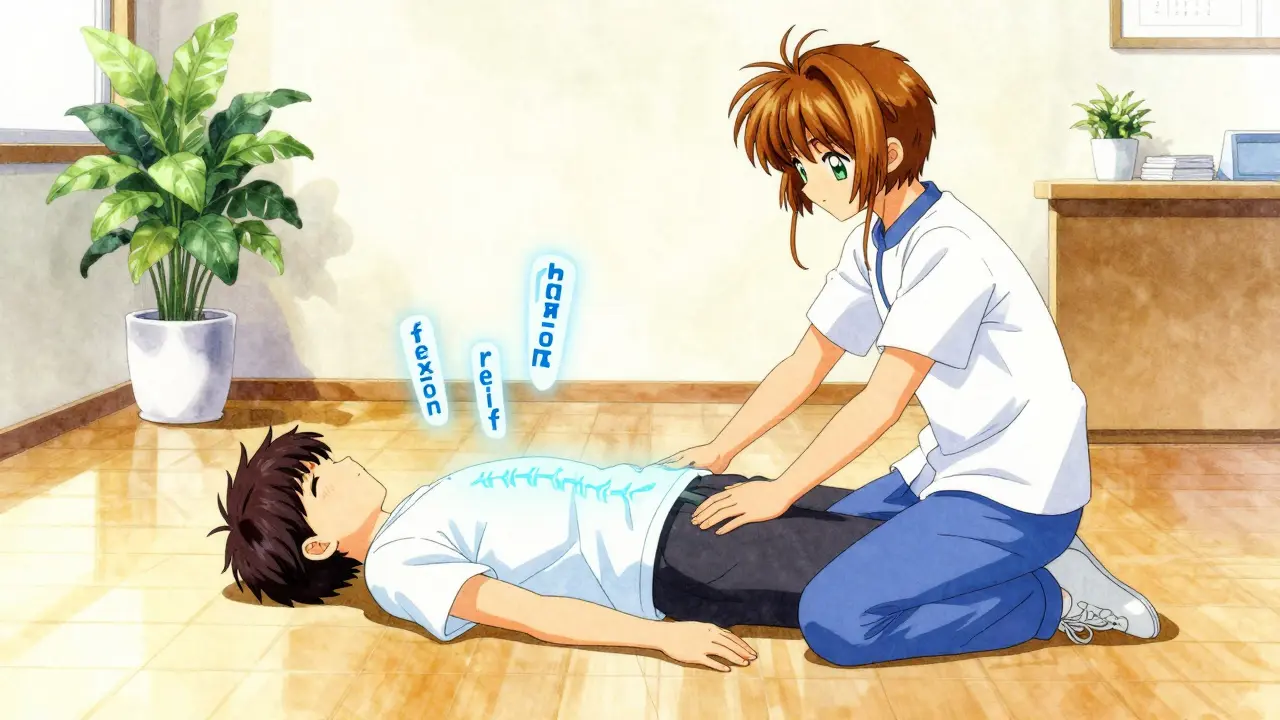
First Steps: Conservative Treatment That Actually Works
Most people start with conservative care-and for good reason. About 82% of those with early-stage neurogenic claudication see improvement without surgery. Physical therapy is the cornerstone. Not just stretching. Specific flexion-based exercises that train your spine to stay in a bent-forward position. Think pelvic tilts, knee-to-chest stretches, and walking with a walker or rolling cart to reinforce the relief position. It’s not about being lazy-it’s about retraining your body to move without triggering pain. Exercise programs usually take 6 to 8 weeks before you see real changes. Consistency matters. Skipping sessions delays progress. Many patients stop too soon because they don’t feel better immediately. But the goal isn’t instant relief. It’s building endurance and reducing nerve irritation over time. Pain meds like NSAIDs (ibuprofen, naproxen) can help manage flare-ups, but they don’t fix the root problem. They just make it easier to do your exercises. Epidural steroid injections are an option if pain persists after a few months of therapy. They don’t cure stenosis, but they can reduce inflammation around the nerves. Success rates? Around 50% to 70% for temporary relief-usually lasting a few months. It’s not permanent, but it can buy you time to keep working on movement.When Surgery Becomes Necessary
If you’ve tried 3 to 6 months of conservative care and your pain is still limiting your life-if you can’t walk to the mailbox, carry groceries, or play with your grandkids-it’s time to talk about surgery. The goal of surgery is to decompress the nerves. That means removing bone, thickened ligaments, or disc material that’s squeezing the spinal canal. Common procedures include laminectomy (removing part of the vertebra), laminotomy (a smaller opening), or minimally invasive decompression. A newer option approved by the FDA in early 2023 is the Superion interspinous process decompression device. It’s a small implant placed between the bones of your spine that keeps the space open when you stand. Early results show 78% patient satisfaction after two years. Studies show that 70% to 80% of carefully selected patients have good to excellent outcomes after surgery. That means less pain, more walking, better sleep. But surgery isn’t for everyone. It carries risks-nerve injury, infection, failed back syndrome. And if you have other health problems, your doctor might advise against it.What Patients Really Say
On patient forums, common phrases pop up: “I used to walk my dog every day. Now I can’t make it to the end of the block.” “I thought it was poor circulation. Three doctors told me to exercise more. One finally asked if I leaned forward to feel better.” One Reddit user wrote: “I can only walk 200 feet before my legs turn to cement. But push a grocery cart? I can walk the whole store. I didn’t even know that was a thing people noticed.” The biggest regret? Delaying diagnosis. Many patients see multiple doctors before someone asks the right question: “Do you feel better when you bend forward?” Those who learn the trick of the “simian stance”-bending at the waist like a monkey-often report better control. One patient told her physical therapist, “I keep a cane with a bent handle now. I lean on it constantly. It’s not pretty, but it lets me live.”
What’s Changing in Treatment Today
The medical community is shifting. No longer is surgery the default. The American Academy of Orthopaedic Surgeons updated its guidelines in 2023 to strongly recommend structured exercise as the first step. Physical therapy isn’t just an option-it’s the standard. Minimally invasive techniques are rising. Between 2018 and 2022, their use jumped 35%. Less cutting, shorter recovery, lower risk. That’s good news for older adults who can’t afford long hospital stays. Research is also moving toward better diagnostic tools. The International Spine Study Group is finalizing a standardized algorithm to help doctors match symptoms with imaging findings. Right now, it’s still more art than science. But soon, we might have clearer rules.What You Can Do Right Now
If you’re experiencing leg pain when walking:- Track your symptoms. How far can you walk before pain starts? Does bending forward help?
- Try walking with a walker or pushing a cart. If it helps, that’s a strong clue.
- See a physical therapist who specializes in spine issues. Ask about flexion-based exercises.
- Don’t assume it’s vascular. Ask your doctor to check your foot pulses and do a neurological exam.
- Don’t rush to surgery. Give conservative care a real shot-6 to 8 weeks minimum.
Final Thought: It’s Manageable, Not a Death Sentence
Neurogenic claudication isn’t curable, but it’s manageable. You don’t have to give up walking. You don’t have to live in pain. With the right diagnosis, the right exercises, and the right timing, most people regain their independence. The key is knowing the difference between normal aging and a treatable condition. If your legs feel heavy when you walk-but you feel better when you lean forward-you’re not just getting older. You might have spinal stenosis. And that’s something you can do something about.Is neurogenic claudication the same as vascular claudication?
No. Neurogenic claudication comes from nerve compression in the spine and improves with forward bending. Vascular claudication comes from poor blood flow and improves with rest, no matter your posture. The treatments are completely different-misdiagnosing one for the other can lead to ineffective or even harmful care.
Can I still walk with neurogenic claudication?
Yes, but you’ll need to adapt. Many people learn to walk in short bursts, using forward-leaning positions to relieve pressure. Walking with a cane, walker, or shopping cart can extend your distance. Regular, paced walking-even 5 to 10 minutes at a time-can improve endurance over weeks.
Does weight loss help with spinal stenosis?
Losing excess weight reduces pressure on the spine and can ease symptoms. While it won’t reverse stenosis, it can make conservative treatments like physical therapy more effective and reduce the need for surgery. Even a 5-10% reduction in body weight can make a noticeable difference.
How long does it take to see results from physical therapy?
Most people start noticing improvement after 6 to 8 weeks of consistent therapy. Progress is often slow at first. The goal isn’t instant pain relief-it’s building strength, improving posture, and teaching your body to move in ways that avoid nerve compression.
Are epidural steroid injections safe for long-term use?
They’re not meant for long-term use. Typically, doctors limit injections to 3 or 4 per year because repeated doses can weaken bones and tissues over time. They’re best used as a bridge-helping you get through a painful flare-up so you can stay active in your rehab program.
What’s the success rate of spinal surgery for neurogenic claudication?
For patients who meet strict criteria-persistent symptoms, failed conservative care, clear nerve compression on imaging-70% to 80% report good to excellent outcomes one year after surgery. Success means less pain, more walking, and better quality of life. But results vary based on age, overall health, and how long symptoms lasted before surgery.






15 Comments
Darren McGuff
January 8, 2026 AT 18:03Let me tell you something-I’ve seen this in clinic for 22 years. The shopping cart sign? That’s gold. I had a patient last month who thought he had peripheral artery disease. Got his ABI checked, pulses were fine, and then I asked him, ‘Do you lean forward when you walk?’ He looked at me like I’d just spoken Klingon. Then he said, ‘Yeah… I push the cart like I’m stealing it.’ That’s neurogenic claudication. No MRI needed. Just listening.
Physical therapy? Absolutely the first step. Not ‘go walk 10K steps.’ Flexion-based. Pelvic tilts, cat-cow on all fours, walking with elbows on knees. Train the nervous system to stop screaming. It’s not magic-it’s biomechanics.
And for God’s sake, stop calling it ‘old age.’ My 78-year-old yoga instructor walks 3 miles a day with a cane and zero pain. It’s not about age. It’s about alignment, mobility, and nerve gliding. Stop blaming the calendar.
Also-epidural steroids? Only if you’ve done 8 weeks of PT and still can’t tie your shoes. They’re a bandage, not a cure. And never more than three a year. Bone density doesn’t recover.
And yes, the Superion device? It’s real. Not for everyone, but for the right person-someone with moderate stenosis, no instability, and who hates surgery-it’s a game-changer. Less invasive, faster recovery. I’ve seen people back to gardening in two weeks.
Stop waiting for surgery to be your answer. The body remembers movement. If you stop moving because it hurts, you teach it to hurt more. Reverse that. Bend forward. Move slow. Be consistent. You’re not broken. You’re just out of sync.
Heather Wilson
January 9, 2026 AT 00:27So let me get this straight-people are walking around with spinal stenosis and not getting surgery because they ‘want to try PT first’? That’s like saying ‘I have a tumor but I’ll try yoga.’ This isn’t a lifestyle tweak. It’s structural compression. Nerves are being squished. That’s not ‘aging.’ That’s a mechanical failure. If your spine is collapsing, you fix it. Not ‘walk with a cart.’
And don’t give me that ‘67% of people over 60 have it on MRI and no symptoms’ nonsense. So what? If you have symptoms and the imaging matches? Then you’re the 33%. And you’re in pain. Why are we pretending conservative care is a solution? It’s just delaying the inevitable. You wouldn’t wait to fix a broken leg. Why wait to fix a crushed nerve?
Also, the ‘shopping cart sign’? That’s not a diagnosis. That’s a parlor trick. Anybody can lean forward. You need an MRI, a neurological exam, and then a surgeon who isn’t afraid to say ‘you need decompression.’
And yes, I know 82% improve with PT. But what about the 18% who get worse? Who get to the point where they can’t even stand for 10 minutes? That’s not ‘manageable.’ That’s a life sentence. And we’re letting people suffer because we’re scared of surgery. That’s not medicine. That’s cowardice.
Micheal Murdoch
January 9, 2026 AT 15:07There’s something deeply human about this condition. It’s not just about nerves or bones-it’s about identity. You used to walk to the store, carry your groceries, play with your grandkids. Now you can’t make it to the mailbox without stopping. That’s not just physical. That’s grief.
I’ve talked to patients who cry because they can’t take their dog out anymore. Not because of pain. Because they feel like a burden. Like their body betrayed them. And then someone says, ‘Just lean forward.’ And suddenly-they can. Not perfectly. Not forever. But enough to feel like themselves again.
That’s the miracle here. It’s not the surgery. It’s the rediscovery of movement. The cane with the bent handle. The grocery cart. The way you learn to move like a monkey-not because it’s silly, but because it works.
Medicine has forgotten this. We focus on the scan, not the story. We measure distance in feet, not in dignity. But the truth? You don’t need to walk a mile to live well. You just need to walk to the end of the block without feeling like your legs are melting.
So if you’re reading this and you’re stuck? Don’t give up. Don’t wait for someone to give you permission to bend. Bend anyway. Lean into it. Your spine doesn’t care how it looks. It just wants to breathe.
And if you’re a doctor? Ask the question. Not the test. The question. ‘Do you feel better when you bend forward?’ That’s the key. Not the MRI. Not the meds. The question.
Jacob Paterson
January 11, 2026 AT 08:14Oh wow. Another feel-good post about ‘managing’ spinal stenosis like it’s a yoga retreat. Let me guess-next you’ll tell us to ‘manifest’ better nerve flow with affirmations?
‘Bend forward and feel better’? Yeah, I bet. I also ‘feel better’ when I stop standing on a live wire. That doesn’t mean the wire isn’t still electrified.
And ‘82% improve with PT’? That’s a lie dressed up as hope. 82% improve *a little*. They go from 200 feet to 300. Still can’t go to the grocery store without a wheelchair. Still can’t sleep. Still in pain. And now they’re told they’re ‘doing well’ because they didn’t get surgery.
Meanwhile, the real solution-decompression-is sidelined because insurance won’t pay for it unless you ‘fail conservative care’ for 6 months. Which means you’re forced to suffer for half a year before you’re allowed to be healed.
And don’t even get me started on the ‘Superion device.’ It’s a metal spacer. You’re literally jamming a piece of plastic between your bones to stop them from collapsing. That’s not innovation. That’s duct tape on a collapsing bridge.
Stop romanticizing suffering. This isn’t ‘manageable.’ It’s a slow-motion disability. And we’re letting people believe they can just ‘walk with a cart’ forever. Newsflash: your cart won’t last forever. Neither will your spine.
Patty Walters
January 12, 2026 AT 01:19Just wanted to say-this post saved me. I thought I had bad circulation. Went to three docs, got told to ‘walk more’ and ‘lose weight.’ Finally saw a PT who asked if I leaned forward. I said, ‘Yeah, I do it all the time, but I thought everyone did.’ She laughed and said, ‘That’s the shopping cart sign. You’ve got stenosis.’
Did PT for 8 weeks. Did the knee-to-chest, pelvic tilts, walked with my walker every day. Didn’t feel better at first. Thought I was wasting time. Then one day-I walked to the end of my street. No stop. No pain. Just… walking.
Still can’t go far, but I can go. And I don’t feel like a broken old person anymore. Just someone who learned how to move differently.
Also-yes, the cane with the bent handle? Genius. I got one from a thrift store. Looks weird. Feels like freedom.
Alicia Hasö
January 12, 2026 AT 22:44For anyone reading this and feeling hopeless-please know this: you are not alone. And you are not too old. You are not broken. You are adapting. And that takes courage.
I’ve worked with hundreds of patients with neurogenic claudication. The ones who thrive? They don’t wait for the ‘perfect’ solution. They start small. One minute of flexion exercises. One block with a cart. One day without guilt.
It’s not about how far you walk. It’s about whether you’re still walking at all.
And if your doctor dismisses you? Find another one. This isn’t just ‘old age.’ It’s a condition with real, evidence-based solutions. You deserve to move without pain. You deserve to carry your groceries. You deserve to hug your grandkids without stopping halfway.
Don’t let anyone tell you that ‘it’s just aging.’ Aging doesn’t mean surrender. It means wisdom. And you’ve already got the wisdom-you noticed something was off. Now go find the right help. You’ve got this.
Jeffrey Hu
January 13, 2026 AT 08:06Okay, but let’s be real-this whole post is just a sales pitch for physical therapists and ortho surgeons. ‘Try PT first’? Sure, if you’re on Medicare and your insurance won’t cover surgery until you’ve suffered for 6 months. That’s not medicine, that’s bureaucracy.
And the ‘shopping cart sign’? That’s not a diagnosis. That’s a symptom. You still need an MRI. You still need to rule out tumors, infections, or cauda equina. This post reads like a pamphlet from a clinic trying to avoid litigation.
Also, ‘up to 67% of people over 60 have stenosis on MRI’? So what? That’s not a reason to ignore symptoms. That’s a reason to screen everyone over 60. We’re not doing that. We’re waiting until they can’t walk to the bathroom.
And the Superion device? FDA-approved? Cool. But it’s only been out for a year. Where are the 5-year outcomes? Where’s the long-term data? You’re pushing a shiny new toy on people who are desperate.
This isn’t education. It’s marketing. And you’re making people feel guilty for wanting a real solution.
Matthew Maxwell
January 14, 2026 AT 10:32Let me tell you what’s really going on here. People don’t want to admit that their bodies are failing. So they cling to this ‘just bend forward’ nonsense like it’s a spiritual awakening. It’s not. It’s a workaround. A temporary hack. A Band-Aid on a severed artery.
You think PT is the answer? Try doing 8 weeks of pelvic tilts when your legs are screaming and your balance is shot. Try getting up from a chair when your quads are atrophied. Try explaining to your kids why you can’t go to their soccer games.
And then you get told, ‘It’s manageable.’ Manageable? My mother managed to die of heart failure. That doesn’t mean it was okay.
This isn’t about ‘retraining your body.’ It’s about a spine that’s literally collapsing under the weight of time, gravity, and neglect. And the medical system is letting people suffer because it’s cheaper to give them a cane than a laminectomy.
Stop glorifying suffering. Stop calling it ‘wisdom.’ It’s not wisdom. It’s abandonment.
Pooja Kumari
January 16, 2026 AT 08:35I’ve been living with this for 7 years. I used to be a dancer. Now I can’t stand for more than 3 minutes. I cry every night because I miss my life. I don’t want to be ‘manageable.’ I want to be whole.
I tried PT. I did the exercises. I pushed the cart. I leaned forward until my back screamed. And then I got worse. The pain got deeper. My feet went numb. I couldn’t feel my toes. I thought I was going to lose them.
I had surgery last year. Laminectomy. Two weeks in the hospital. Three months of rehab. I still have pain. But I can walk to the mailbox. I can stand in the kitchen. I can hug my daughter without stopping.
People say ‘try PT first.’ But what if PT doesn’t work? What if you’re one of the 18%? Who helps you then? No one. You’re just told to ‘live with it.’
I’m not grateful for ‘managing.’ I’m angry that it took 5 years for someone to listen. And now I’m scared it’ll come back.
This isn’t a blog post. It’s my life. And I’m tired of being told to smile and lean forward.
Diana Stoyanova
January 17, 2026 AT 04:47Okay, real talk: I used to think this was just ‘getting old.’ I’m 67. I’ve had back pain since I was 50. But when I started walking with my walker and realized I could go farther if I leaned forward? I felt like I’d unlocked a secret code.
My PT gave me a little notebook. Every day, I wrote: ‘How far did I walk? Did I lean? Did I feel better?’ After 3 weeks, I went from 150 feet to 400. Not because I got stronger. Because I learned how to move differently.
I still have bad days. But now I know: it’s not my legs. It’s my spine. And I can help it. Not cure it. Help it.
And guess what? I started teaching other people at the senior center. We walk together. We lean. We laugh. We call it ‘the monkey walk.’
It’s not glamorous. But it’s mine. And I’m not giving it up.
Also-yes, the bent-handle cane? I got mine from a thrift store for $3. It’s ugly. I love it.
Jenci Spradlin
January 18, 2026 AT 12:35PT was a game changer. I did 12 weeks. Didn’t feel much at first. Then one day, I walked to the corner store-no cart, no cane, no leaning. Just… walking. Felt like a miracle.
Don’t let anyone tell you it’s ‘just aging.’ It’s not. It’s nerve compression. And it’s treatable. I’m 71. I walk 1.5 miles now. With my dog. Every morning.
And yeah-I still lean forward sometimes. But now I do it because I want to, not because I have to.
Thanks for the post. It helped me feel less alone.
tali murah
January 19, 2026 AT 16:46Oh, so now we’re supposed to be grateful that we can walk 300 feet with a cart? That’s not progress. That’s resignation. You call that ‘managing’? I call it settling.
And the ‘shopping cart sign’? That’s not a diagnosis. That’s a coping mechanism. A desperate hack. You’re not ‘retraining your body.’ You’re just learning how to avoid pain by moving like a hunchback.
And the Superion device? A metal spacer jammed between your vertebrae? That’s not innovation. That’s a Band-Aid on a collapsing skyscraper.
People are being sold false hope. ‘Try PT first’-then when it fails, you’re told you ‘weren’t consistent enough.’ Meanwhile, your nerves are getting more damaged.
Stop romanticizing suffering. This isn’t a mindfulness retreat. It’s a slow, silent neurological erosion. And we’re pretending it’s okay because it’s cheaper to let people suffer than to fix it.
Phil Kemling
January 20, 2026 AT 09:46There’s a quiet tragedy here: we treat the spine like a machine, but the pain is a scream from the soul. We fix the structure, but we ignore the story.
Neurogenic claudication isn’t just about compressed nerves. It’s about lost autonomy. It’s about the fear of becoming invisible. The grocery cart isn’t a tool-it’s a shield. The bent cane isn’t a device-it’s a lifeline.
And yet, we reduce it to percentages: ‘82% improve with PT.’ ‘70% success with surgery.’ But what about the person who sits alone, staring at the door, wondering if they’ll ever walk to the mailbox again?
Maybe the real treatment isn’t in the exercises or the scalpel.
Maybe it’s in being seen.
When the doctor asks, ‘Do you lean forward?’-that’s not a diagnostic question. That’s a human one.
And sometimes, that’s the only cure we need.
Elisha Muwanga
January 21, 2026 AT 23:09As someone who spent 14 years in the military and now has two titanium rods in my spine, I can say with certainty: this post is dangerously naive. You don’t ‘manage’ spinal stenosis. You survive it. And if you’re lucky, you get surgery before your legs turn to jelly.
PT is a distraction. A delay tactic. A way for hospitals to avoid the liability of surgery. Don’t be fooled. This isn’t wellness. It’s triage.
And the ‘shopping cart sign’? That’s not a clue-it’s a cry for help. You’re not ‘learning to move differently.’ You’re learning how to hide your disability.
Stop pretending this is a choice. It’s not. It’s a countdown.
Matthew Maxwell
January 22, 2026 AT 14:01And to the person who said ‘you’re not broken, just out of sync’-that’s poetic. But it doesn’t change the fact that my spine is collapsing. Poetry doesn’t decompress a nerve. Surgery does.
Don’t romanticize my pain. Don’t call it wisdom. Call it what it is: a medical failure we’re pretending is acceptable.