
Every year, hundreds of essential generic drugs disappear from hospital shelves and pharmacy counters. These aren’t rare specialty medications-they’re the pills and injections millions of people rely on daily: antibiotics, blood pressure meds, chemotherapy drugs, and anesthetics. When these drugs vanish, doctors scramble. Patients delay treatment. Some even die. And the root cause isn’t a single mistake or bad batch-it’s a broken system built on thin margins, global dependencies, and zero room for error.
Manufacturing Failures Are the #1 Cause
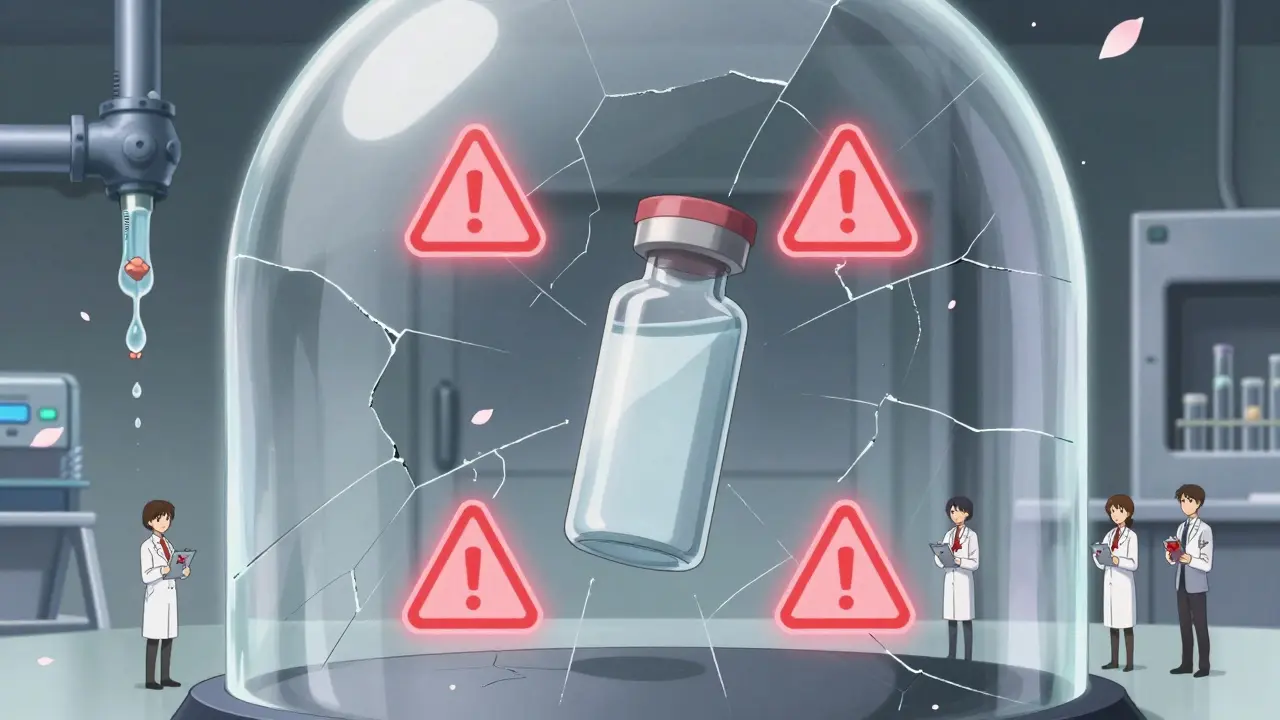
More than 60% of all generic drug shortages in the U.S. since 2010 trace back to manufacturing problems. It’s not about bad luck. It’s about how these drugs are made. A single contamination event in a cleanroom can shut down production for months. A broken mixer, a failed quality test, or an FDA inspection that finds paperwork errors can halt everything. These aren’t rare events-they happen constantly.
One major U.S. plant that made injectable antibiotics shut down in 2021 after a fungal contamination was found in its water system. That one facility supplied nearly half the country’s supply of that drug. No backups. No alternate sources. Just silence. The FDA had to issue emergency alerts. Hospitals rationed doses. Patients got less effective alternatives.
What makes this worse? Many generic drug manufacturers operate with no excess capacity. They run their lines at 95%+ utilization because there’s no profit in keeping extra machines idle. When something breaks, there’s no spare part, no backup line, no Plan B. It’s like driving a car with no spare tire-and no roadside assistance.
Global Supply Chains Are a Single Point of Failure
Eighty percent of the active ingredients in generic drugs come from just two countries: China and India. That’s not diversity. That’s a gamble. If a factory in Shanghai shuts down because of a power outage, a regulatory crackdown, or a natural disaster, the entire North American supply chain feels it.
In 2020, when COVID-19 lockdowns hit India, production of antibiotics and heart meds dropped sharply. The U.S. didn’t have enough domestic production to fill the gap. Even though the U.S. has the technology and skilled workers to make these drugs, it doesn’t have the economic incentive. Generic drug makers can’t compete with factories in India that pay workers $3 an hour and operate with lower environmental and safety standards.
And it’s not just ingredients. Packaging materials, vials, syringes, and even the ink used on labels often come from the same regions. One supply chain disruption can knock out multiple drugs at once. A single factory in Guangdong that makes sterile vials for injectables went offline for six months in 2022. Dozens of critical IV drugs vanished overnight.
Low Profit Margins Drive Manufacturers Out
Generic drugs are cheap. That’s the point. But that low price is killing the industry. While branded drugs can earn 30-40% profit margins, generics often make less than 15%. Some make barely 5%. When you’re selling a 30-day supply of amoxicillin for $4, there’s no money left for upgrades, inspections, or expansion.
Manufacturers are forced to cut corners. They delay equipment maintenance. They reduce quality control staff. They stop investing in newer, safer technology. Over time, this leads to more failures. And when a plant gets shut down by the FDA, the company often can’t afford to fix it. So they just walk away.
Since 2010, over 3,000 generic drugs have been discontinued. Many weren’t recalled because they were dangerous. They were pulled because no one could make them profitably. A drug that treats a common infection might only be used by 50,000 people a year. It’s not worth the $10 million it costs to keep a manufacturing line running. So it disappears.
Market Power Is Concentrated in the Hands of a Few
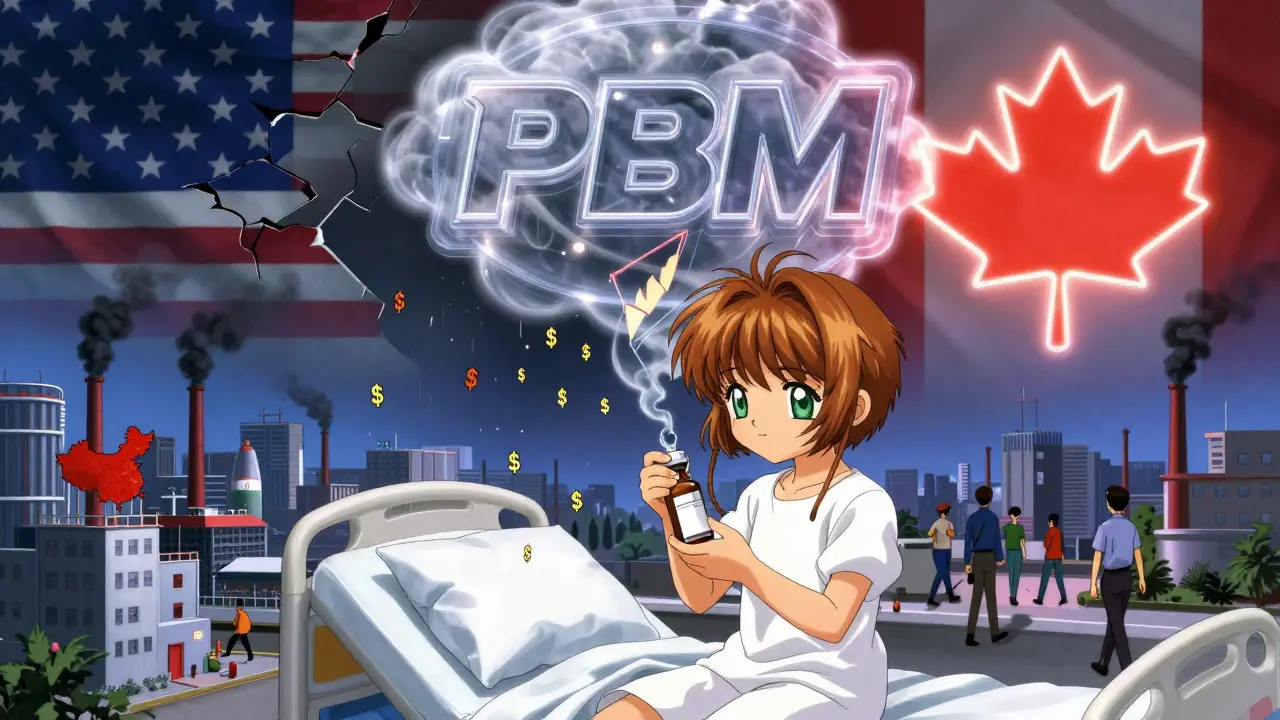
Three pharmacy benefit managers (PBMs) control about 85% of all prescription drug spending in the U.S. These are middlemen between insurers, pharmacies, and drug makers. They negotiate prices. They decide which drugs get covered. And they demand the lowest possible price.
They don’t care if a drug is in shortage. They care about the bottom line. So they push manufacturers to lower prices even further. The result? Manufacturers lose money. They cut production. They exit the market. And the shortage gets worse.
It’s a vicious cycle. Lower prices → lower profits → fewer manufacturers → less competition → higher prices when supply returns → PBMs demand even lower prices again. Meanwhile, hospitals and pharmacies have no power to negotiate. They’re stuck buying from whoever’s left.
Canada has the same generic drugs, the same manufacturing issues, and the same global supply chains. But they don’t have the same level of shortages. Why? Because Canada’s system doesn’t let middlemen dictate prices. The government negotiates directly. Manufacturers get stable, predictable revenue. They can plan. They can invest. They don’t have to chase the lowest bid.
No Redundancy. No Backup. No Safety Net
One in five drug shortages involves a product made by only one company. That’s called sole sourcing. And it’s terrifying. If that one company has a problem, there’s no one else to step in.
Some drugs have been made by the same manufacturer for 20 years. No one else tried to enter the market because the profit was too low. Even when shortages hit, new companies won’t jump in. Why? Because it takes years and millions of dollars to get FDA approval. By the time they’re ready, the shortage might be over-or the price might have dropped so low that it’s not worth it.
There’s no strategic stockpile for everyday generic drugs in the U.S. The federal government keeps emergency reserves for bioterrorism or pandemics-but not for insulin, heparin, or propofol. Hospitals are expected to stockpile on their own. But most can’t afford to. They buy just enough to last a few weeks. When a shortage hits, they’re left with nothing.
What’s Being Done? Not Enough.
There are proposals. The RAPID Reserve Act, introduced in 2023, wants to create a government stockpile of critical generic drugs. It wants to offer tax breaks to companies that make these drugs in the U.S. It wants to require manufacturers to report potential shortages six months in advance.
But none of these fix the core problem: the market doesn’t reward making cheap drugs reliably. Until manufacturers can make a living from producing generics without being crushed by price pressure, shortages will keep happening.
Some hospitals are trying to work around it. They’re building regional drug-sharing networks. They’re switching to alternative medications. But these are bandaids. The real fix needs policy change: stable pricing, incentives for domestic production, and limits on how much PBMs can drive down prices.
For now, patients and providers are left in the dark. A quarter of all shortage reports in the U.S. don’t even list a reason. No explanation. No timeline. Just: ‘Out of stock.’
What This Means for You
If you take a generic drug, you’re already living with this system. You might not notice when your blood pressure pill switches brands. But when the supply vanishes entirely, you’ll feel it. Your doctor might have to prescribe a more expensive brand-name version. Or a less effective alternative. Or nothing at all.
There’s no easy fix. But awareness is the first step. When you hear about a drug shortage, ask: Why? Who makes it? Where is it made? Who controls the price? These aren’t just technical questions-they’re questions about who gets to live, and who gets left behind.
Why are generic drugs more likely to be in short supply than brand-name drugs?
Generic drugs make up 95% of all drug shortages because they’re sold at very low prices with thin profit margins. Manufacturers have little incentive to invest in backup production, quality upgrades, or multiple supply sources. Brand-name drugs, by contrast, earn higher profits and often have multiple manufacturers or exclusive contracts that protect supply.
Can the U.S. make its own generic drugs instead of relying on China and India?
Yes, technically. The U.S. has the labs, engineers, and regulatory expertise. But it doesn’t have the economic model. Building a domestic manufacturing facility for generics costs $50 million to $200 million. Without guaranteed sales and stable pricing, no company will risk that investment. Incentives like tax credits or government purchase agreements would be needed to make it viable.
Why don’t more companies enter the generic drug market when there’s a shortage?
Getting FDA approval for a new generic drug takes 3-5 years and costs $1-3 million. By the time a company gets approved, the shortage may be over-or the price may have dropped so low that the profit isn’t worth it. Many companies wait until the shortage peaks, but by then, the market is flooded and margins collapse. It’s a high-risk, low-reward game.
How do pharmacy benefit managers (PBMs) contribute to drug shortages?
PBMs control 85% of U.S. drug spending and demand the lowest possible prices from manufacturers. This squeezes profit margins so tight that manufacturers can’t afford to maintain quality, upgrade equipment, or keep backup production lines. When a plant fails, they often can’t afford to fix it-and exit the market entirely. PBMs don’t track shortages; they track cost per pill.
What can patients do if their generic drug is unavailable?
Talk to your doctor or pharmacist immediately. They may have access to alternative medications, similar generics from different manufacturers, or can request a temporary exception from your insurer. Some hospitals have drug shortage hotlines. Don’t skip doses or substitute with over-the-counter options without professional advice-many shortages involve critical medications like antibiotics or heart drugs where alternatives aren’t safe.

11 Comments
Himanshu Singh
December 31, 2025 AT 09:58Man this hit home 😔 my cousin in Delhi got her chemo delayed cause the active ingredient came from a plant that shut down in China. We thought it was just bad luck but now I see it’s systemic. Hope something changes soon.
Jasmine Yule
January 1, 2026 AT 03:04THIS. IS. OUTRAGEOUS. 🤬 We pay more for prescriptions than ANY other country and still can’t get basic meds? PBMs are sucking the life out of healthcare. Someone needs to burn them down. #PharmaCrime
Greg Quinn
January 1, 2026 AT 15:26It’s funny how we treat medicine like a commodity instead of a public good. We optimize for cost, not resilience. We don’t build bridges with no spares. We don’t fly planes with one engine. But we’ll let people die because a $0.10 pill isn’t profitable enough. What does that say about us?
Lisa Dore
January 3, 2026 AT 13:15Hey everyone - I work in a rural clinic and we’ve been using regional drug-sharing networks since last year. It’s not perfect, but when one hospital has extra heparin, we coordinate via Slack. Small wins matter. Also, if you’re reading this and have a pharmacy degree - please consider working in underserved areas. We need you.
Sharleen Luciano
January 3, 2026 AT 21:45Let’s be brutally honest: the fact that we outsource the production of life-saving pharmaceuticals to nations with lax regulatory oversight isn’t just poor policy - it’s intellectually lazy. We have Ivy League-educated chemists, world-class FDA inspectors, and $2 trillion in healthcare spending - yet we’re outsourcing our biological security to factories where workers earn less than the cost of your daily coffee? This isn’t capitalism. It’s self-sabotage dressed in neoliberal pajamas.
And don’t give me that ‘but it’s cheaper’ nonsense. When your grandmother dies because propofol isn’t available, tell me how much money you saved.
Jim Rice
January 5, 2026 AT 19:46China and India? Pathetic. We’re a superpower. We built the atomic bomb, landed on the moon, and invented the internet - but we can’t make a damn antibiotic? It’s all because of liberal weaklings who think ‘global cooperation’ is more important than American sovereignty. Build the plants here. Pay the workers. Protect our people. Or get out of the way.
Henriette Barrows
January 7, 2026 AT 15:15I had to switch my mom’s blood pressure med three times last year because of shortages. It’s terrifying how little info you get - no warning, no explanation. Just ‘sorry, we’re out.’ I wish there was a public dashboard showing real-time stock levels. Like a weather map for medicine. Would that be too much to ask?
Alex Ronald
January 9, 2026 AT 08:12One thing people don’t talk about: the FDA approval process for generics is designed to be fast - but only if you have the capital to navigate it. Small manufacturers can’t afford the $2M upfront. Big ones don’t want to risk it because PBMs will undercut them in 6 months. We need a public-private partnership model - like the vaccine program - where the government guarantees a minimum purchase volume for critical generics. Then the market can function.
Teresa Rodriguez leon
January 9, 2026 AT 18:52You all think this is about money? It’s about control. The system was designed this way. People who need these drugs? They’re invisible. They don’t vote. They don’t donate. They don’t matter. And that’s why nothing changes.
Nisha Marwaha
January 10, 2026 AT 04:57From a supply chain perspective, the bottleneck isn’t just manufacturing - it’s the lack of vertical integration in the API-to-finished-product pipeline. Most generic firms are contract manufacturers without upstream control. Add to that the absence of strategic inventory buffers under just-in-time logistics paradigms, and you get systemic fragility. The solution requires multi-tiered redundancy, not just domestic production. We need regional hubs with dual-sourcing protocols for critical APIs, coupled with real-time inventory visibility across Tier-1 and Tier-2 suppliers.
David Chase
January 10, 2026 AT 15:54🇺🇸 MAKE AMERICA DRUG-AGAIN! 🇺🇸 We let China own our medicine? That’s treason. Build the factories. Put the workers to work. Stop begging for pills from dictators. If we can send nukes to the moon, we can make penicillin in Ohio. This isn’t debate - it’s duty. #BuyAmerican #DrugSober
PS: I’ve been saying this since 2018. Nobody listened. Now people are dying. Typical.