
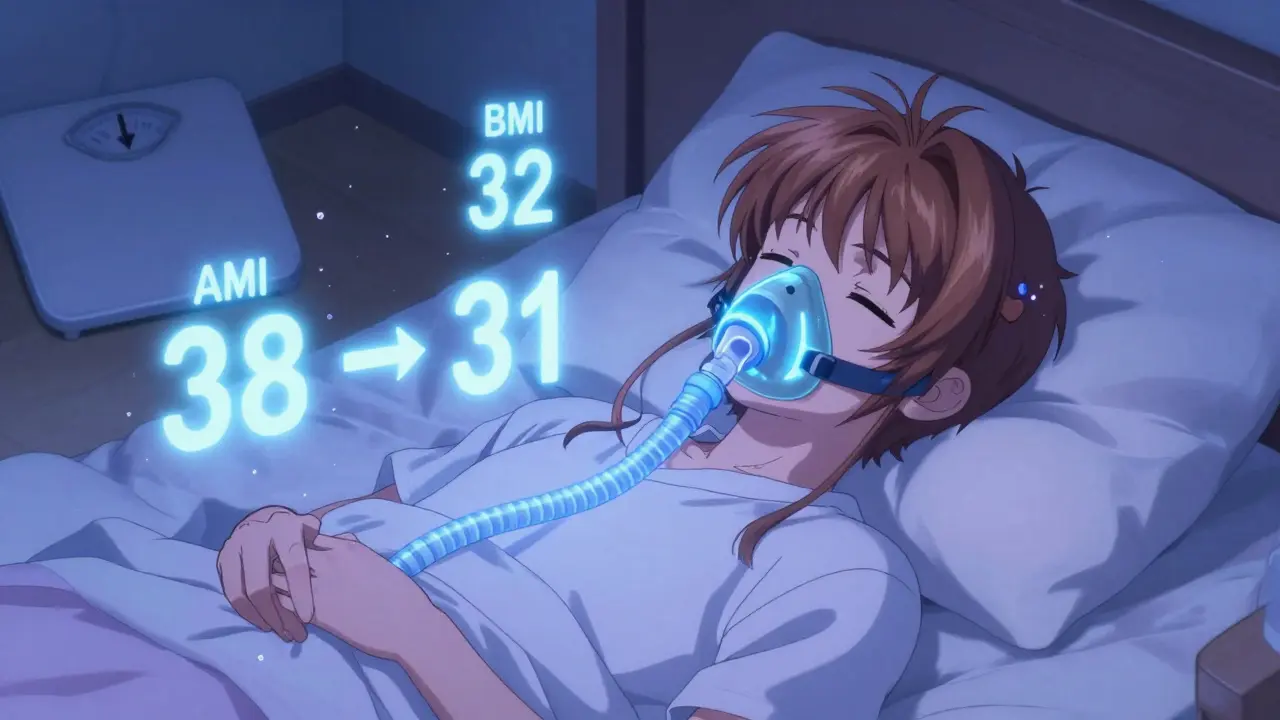
When you’re struggling with sleep apnea, the machine that keeps you breathing at night - your CPAP - isn’t just a device. It’s a lifeline. But here’s something most people don’t realize: your BMI isn’t just a number on a chart. It’s the main reason your CPAP pressure needs to be so high, and it’s also the key to lowering it - maybe even getting off it entirely.
Why BMI Controls Your CPAP Pressure
Your CPAP machine works by blowing a steady stream of air into your throat to keep your airway open while you sleep. That air pressure? It’s measured in centimeters of water (cm H₂O), and it ranges from 4 to 20. The higher your BMI, the more pressure you need. Why? Because extra fat doesn’t just sit on your belly. It builds up around your neck, tongue, and chest. That tissue presses down on your airway, making it collapse more easily during sleep. A 2022 study of 434 veterans found that for every single point your BMI drops, your apnea-hypopnea index (AHI) - the number of breathing pauses per hour - falls by about 6.2%. In the most common BMI range (25-40), that jump to 7.1% per point. That means if you lose 7 pounds, your breathing problems drop by roughly 7%. That’s not theory. That’s math. And it’s why someone with a BMI of 38 might need 14 cm H₂O of pressure, while someone at 28 only needs 9. Every extra point in BMI adds about 0.5 cm H₂O to your required pressure. That’s why high-BMI users often struggle - the machine feels like it’s blasting air at them, the mask leaks, and the discomfort makes them quit.The Paradox: CPAP Can Make You Gain Weight
Here’s the twist: treating sleep apnea with CPAP doesn’t always lead to weight loss. In fact, many people gain weight after starting it. A 2015 analysis of over 3,000 patients showed an average gain of 1.2 kg (2.6 lbs) in six months. Why? When you stop gasping for air at night, your body doesn’t have to fight so hard to breathe. That sounds good - and it is - but it also lowers your metabolism. One study found basal metabolic rate dropped by 5.3% after starting CPAP. At the same time, levels of ghrelin - the hunger hormone - rise, while leptin - the fullness signal - drops. People report eating 287 more calories a day after starting CPAP, often without realizing it. But here’s the catch: this weight gain mostly happens in people who use their CPAP less than 5 hours a night. Those who use it consistently - 6+ hours - don’t gain weight. Why? Because full treatment fixes your sleep enough to restore your hormones and energy levels. That’s when you start moving more, craving healthier food, and actually losing weight.Weight Loss Can Get You Off CPAP
If you’re tired of wearing a mask every night, the most powerful tool you have isn’t a new machine - it’s losing weight. A 2022 survey of 1,200 CPAP users found that 74% of those who lost 10% of their body weight were able to lower their CPAP pressure by an average of 2.3 cm H₂O. And 31% of people with mild sleep apnea stopped using CPAP altogether. One Reddit user, u/SleepWarrior42, lost 45 pounds - dropping from BMI 38 to 31. His AHI fell from 32 to 9. His pressure went from 14 to 9 cm H₂O. He now only uses CPAP when he sleeps on his back. Studies show that losing just 5-10% of your body weight can cut your AHI by half. That’s because fat loss doesn’t happen evenly - your body pulls fat first from around your airway. That’s why even modest weight loss has such a big impact. Bariatric surgery? It works even better. After gastric bypass, 78% of patients no longer meet the criteria for sleep apnea after one year. But you don’t need surgery. A 2021 trial showed that people who got help from a sleep specialist, dietitian, and obesity doctor lost 42% more weight than those just told to “eat less.”
Why Most People Don’t Lose Weight - And How to Fix It
The problem isn’t willpower. It’s the system. Only 34% of people with obesity and sleep apnea get any kind of formal weight loss plan. Doctors often focus on the CPAP - and forget the BMI. But here’s what works: a team. A sleep specialist checks your AHI. A dietitian designs a plan that doesn’t leave you starving. An obesity medicine doctor might prescribe medication like semaglutide, which helps reduce appetite and improve insulin sensitivity. And together, they adjust your CPAP pressure as you lose weight. You don’t need to lose 50 pounds to see results. Lose 15. Your pressure drops. Your nights get better. Your energy returns. You start walking more. You sleep deeper. You lose more. It becomes a cycle - not a struggle.What’s New in CPAP Tech for Higher BMI
Manufacturers are catching on. ResMed’s AirSense 11 AutoSet for Her now has algorithms calibrated specifically for BMI over 35. Philips’ DreamStation 3, released in late 2023, tracks your weight and automatically adjusts pressure if you’ve lost or gained. These aren’t gimmicks. They’re responses to real data. If you’re using an older machine, ask your provider if an upgrade is covered. Newer models are smarter, quieter, and better at matching pressure to your changing needs.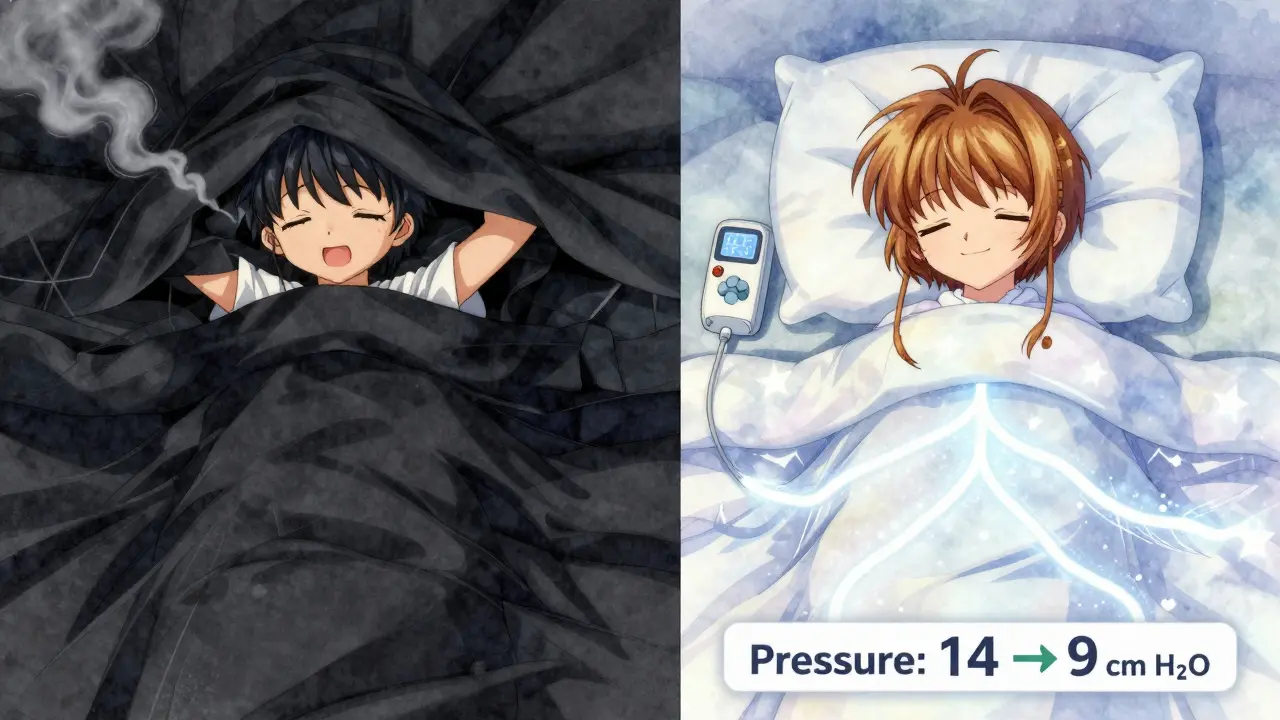
What to Do Right Now
If you’re on CPAP and your BMI is above 30, here’s your action plan:- Get your BMI and AHI measured together. Don’t assume one tells you the other.
- Ask your sleep doctor for a follow-up sleep study after you lose 10% of your body weight. That’s the threshold for pressure adjustment.
- Work with a dietitian who understands sleep apnea. Not all nutritionists know how ghrelin and leptin behave in OSA.
- Track your CPAP use. If you’re below 5 hours a night, you’re at risk for weight gain - not relief.
- Don’t give up if you gain a few pounds at first. Keep using the machine. Your body will reset.
Insurance and Access: What You Should Know
Medicare requires an AHI over 15 (or over 5 with other health problems) to cover CPAP. But weight loss programs? Coverage is spotty. Only 41% of private insurers cover FDA-approved weight-loss drugs in 2023. That’s changing. More clinics are offering bundled care - CPAP + weight loss - and insurers are starting to pay for it because it saves money long-term. Ask your provider: “Can you refer me to a program that treats both my sleep apnea and my weight?”The Bigger Picture
Sleep apnea isn’t just about snoring. It’s a sign your body is under stress - from fat, from poor sleep, from hormones gone out of balance. CPAP treats the symptom. Weight loss treats the cause. The American Thoracic Society estimates that if everyone with obesity lost just 5% of their weight, the number of people needing CPAP would drop by over 18 million globally. That’s not a fantasy. It’s a calculation. You don’t need to be perfect. You just need to start. Lose 10 pounds. Get your pressure checked. Sleep better. Feel more awake. Move more. Lose more. It’s not a diet. It’s a reset.Can losing weight eliminate my need for CPAP?
Yes, for many people - especially those with mild to moderate sleep apnea. Losing 10% of your body weight can reduce your apnea-hypopnea index (AHI) by up to 50%. In some cases, especially with a BMI drop from 35+ to below 30, CPAP may no longer be needed. A follow-up sleep study after weight loss is required to confirm this.
Why do I gain weight after starting CPAP?
CPAP improves sleep, which can lower your metabolism and increase hunger hormones like ghrelin while reducing satiety signals like leptin. People often eat more without realizing it. This weight gain is most common in those who use CPAP less than 5 hours a night. Consistent use (6+ hours) usually leads to weight loss over time due to improved energy and hormone balance.
How much weight do I need to lose to lower my CPAP pressure?
Losing just 5-10% of your body weight typically leads to a noticeable drop in CPAP pressure needs. For example, a 200-pound person losing 10-20 pounds may reduce their pressure by 1-3 cm H₂O. Every 1-point drop in BMI reduces AHI by about 6-7%, which often allows for lower pressure settings.
Does CPAP help with weight loss?
CPAP doesn’t directly burn fat, but it creates the conditions for weight loss. Better sleep improves insulin sensitivity, reduces stress hormones like cortisol, and increases energy for physical activity. Studies show that consistent CPAP users who combine it with diet and exercise lose more weight than those who don’t use it regularly.
What’s the best way to lose weight with sleep apnea?
The most effective approach is a team-based plan: a sleep specialist to monitor your AHI, a registered dietitian to design a sustainable eating plan, and possibly an obesity medicine doctor to discuss medications like semaglutide. Exercise alone isn’t enough - you need to fix the hormonal imbalances caused by poor sleep. Programs that combine CPAP support with structured weight loss see 42% greater success than standard advice.
If you’re using CPAP and carrying extra weight, you’re not broken. You’re caught in a cycle - and the way out is through weight loss. Not because you need to look a certain way, but because your body needs to breathe easier. Start small. Track your progress. Talk to your doctor about adjusting your CPAP as you lose. The machine doesn’t define your health - your choices do.





12 Comments
Nadia Watson
January 20, 2026 AT 17:07It’s wild how much weight affects breathing at night. I never connected my CPAP pressure to my BMI until I saw the numbers. I lost 18 pounds last year and my pressure dropped from 16 to 11. It’s not magic-it’s physics. My mask stopped leaking, I actually sleep through the night now, and I don’t feel like I’m being punched in the face by air every time I turn over.
I wish doctors talked about this more. They hand you the machine like it’s the end of the story, not the beginning.
Courtney Carra
January 22, 2026 AT 10:11Life’s just a series of biological compromises, isn’t it? 🤔
We build machines to keep us alive while our bodies betray us. CPAP is a bandage on a bullet wound. Weight loss? That’s the surgery. The irony? The very thing that’s supposed to fix you-the machine-can make you heavier if you’re not careful. It’s like your body’s whispering, ‘Hey, now that you’re not gasping, let’s囤积脂肪.’
But here’s the quiet rebellion: lose 10%. Not for looks. Not for approval. Just so your throat remembers how to stay open without a hose.
thomas wall
January 23, 2026 AT 14:12It is utterly irresponsible that medical professionals routinely prescribe CPAP without simultaneously mandating a structured weight management protocol. This is not a medical device-it is a symptom management tool, and its overuse reflects a systemic failure of preventive medicine. The fact that 78% of post-bariatric patients no longer require CPAP is not a coincidence; it is a moral indictment of our current paradigm.
Those who gain weight on CPAP are not weak-they are victims of a healthcare system that prioritizes convenience over cure. Shame on the industry for profiting from perpetual dependency.
Paul Barnes
January 24, 2026 AT 01:03Every 1-point BMI drop = 6.2% AHI reduction? Where’s the citation for that exact number? The study you cited says ‘approximately 6.2%,’ not ‘exactly.’ And you say ‘7 pounds = 7% reduction’-that’s mathematically nonsensical unless you assume linear scaling across all BMI ranges, which the data doesn’t support.
Also, ‘287 more calories a day’-who measured that? Self-reported intake? That’s garbage data. Fix the methodology before you fix my pressure.
sagar sanadi
January 24, 2026 AT 06:15they told us to lose weight but they dont tell us why the machine makes you gain weight. why? because they dont want you to know the truth. cpap is a trap. the air pressure is not helping your throat. it is crushing your diaphragm. your body is storing fat to protect itself from the machine. they dont want you to know this. they want you to buy new masks every month.
kumar kc
January 25, 2026 AT 07:03Stop blaming the machine. Start lifting weights. Eat less sugar. Sleep better. Done.
Carolyn Rose Meszaros
January 26, 2026 AT 06:22I’ve been on CPAP for 4 years. Lost 22 pounds. Pressure dropped from 15 to 10. I still use it, but now I can sleep on my side without leaks. I didn’t do it for looks-I did it because I was tired of waking up choking. My energy came back. I started walking with my dog again. Then I lost more. It’s not about willpower. It’s about giving your body a chance to heal.
Also, I cried when my pressure went down. No joke. It felt like freedom.
Greg Robertson
January 26, 2026 AT 22:00Hey, I just wanted to say thanks for writing this. I’ve been stuck in the CPAP loop for years and felt like I was failing because I couldn’t lose weight. But reading this made me realize it’s not me-it’s the system. I’m seeing a dietitian next week who specializes in sleep disorders. Small step, but it’s a step.
Also, my machine’s 5 years old. I’m calling my provider about upgrading. The new ones sound like a whisper. That alone might help me sleep better.
Jacob Cathro
January 27, 2026 AT 01:05Okay but let’s be real-this whole thing is a corporate cash cow. CPAP machines are $2k. Masks are $80/month. Insurance pays for it. But weight loss programs? ‘Not medically necessary.’
And the new ‘smart’ machines? They’re just tracking your weight so they can upsell you a $300 ‘adaptive pressure’ upgrade next year. Meanwhile, your doctor doesn’t even ask if you’ve eaten a vegetable this week.
They’re not treating sleep apnea. They’re treating your insurance card.
pragya mishra
January 28, 2026 AT 23:01Why are you all acting like this is new? I’ve been telling people for years: lose weight or keep paying for a machine that makes you miserable. You think your doctor cares? They get paid per CPAP setup. Your health is a billing code. If you want to live, stop waiting for permission. Start walking. Stop soda. Eat protein. Do it now. Not tomorrow. Today.
Manoj Kumar Billigunta
January 29, 2026 AT 08:56I’m a nurse in India. I see this every day. People come in with CPAP, scared, tired, ashamed. I tell them: your body isn’t broken. It’s just overloaded. Start with one change: no sugar after 6 PM. Walk 15 minutes after dinner. Drink water before bed. Small things. Not a diet. Just habits.
One man lost 14 kilos in 5 months. His pressure went from 18 to 10. He stopped crying at night. He started playing with his kids again.
You don’t need surgery. You don’t need magic pills. You need someone to say: ‘I believe you can do this.’ And I believe you.
Nadia Watson
January 29, 2026 AT 09:58Just read the comment about the nurse in India. That hit me. I’ve been so focused on the machine, I forgot I’m a person. Not a diagnosis. Not a BMI number. Just someone trying to breathe better.
Thanks for saying that. I’m going to walk after dinner tonight. Just 15 minutes. That’s it. No pressure. Just movement.