

Stop Juggling Prescriptions-Here’s How to Cut Your Copays in Half
If you’re managing three or more prescriptions, you know the drill: running to the pharmacy every few weeks, paying a copay each time, forgetting which med is due when, and sometimes skipping doses because it’s just too much. You’re not lazy-you’re overwhelmed. And the system isn’t helping. A medication synchronization program can fix this-not by lowering the price per pill, but by cutting how often you pay.
Med sync isn’t magic. It’s a simple pharmacy service that lines up all your chronic meds to refill on the same day each month. No more juggling 30-day, 60-day, and 90-day schedules. Just one trip. One copay. One less thing to stress about. And it’s free.
How Medication Synchronization Actually Works
You don’t need a doctor’s note or special approval. Just walk into your pharmacy and ask. Most major chains-CVS, Walgreens, Shoppers Drug Mart, and others-offer this at no extra cost. Here’s how it rolls out:
- Enroll: Tell your pharmacist you want to sync your prescriptions. They’ll pull up your full list, including over-the-counter meds and supplements.
- Review: The pharmacist checks for interactions, duplicates, and refill timing. They’ll spot if you’re taking two blood pressure pills that do the same thing-or if you’re out of insulin and didn’t realize it.
- Short fills: This is the key step. If your metformin is due in 10 days but your lisinopril isn’t due for 45, the pharmacy will give you a partial refill of the metformin so it lines up with the lisinopril. You might get a few extra days of one med, or a few fewer days of another. It’s temporary. Just enough to align everything.
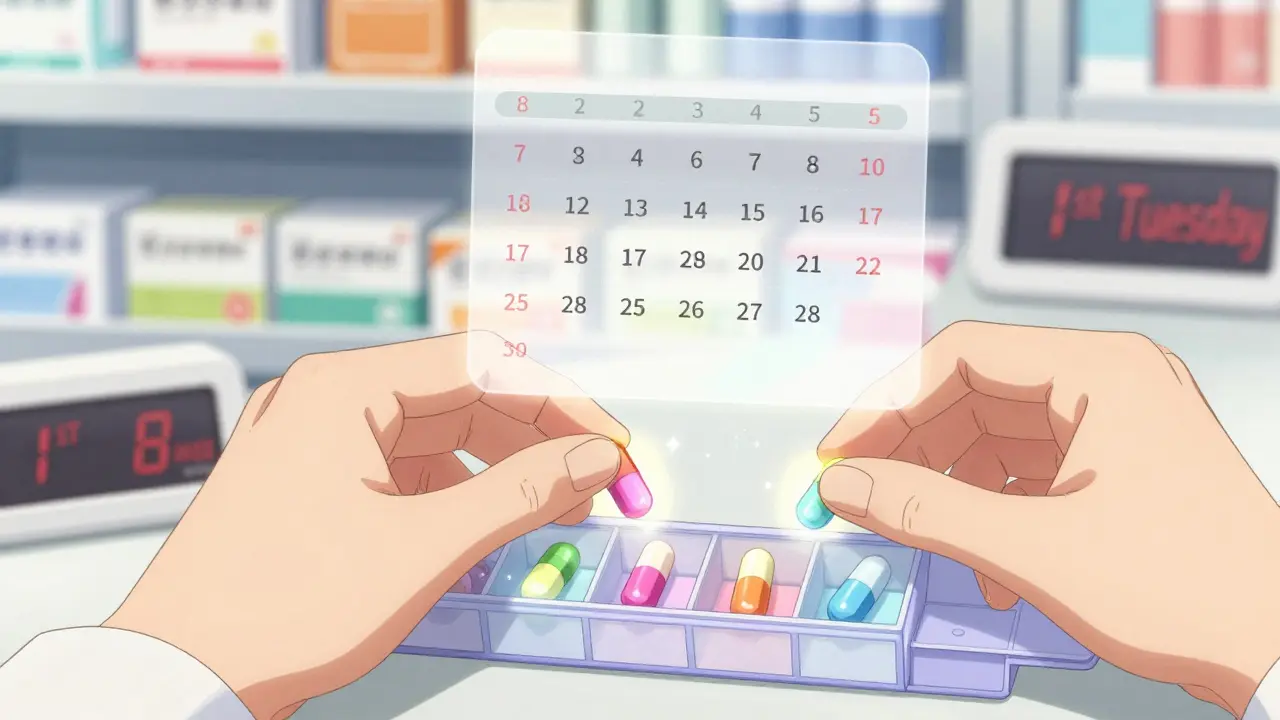
- Monthly pickup: From then on, all your meds are ready on the same day-say, the first Tuesday of every month. You get a text reminder. You walk in. You grab everything. You’re done.
It takes 1 to 3 months to fully sync everything, depending on your refill cycles. But once it’s set, you’ll go from 10-12 pharmacy trips a year down to 4. That’s not just convenience-it’s savings.
Why Fewer Visits = Lower Out-of-Pocket Costs
Each time you fill a prescription, you pay a copay. Even if it’s $10, $20, or $40, those add up fast. A Medicare beneficiary on a three-tier plan pays 57.6% more per prescription than someone on a two-tier plan, according to a Marketscan study. That means if you’re taking five meds and refill them on different dates, you could be paying 15 copays a year. At $30 each? That’s $450. Just in copays.
With med sync, you pay five copays-but only four times a year. That’s $600 down to $200. That’s $250 saved, just by aligning refill dates. And that’s not counting transportation costs, missed work, or the stress of running out of meds.
Studies show patients who use med sync have 23.6% fewer hospital visits for medication-related issues. Why? Because they’re not forgetting doses. They’re not mixing up pills. They’re not skipping refills because the pharmacy’s too far or the copay’s too high.
What If Your Insurance Blocks You?
Some plans make it harder. Copay accumulator programs are one of the biggest roadblocks. These programs, pushed by insurers since 2017, say: “If you use a manufacturer coupon to lower your copay, we won’t count that toward your deductible.” So if you’re on a $650-a-month specialty drug and you have a $5,000 annual coupon, your insurer might say, “We’ll only count the $50 you paid out of pocket.” That means you’re stuck paying the full deductible yourself.
This hits hardest with patients on biologics for rheumatoid arthritis, multiple sclerosis, or Crohn’s disease. A 2023 KFF report found these programs increase out-of-pocket costs by hundreds-even thousands-of dollars a year. The good news? The 2025 Medicare Part D proposed rule aims to limit this. If you’re on Medicare, ask your pharmacist if your plan still uses accumulators. If you’re on private insurance, call your insurer and ask: “Do you use copay accumulator programs?” If they say yes, ask if they’ll waive it for chronic condition meds.
Another issue: some plans restrict early refills. Medicare Part D only lets you refill a 30-day script 2 days before you hit 70% of the supply. That can mess with sync schedules. But pharmacists can request early refill exceptions. It’s not automatic-but it’s worth asking. One pharmacy in Halifax reported 63% of sync requests needed a special authorization for at least one med. They got approved 87% of the time.
Combination Pills: The Ultimate Coordination Hack
Some meds come already combined. Like a single pill that has both a blood pressure drug and a water pill. Or a diabetes pill that includes metformin and a GLP-1 agonist. These are called fixed-dose combinations. They’re not available for every drug pair-but when they are, they’re game-changers.
MaxCareRx found that patients switching to a single-pill combo reduced missed doses by up to 27%. That’s because there’s no confusion. No two bottles. No different refill dates. Just one pill, once a day. And often, the copay is lower than paying for two separate pills.
Ask your doctor: “Are there combination versions of my meds?” If you’re on three pills for hypertension, there’s a good chance one combo exists. Your pharmacist can check too. Between 2018 and 2023, the FDA approved 127 new fixed-dose combinations. The odds are better than you think.
Specialty Drugs and the Hidden Trap
Specialty drugs-like those for cancer, MS, or rare diseases-make up less than 2% of all prescriptions but account for over half of total pharmacy spending. They’re expensive. And manufacturers often offer copay cards to help. But here’s the catch: if your insurer uses a copay maximizer program, they’ll use your card to cover the full cost, then charge you the full deductible anyway.
That’s right. You think you’re getting help. You’re not. You’re just being funneled into a system that lets your insurer pay less. The Journal of Managed Care & Pharmacy called this “a financial loophole that shifts cost to the patient.”
What to do? If you’re on a specialty drug:
- Ask your pharmacist: “Is this covered by a copay maximizer program?”
- Call the manufacturer’s patient support line. Some now offer direct financial aid that bypasses insurance entirely.
- Ask if you can switch to a generic or biosimilar. Many are now available and cost 80% less.
Don’t assume your copay card is helping. Verify it.
Real People, Real Savings
One user on Reddit shared that syncing her 72-year-old mother’s eight prescriptions cut her pharmacy visits from 12 to 4 a year. She saved $120 in gas and reduced missed doses by 40%. Another, a 64-year-old with diabetes and heart disease, switched from three separate pills to one combo pill. His copay dropped from $58 to $22 per month.
Walgreens’ med sync program has over 1,200 reviews with a 4.2/5 rating. The most common praise? “I finally know when my meds are due.” The most common complaint? “I ran out for a few days during the sync adjustment.” That’s normal. Your pharmacist should warn you about that. If they don’t, ask.

What to Do Next
Don’t wait for your next refill. Take action now:
- Make a list of every prescription you take, including over-the-counter and supplements.
- Call your pharmacy and ask: “Do you offer medication synchronization?”
- Bring your list in. Ask them to review for duplicates, interactions, and combo options.
- Ask: “Do you use copay accumulators or maximizers?”
- If you’re on a specialty drug, ask about alternative funding programs.
- Set a calendar reminder to check in with your pharmacist every three months.
This isn’t about being perfect. It’s about making your medication routine simpler, safer, and cheaper. You’re not just saving money-you’re protecting your health.
Frequently Asked Questions
Is medication synchronization free?
Yes. Most major pharmacies in Canada and the U.S. offer med sync at no extra charge. It’s part of their clinical services, not a paid add-on. You still pay your regular copay for each medication-but only once a month instead of multiple times.
Can I sync prescriptions if I take a 90-day supply?
Yes. Most pharmacies can sync 90-day supplies with 30-day ones. They’ll adjust your 30-day meds to align with your 90-day refill. For example, if your blood pressure med is 90-day and your cholesterol is 30-day, they’ll give you two extra 30-day fills of the cholesterol med so you only pick up everything once every three months. It’s not always perfect, but it’s usually doable.
What if my insurance won’t let me refill early?
Medicare Part D only allows early refills if you’ve used at least 70% of your current supply. For example, if you have a 30-day supply, you can refill after day 21. Your pharmacist can request an early refill exception for sync purposes. Many approvals come through-especially for chronic conditions. If they say no, ask for a written explanation and appeal it.
Do combination pills always cost less?
Not always-but often. A single-pill combo usually costs less than buying two separate pills, especially if one is brand-name. Check with your pharmacy. Sometimes the copay for the combo is the same as one of the individual pills. That’s still a win-you’re reducing the number of pills you take, which improves adherence.
Can I use med sync if I don’t have Medicare?
Absolutely. Med sync is available to anyone with multiple chronic prescriptions, regardless of insurance type. Private insurers, Medicaid, VA, and even cash-paying patients can enroll. It’s a pharmacy service, not a benefit tied to a specific plan.
What Comes Next?
If you’ve been juggling pills, missed doses, and surprise copays, you’re not alone. But you don’t have to keep doing it this way. Medication synchronization is proven, widely available, and free. It doesn’t fix high drug prices-but it fixes how you pay for them. And that’s a big deal.
Start today. Walk into your pharmacy. Ask for med sync. Bring your list. Ask the hard questions about copay programs. You’ve got nothing to lose-and months of stress, money, and health to gain.