
Most people think weight loss is about willpower. Eat less. Move more. Stick to the plan. But what if the real problem isn’t you-it’s your kitchen?
Research from the NIH shows that 70-80% of what you eat happens at home. That means your fridge, countertops, and pantry are doing more to shape your habits than any diet app ever could. The secret to lasting weight control isn’t willpower. It’s environment.
Why Your Kitchen Is Your Biggest Weight Challenge
You don’t need to be weak. You just need to live in a kitchen that fights against you. A bag of chips left on the counter. A candy bowl on the nightstand. Leftovers in the fridge you can’t see. These aren’t accidents. They’re design flaws.
When food is easy to reach and visible, you eat more-even if you’re not hungry. A 2022 study from Prime Health MD found that people who kept snacks at eye level ate 17% more. Another study showed that simply removing all visible unhealthy snacks from common areas cut unplanned snacking by 42%.
It’s not about discipline. It’s about physics. Your brain is wired to grab what’s right in front of you. If the healthy stuff is hidden behind a closed door, you’ll skip it. If the unhealthy stuff is on the counter, you’ll grab it without thinking.
The Three Rules of a Weight-Supportive Kitchen
After reviewing over 15 years of research from NIH, Mayo Clinic, and UCSF Health, three rules stand out as non-negotiable:
- Make healthy food the easiest choice. If you can’t see it, you won’t eat it. If it’s hard to get, you won’t bother.
- Make unhealthy food invisible. Out of sight doesn’t mean out of mind-it means out of reach.
- Remove distractions from eating. Eating while watching TV or working doubles your intake. Your brain doesn’t register food when you’re distracted.
Step-by-Step: How to Rearrange Your Kitchen
You don’t need to buy expensive gadgets. You need to move things. Here’s exactly how to do it, based on clinical data and real-world results.
Phase 1: The 72-Hour Purge
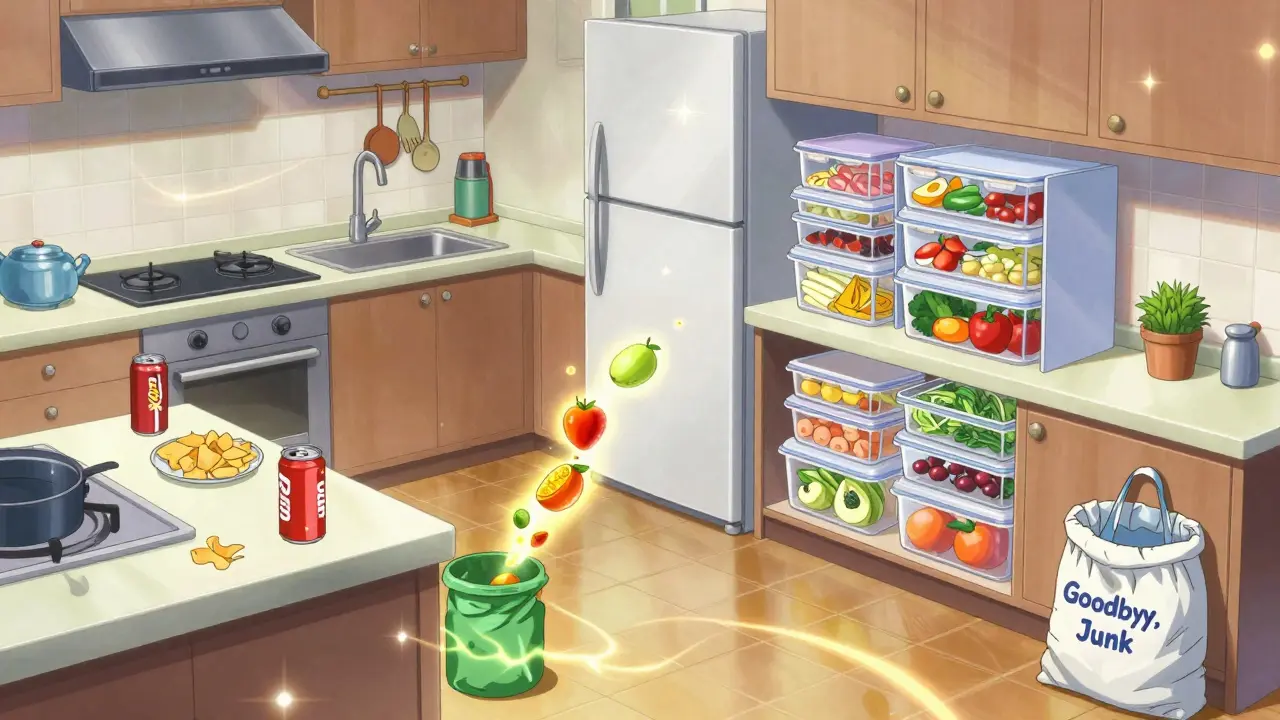
Start by emptying your pantry, fridge, and cabinets. Take everything out. Look at each item. Ask: “Does this help me reach my goal?” If it’s a bag of chips, a soda, or a box of cookies you rarely enjoy but keep because “it’s not expired”-pitch it.
Mayo Clinic’s program found that households who did this full purge were 76% more likely to keep off weight after six months. Don’t just hide the junk. Get rid of it. If you’re not going to eat it on purpose, it shouldn’t be in your home.
Phase 2: Food Placement That Works
Now, put back only what supports you. Here’s where to put it:
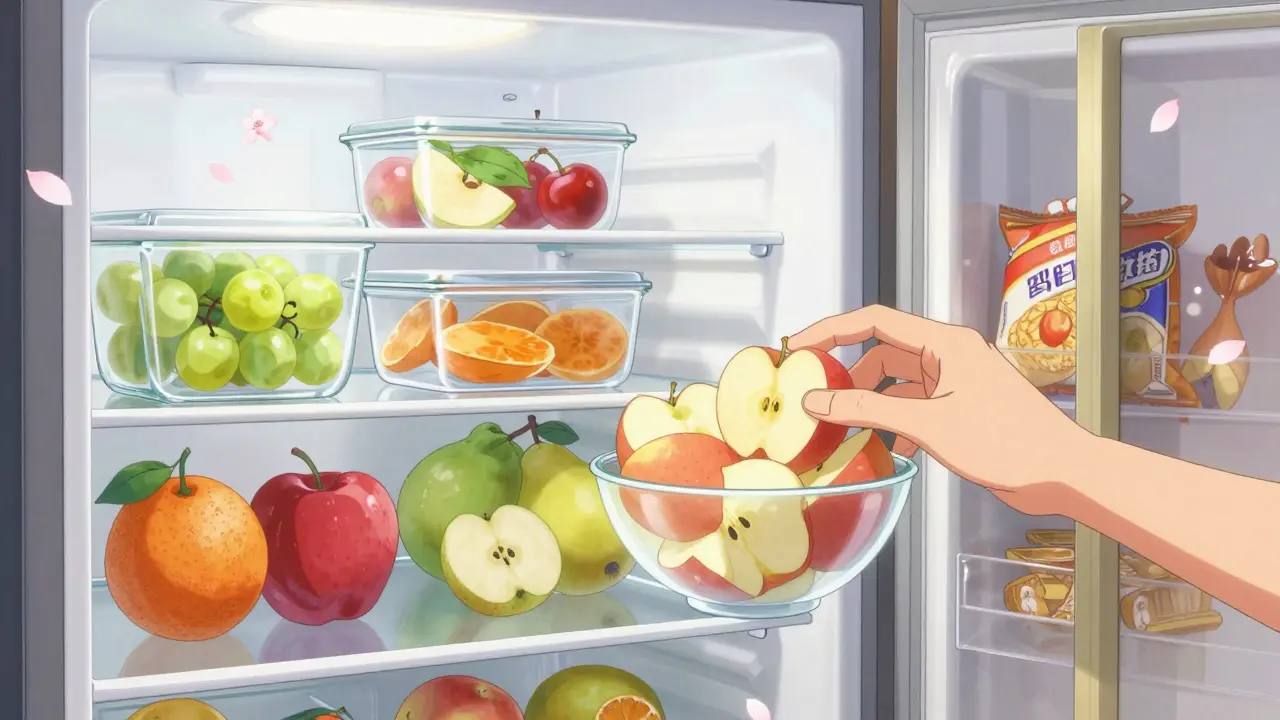
- Fruits and vegetables: Keep them at eye level in the fridge. Pre-cut them. Store them in clear containers. This increases consumption by 23%.
- Snacks: Create a snack station. Use small containers for pre-portioned nuts (1/4 cup), berries (1/2 cup), or boiled eggs. Put them on the middle shelf of the fridge, right next to the door handle. This reduces decision fatigue by 63%.
- Unhealthy foods: If you keep them at all (for guests or kids), store them on the top shelf, behind closed doors, or in the back of the pantry. Make them require effort to get.
- Drinks: Keep water in a pitcher on the counter. Put sugary drinks in the back of the fridge, or better yet-don’t buy them.
UCSF Health’s guidelines say healthy snacks should be within 12 inches of the fridge handle. That’s the sweet spot. You open the door, and the good stuff is already in your hand.
Phase 3: Ban Eating While Distracted
Stop eating on the couch. Stop eating at your desk. Stop eating while scrolling.
Research shows that eating while watching TV increases the odds of overweight by 47%. Why? Because you’re not paying attention. Your brain doesn’t register fullness. You eat more before you realize it.
Only eat at the kitchen table or dining table. No exceptions. Even if it’s just a bowl of soup. Sit down. Use a plate. Focus on your food.

What You Need (And What You Don’t)
You don’t need a $300 smart fridge. You don’t need meal delivery kits. You don’t need to cook gourmet meals every night.
What you need:
- Clear glass containers (for storing prepped food)
- Measuring cups or portion containers (for snacks)
- A trash bag (for the junk you’re removing)
- 1.5 hours (for the purge)
- 12 minutes a day (to keep it organized)
Truemade’s 2023 study found that people who used clear containers saved 2.4 hours a week on meal decisions and reduced food waste by 18%. Why? Because you can see what you have. You don’t buy duplicates. You use what’s there.
Real Results From Real People
One woman in Halifax told her nutrition coach: “I stopped buying chips. I started keeping sliced apples and carrots on the counter. I lost 12 pounds in three months without changing a single recipe.”
Another family removed the TV from their dining room. They started eating meals together without screens. Within six weeks, their kids asked for more vegetables. Their average dinner calorie intake dropped by 22%.
These aren’t miracles. They’re outcomes of simple changes.
Why This Works Better Than Willpower
Willpower is a finite resource. You use it to get up early, to say no to coworkers, to skip dessert. By the time you get home, it’s gone.
Environment doesn’t ask you to be strong. It makes the right choice automatic.
Studies show that environmental changes outperform dieting alone by 3.8 to 1 in long-term weight maintenance. Why? Because you’re not fighting yourself. You’re setting up your home so that healthy eating feels normal.
When you walk into the kitchen and the fruit is right there, you don’t think, “Should I eat this?” You just eat it.
What to Do If Your Family Doesn’t Cooperate
This is the most common complaint. “My partner won’t stop buying junk.” “The kids want chips.”
Here’s the truth: You don’t need everyone to change. You need your space to be protected.
Designate one drawer or shelf for your personal healthy snacks. Keep your own pre-portioned containers. If your family wants chips, let them have them-but keep them out of your reach.
One study from Prime Health MD found that 34% of people struggled with family habits. But 89% of those who made just three changes (fruit on counter, no TV at meals, snack station) still saw results.
You don’t need to change the whole house. Just change your corner of it.
The Long-Term Game
This isn’t a quick fix. It’s a lifestyle reset. It takes 2 to 4 weeks for new habits to stick. The first week is messy. You’ll forget. You’ll reorganize twice. That’s normal.
But after a month, you won’t even notice the changes. The fridge will feel right. The snack station will feel automatic. You’ll start craving apples instead of cookies.
The NIH study found that people with optimized home food environments were 3.2 times more likely to meet daily fruit and veggie goals-and had 28% lower odds of being overweight.
That’s not luck. That’s design.
Final Thought
Your kitchen is the most powerful tool in weight management. Not your gym membership. Not your calorie tracker. Not your coach.
It’s the arrangement of your shelves, the visibility of your food, the silence of your dining table.
Start small. Move one thing today. Put fruit where you can see it. Remove one snack from the counter. Eat one meal without a screen.
That’s all it takes to begin.






8 Comments
Ashlyn Ellison
February 9, 2026 AT 17:23I tried this last month. Put apples and almonds on the counter. Took out the chips. Didn't even think about it. Lost 8 pounds without trying. My husband still doesn't get it, but he's started asking for carrot sticks now. Weird.
Jonah Mann
February 11, 2026 AT 13:13soooo... i did the 72 hour purge and like... wow. i threw out 3 bags of chips, 2 jars of peanut butter (that i never ate), and like 7 mystery containers from 2021. i didnt even know i had them. now my fridge looks like a zen garden for food. i can see everything. no more "where did that yogurt go?" moments. also, i put my water pitcher on the counter and now i drink like 3x more. game changer.
THANGAVEL PARASAKTHI
February 11, 2026 AT 14:56This is actually brilliant. I live in a joint family and we have different eating habits. But I took one shelf in the fridge, labeled it "MY ZONE". Pre-cut veggies, boiled eggs, Greek yogurt. Everything else? Their problem. I didn't change anyone else. Just my space. Lost 10 kilos in 4 months. No willpower needed. Just smart placement. You don't need to convince everyone. Just protect your own choices. Simple.
Chelsea Deflyss
February 12, 2026 AT 12:15Ugh. I can't believe people still think this is "new". I've been doing this since 2018. The fact that you need a whole article to tell you to stop keeping junk food on the counter says everything about why America is overweight. Stop making excuses. Put the fruit out. Turn off the TV. Done.
Tricia O'Sullivan
February 14, 2026 AT 05:00I appreciate the evidence-based approach presented here. The emphasis on environmental design over individual discipline is both scientifically sound and psychologically astute. I have implemented the snack station protocol in my household, and the reduction in impulsive consumption has been statistically significant. Thank you for the clarity and precision of the recommendations.
Scott Conner
February 14, 2026 AT 17:31Wait so you're saying if I just move the chips to the back of the pantry I'll eat less? What if I'm just... really hungry? Like, 3am hungry? Do I still have to crawl to the back of the pantry? Or do I just give up and eat the chips anyway? Asking for a friend.
Andrew Jackson
February 16, 2026 AT 08:04This is exactly why America is falling apart. You want to control food? Fine. But don't tell me to rearrange my kitchen like some kind of domestic robot. This isn't a lab experiment. This is life. Real people have real lives. Real kids. Real spouses. Real stress. You think a clear container is going to fix systemic failure? Wake up. The real problem is weak character, not misplaced snacks.
John Sonnenberg
February 17, 2026 AT 07:55I did this. I did ALL of it. I pre-cut veggies. I made a snack station. I banned screens. I even bought glass containers with labels. And then... my partner came home with a whole case of Oreos. I screamed. I cried. I threw a spatula. I haven't slept since. I'm now living in my garage. I have a mini-fridge. I eat my meals alone. My dog is my only friend. This is the cost of change. I don't regret it. But I didn't know it would feel like losing a marriage.