
Imagine you’re on vacation in southern France and your asthma inhaler runs out. Back home, you’ve been using the same generic version for years-cheap, effective, and covered by your insurance. But here? The pharmacy doesn’t recognize your prescription. It’s printed on paper. No barcode. No digital trace. You’re stuck. This isn’t a rare situation. It’s happening every day across the EU, even though the system was designed to make this exact thing easier.
How the EU’s cross-border pharmacy system actually works
The European Union built a digital bridge for prescriptions. It’s called eHDSI, part of the MyHealth@EU platform. Since 2011, EU law has guaranteed that if you’re legally prescribed a medicine at home, you can get it filled in another EU country. No extra paperwork. No need to see a new doctor. Just show up at a pharmacy with your ePrescription, and they pull it up securely through your home country’s system.
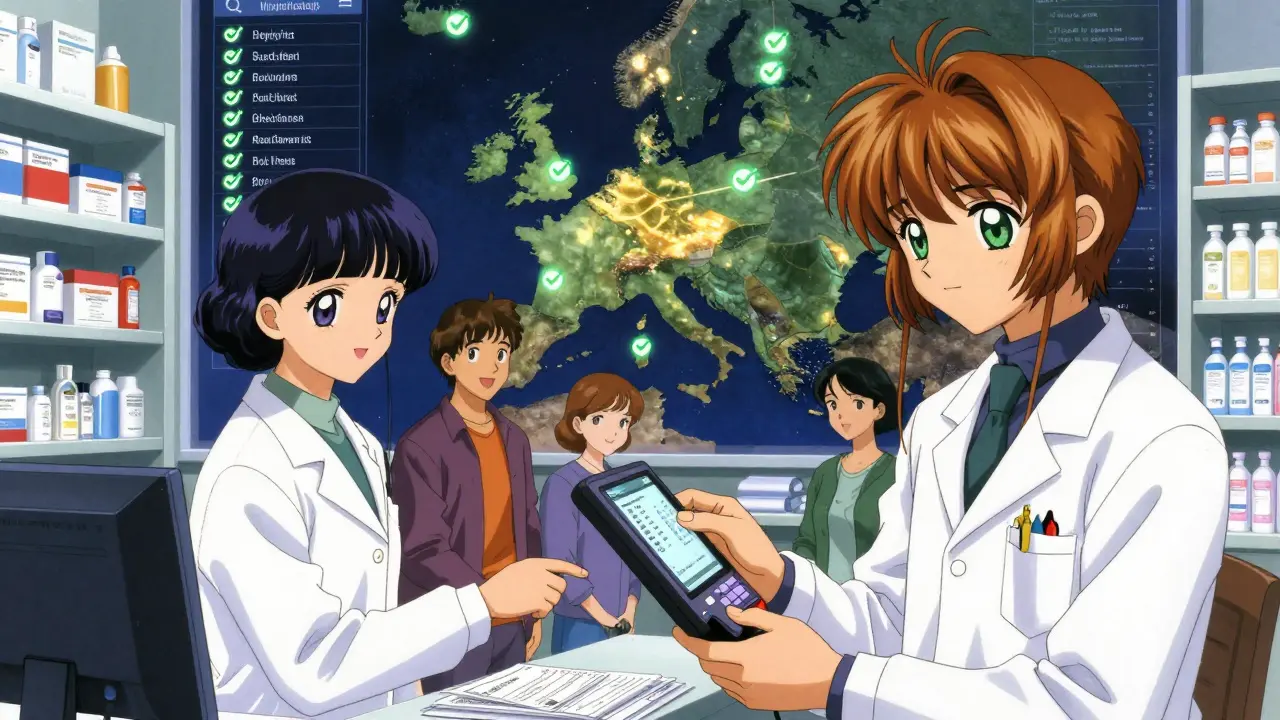
Right now, 27 EU and EEA countries are connected. That means if you live in Poland and need your blood pressure meds while visiting Spain, your doctor’s digital prescription follows you. The pharmacy in Madrid accesses it through the secure EU network. No physical paper. No translation headaches. The system even sends a Patient Summary-your allergies, current meds, and past conditions-in the local language.
But here’s the catch: it only works if both sides are actually using it. Germany, France, Austria, and the Netherlands have fully integrated. But in countries like Romania or Bulgaria, the system exists on paper, not in practice. Pharmacists there might not have the software. Or they might not know how to use it. And if they don’t, you’re back to square one.
Why some prescriptions still get rejected
One of the biggest problems isn’t technology-it’s rules. Take Ireland. If you show up with a prescription from a UK telehealth service, the pharmacist is legally required to refuse it. Even if the medicine is identical, the prescriber wasn’t registered in the EU. The same goes for prescriptions from non-EU countries. The EU doesn’t recognize them. Period.
Even within the EU, differences cause confusion. Italy switched from the old ‘bollino’ sticker on prescriptions to GS1 DataMatrix codes in February 2025. That’s a scannable barcode. But if you’re from Slovenia and your prescription still has the old sticker, the Italian pharmacy might not be able to read it. They’ll ask you to go back to your doctor. And that’s not just inconvenient-it’s dangerous if you’re running out of medicine.
Pharmacists are stuck in the middle. They’re expected to verify prescriptions from 27 different systems, each with different rules, formats, and security protocols. A 2025 study found pharmacists need about 40 hours of training just to handle cross-border prescriptions properly. Most don’t get it. So they play it safe: reject anything that looks unfamiliar.
The gap between policy and reality
Only 8 out of 27 EU countries have clear rules for how pharmacists should behave in online or cross-border settings. That means in half the bloc, there’s no official guidance on what to do if a patient shows up with a prescription from another country. Do they call the home country? Do they check the prescriber’s license? Do they even know how?
And then there’s awareness. A 2025 Eurobarometer survey found only 38% of EU citizens even know they have the right to fill prescriptions abroad. That number jumps to 72% in places like the Dutch-German border, where cross-border healthcare has been common for decades. But in rural areas of Portugal or Hungary? Most people don’t know the system exists.
It’s not just about access-it’s about trust. People are afraid. They worry their medical data is being shared without consent. The system requires explicit permission through national portals like island.is in Iceland or eID in Germany. But the process is clunky. You might need to log in twice, set time limits, and approve each country individually. If you’re 70 and not tech-savvy? You give up.
Who’s benefiting-and who’s being left behind
The real winners are people in border regions. In the Nordics, where Sweden and Finland share a long border, pharmacies often stock identical generic drugs from both countries. Patients cross for cheaper insulin or cheaper asthma inhalers. In the Netherlands, pharmacies near the German border have bilingual staff and dedicated EU prescription lanes. A 2025 survey found 78% of patients there successfully filled cross-border prescriptions.
But outside those zones? It’s a mess. Travelers report being turned away for medications they’ve used for years. One Reddit user from Lithuania described flying to Portugal and being denied her epilepsy medication because the pharmacist didn’t recognize the German prescription format. Another from Ireland spent three days in Spain trying to refill her diabetes meds-only to be told she needed a new prescription from a Spanish doctor.
And then there’s the shortage problem. The EU’s new Critical Medicines Act, launched in 2025, forces drug makers to report supply issues across borders. That’s good in theory. But in practice, it’s still patchy. If a generic drug runs out in Belgium, the system doesn’t automatically reroute stock from Poland. Pharmacies still have to call each other. Fax requests. Wait days. And patients suffer.
What’s changing in 2025 and beyond
There are signs of progress. Iceland is set to fully join the EU health data network by August 31, 2025. That means patients from Iceland will soon be able to fill prescriptions anywhere in the EU, and vice versa. Italy’s switch to scannable codes is making prescriptions more reliable. The European Commission is tightening rules under Regulation (EU) 2025/327, giving itself power to shut down non-compliant systems.
The European Association of E-Pharmacies (EAEP) is pushing for five big changes: full pan-European prescription delivery, access to electronic health records, flexible supply chains to fix shortages, fair reimbursement for digital services, and expanded telepharmacy for rural areas. Their 2025 Action Plan says digital pharmacy services cut medication errors by 22% and improve chronic disease adherence by 17%. Those are real numbers.
But the biggest hurdle isn’t tech-it’s politics. Each country still controls its own pharmacy rules, pricing, and reimbursement. A drug that costs €5 in Poland might cost €22 in Denmark. Who pays? The patient? The home country? The destination country? No one has agreed.
What you need to do to use cross-border pharmacy services
If you’re planning to travel and need your meds:
- Ask your doctor for an ePrescription-not a paper one. Make sure it’s issued through your national digital health system.
- Confirm your home country has activated ePrescription export. Germany, France, Austria, the Netherlands, and Estonia have. Others? Not always.
- Check if your medicine is available in the country you’re visiting. Generics have different names. A drug called “Metformin” in Germany might be sold as “Glucophage” in Italy.
- Bring your European Health Insurance Card (EHIC). It doesn’t cover the cost, but it proves you’re covered under EU health rules.
- Know your rights. Under Directive 2011/24/EU, you can’t be denied a prescription just because it’s from another EU country.
And if you’re a pharmacist? Start training. Learn how to read ePrescriptions. Understand the Patient Summary. Know which countries are connected. Your role is now part of a cross-border health network-not just a local pharmacy.
The future isn’t automatic-it’s negotiable
The EU has the tech. It has the laws. It has the data. But it doesn’t have the will to make it work everywhere. Right now, cross-border pharmacy services are like a highway with toll booths in every country. Some booths are open. Others are locked. Some don’t even have signs.
By 2030, IQVIA predicts the system could cut medication access gaps by 35%. But only if countries stop treating this as a national issue and start treating it like a shared health system. Right now, patients are paying the price for bureaucracy.
Can I use my EU prescription in a non-EU country like the UK or Switzerland?
No. The EU’s cross-border system only works between EU and EEA countries. The UK is no longer part of this network, so prescriptions issued there are not recognized in the EU. Switzerland is not in the EU, so it has separate agreements. Always check with the pharmacy before traveling.
Do I need to pay extra for cross-border prescriptions?
No, you shouldn’t. Under EU law, you pay the same price as a local patient. If the medication is cheaper in another country, you pay that lower price. But your home country may not reimburse you for the full cost-check your national insurance rules before you go.
What if my medicine isn’t available in the country I’m visiting?
You may need to get a new prescription from a local doctor. Generic drugs often have different brand names or formulations across countries. If your usual medicine isn’t available, ask the pharmacist for an equivalent. They’re trained to match active ingredients.
Is my personal health data safe when using ePrescriptions?
Yes. The system uses strict EU data protection rules. Your data is encrypted and only shared with your explicit consent. You control which countries can access your records and for how long. No one can view your history without your digital approval.
Why do some pharmacies refuse my prescription even though I’m from another EU country?
Often because they’re not trained, don’t have the right software, or are unsure of the rules. Some pharmacists still rely on paper prescriptions and don’t know how to access the ePrescription system. If you’re refused, ask to speak to the pharmacist in charge or contact your home country’s national contact point for digital health.

11 Comments
Laura Gabel
March 18, 2026 AT 03:50This whole EU thing is a joke. I can't believe we're expected to trust foreign pharmacists with our meds. Paper prescriptions work fine. Why complicate life with digital nonsense? Just carry extra pills like normal people.
jerome Reverdy
March 19, 2026 AT 11:50Look, the tech exists. The legal framework exists. The problem is implementation. It’s not that the system is broken-it’s that 15 countries haven’t bothered to train their pharmacists or update their software. We’re talking about a 40-hour training module here. That’s less than a week of work. If you’re not investing in your workforce, you’re not serious about healthcare integration. 🤷♂️
Andrew Mamone
March 21, 2026 AT 09:08I’ve had this happen in Portugal. My German prescription got rejected because the barcode wasn’t GS1-compliant. I had to wait 3 hours while they called my doctor. The system *works*-but only if everyone’s on the same page. We need a single EU-wide standard for prescription formats. Not 27 different ones. 🇪🇺💻
MALYN RICABLANCA
March 22, 2026 AT 06:40THIS IS A DISASTER!!! I SAW A WOMAN CRYING IN A PHARMACY IN BARCELONA BECAUSE SHE COULDN’T GET HER EPINEPHRINE INJECTION BECAUSE THE PHARMACIST SAID HER PRESCRIPTION WASN’T ‘EU-APPROVED’-BUT IT WAS FROM A GERMAN HOSPITAL!!! THIS ISN’T JUST INCONVENIENT-IT’S LETHAL!!! THEY’RE LETTING PEOPLE DIE BECAUSE OF BUREAUCRATIC TERRITORIALISM!!! WHO IS IN CHARGE OF THIS?!?!?!?!?!
gemeika hernandez
March 23, 2026 AT 17:32People don’t get it. It’s not about tech. It’s about trust. If you don’t know the pharmacist, you don’t know if they’re giving you the right stuff. I’ve seen fake meds in some countries. Why risk it?
Nicole Blain
March 25, 2026 AT 04:09I just got back from Croatia. Used my ePrescription. Pharmacist scanned it, read my allergies in English, handed me the meds. Took 4 minutes. No drama. 🌿✨
Kathy Underhill
March 25, 2026 AT 17:16The infrastructure is there. The will isn’t. This isn’t a technical problem. It’s a political one. Countries treat healthcare like sovereignty, not service. Until we stop seeing medicine as national property and start seeing it as human right, we’ll keep leaving people behind.
Srividhya Srinivasan
March 27, 2026 AT 17:06This is all a plot. The EU doesn’t want you to have control over your own health data. They’re building a surveillance network under the guise of ‘convenience’. Your allergies, your meds, your history-all being stored in some Brussels server. Who’s really accessing it? Big Pharma? The UN? The Illuminati? I’ve seen the documents. They’re coming for your pills next.
Prathamesh Ghodke
March 28, 2026 AT 01:37Honestly? I’m from India. We don’t have this system. But I’ve seen how messy it gets even in places with good infrastructure. The real hero here? The pharmacist who takes the extra 10 minutes to figure out a foreign script. They deserve a medal. And better training. And maybe a raise.
Stephen Habegger
March 28, 2026 AT 14:20Small wins matter. Iceland joining in August? That’s huge. Every country that connects adds more people who can get their meds. Progress isn’t perfect-but it’s real.
Justin Archuletta
March 29, 2026 AT 21:05I’m so glad this is finally being talked about!! I had to fly home from Italy because they wouldn’t refill my asthma meds!! I’m telling everyone I know!! This has to change!!