

Let’s be honest - if you’re trying to lose weight, alcohol is one of the sneakiest obstacles you’ll face. It’s not the sugar in your soda or the grease in your fries. It’s the drink you have after work, the glass of wine with dinner, or the weekend cocktail that feels harmless - until you see the scale. Alcohol doesn’t just add empty calories. It messes with your metabolism, tricks your brain into eating more, and makes your body hold onto fat - especially around your middle. And most people have no idea how much it’s costing them.
Alcohol Has More Calories Than You Think
One gram of alcohol contains 7 calories. That’s almost double the calories in protein or carbs (4 calories per gram) and close to fat (9 calories per gram). But unlike food, alcohol gives you zero nutrition. No fiber. No vitamins. No protein. Just pure energy your body has to burn - and fast.
Here’s what that looks like in real drinks:
- A 12-ounce beer: ~150 calories
- A 5-ounce glass of wine: ~120-125 calories
- 1.5 ounces of vodka, gin, or whiskey (80-proof): ~100 calories
- A piña colada: 400-500 calories
- A large cocktail with syrup, juice, and cream: up to 700 calories
That’s not just a snack. That’s a full meal. A pint of lager? Roughly the same as a slice of pizza. A big glass of wine? Equal to an ice cream sundae. And unlike pizza or ice cream, alcohol doesn’t fill you up. You drink it, and your body doesn’t register it as food. So you eat anyway - and often more than you planned.
Your Body Treats Alcohol Like Poison (And That’s a Problem)
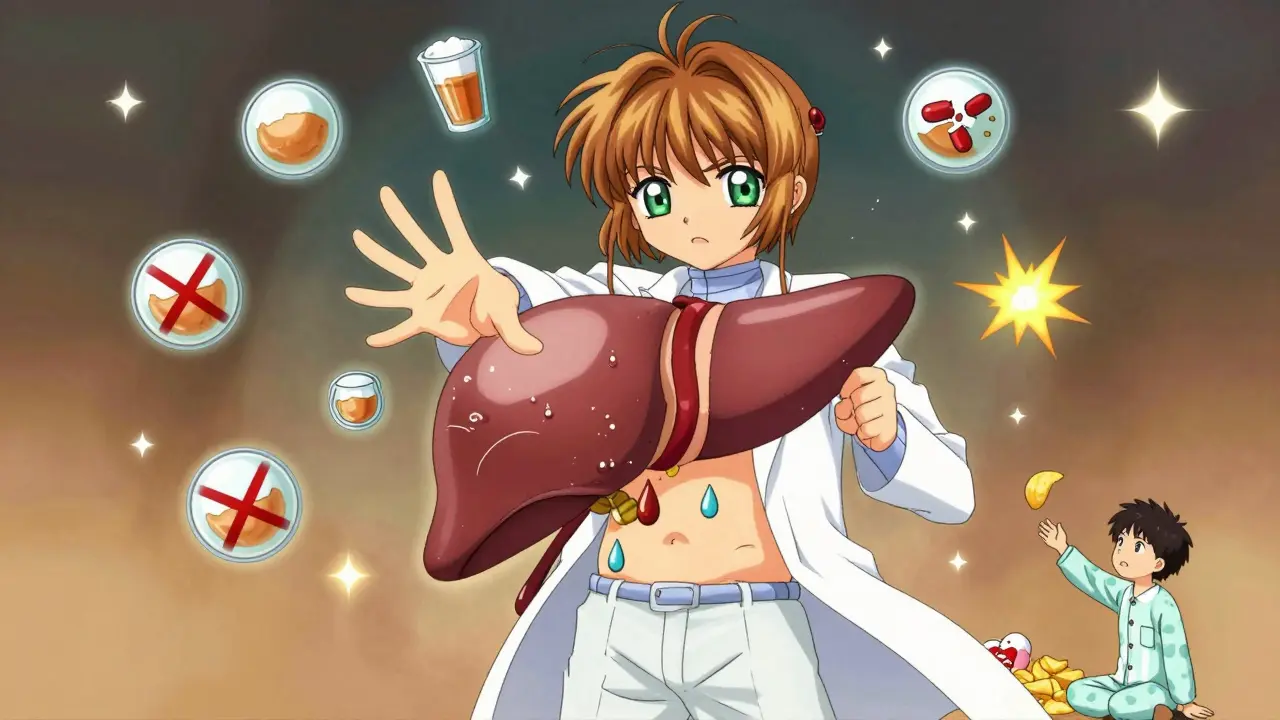
When you drink alcohol, your body doesn’t wait to digest it. It stops everything else - including burning fat - to get rid of it. Your liver prioritizes breaking down ethanol because it’s toxic. That means for the next 1-2 hours after each drink, your body isn’t burning stored fat. It’s burning alcohol. And while it’s doing that, any fat you ate earlier? It’s getting stored.
Studies show this metabolic pause increases fat storage by 30-40% during that window. That’s why people who drink regularly often gain weight around their belly - even if they’re eating “clean” the rest of the time. Your body isn’t lazy. It’s just doing what it’s programmed to do: survive. And in its eyes, alcohol is a threat that needs to be cleared before anything else.
Alcohol Makes You Hungrier - Even When You’re Full
Here’s the kicker: alcohol doesn’t just add calories. It makes you eat more of them.
Research from the Cleveland Clinic found that people who drank alcohol before a meal ate 20% more food than those who had a non-alcoholic drink. Why? Alcohol lowers your inhibitions and disrupts hormones that tell you you’re full. Leptin, the hormone that says “stop eating,” gets suppressed. Ghrelin, the hunger hormone, spikes. You end up reaching for chips, pizza, or late-night fries - even if you weren’t hungry before.
And it gets worse. Alcohol increases late-night snacking by 45%, according to UC San Diego’s 2022 study. You go to bed thinking, “I’ll eat better tomorrow.” But tomorrow, you’re still tired, still craving, still drinking. The cycle repeats.
Alcohol vs. Soda: Which Is Worse for Weight Loss?
People often compare alcohol to sugary sodas. Both are high in calories. But alcohol is worse - and here’s why.
A 12-ounce soda has about 150 calories from sugar. So does a beer. But soda doesn’t shut down fat burning. It doesn’t mess with your hunger hormones. It doesn’t lower your willpower. Alcohol does all three.
In a 2022 randomized trial published in Obesity Science & Practice, two groups cut the same number of calories. One group cut out soda. The other cut out alcohol. The alcohol group lost 3.2% more body fat - not because they ate less, but because their metabolism started working again. Their body could finally burn fat instead of just processing booze.
Real Strategies That Work (No Abstinence Required)
You don’t have to quit alcohol forever to lose weight. But you do need to be smarter about it. Here’s what actually works:
- Choose lower-calorie drinks. Skip the sugary mixers. Stick to vodka or gin with club soda and lime. That’s 100 calories instead of 400. A simple swap can save you 1,000+ calories a week.
- Designate alcohol-free days. Three to four days a week without alcohol? That’s 750-1,200 fewer calories per week. That’s almost half a pound of fat lost - without changing anything else.
- Pour smaller servings. Most people pour 30% more wine than a standard 5-ounce glass. Use a measuring cup once. See how much you’re actually drinking. Then stick to that amount.
- Pre-load with protein. Eat 20-30 grams of protein (like eggs, chicken, or Greek yogurt) before you drink. Research shows this cuts post-drinking food intake by 18%.
- Track your drinks. Most people underestimate how many calories are in cocktails by 47%. Use an app. Log it like food. Because it is food - just empty calories.
Why Cutting Alcohol Works Better Than Other Diet Tweaks
Think about how many diets fail because they’re too complicated. Counting macros. Skipping carbs. Intermittent fasting. It’s exhausting. Alcohol reduction is different. It’s simple. You don’t need a plan. You just need to stop drinking - or at least cut back.
A 2021 study tracked 12,500 adults over five years. Those who reduced their drinking from heavy to moderate (from over 14 drinks a week to 7 or fewer) lost an average of 3.7 pounds - without changing their diet or exercise. Just less alcohol. That’s it.
And it’s not just about weight. Regular drinkers (8+ drinks per week) are 23% more likely to be obese than non-drinkers, even when other factors like diet and activity are accounted for. That’s not correlation. That’s causation.

What About Moderate Drinking?
The Dietary Guidelines say up to one drink a day for women and two for men can fit into a healthy pattern. That’s true - if you’re tracking every calorie and not eating more because you drank.
But here’s the catch: most people can’t stick to “moderate.” One drink turns into two. Two turns into three. And then you’re at the bar, eating nachos, and wondering why the scale hasn’t moved.
If you’re trying to lose weight and you’re not seeing results, alcohol is the first thing to cut - not the last. It’s not about being perfect. It’s about removing the biggest leak in your calorie bucket.
Long-Term Success Requires More Than Just Cutting Drinks
Here’s the truth: people who cut alcohol and lose weight often regain it if they don’t change anything else. A 2023 study in the International Journal of Obesity found that 68% of people who lost weight by reducing alcohol regained it within a year.
But those who combined alcohol reduction with structured meal planning? 82% kept the weight off.
That’s the key. Alcohol isn’t the only problem. But it’s the easiest fix. Fix that first. Then build habits around food, sleep, and movement. You don’t need to overhaul your life. Just stop giving your body a reason to store fat.
Does alcohol turn into fat?
Alcohol doesn’t directly turn into fat. But while your body is busy breaking down alcohol, it stops burning fat. Any fat you eat during that time - from your meal or snack - gets stored instead. So yes, alcohol indirectly leads to fat gain, especially around your belly.
Can I drink alcohol and still lose weight?
Yes - but only if you’re very careful. You need to account for every calorie from alcohol, avoid sugary mixers, eat protein before drinking, and limit yourself to 1-2 drinks a week. Most people can’t do this consistently. That’s why cutting alcohol is the fastest way to see results.
Which alcoholic drink has the least calories?
The lowest-calorie option is 1.5 ounces of 80-proof vodka, gin, or whiskey mixed with plain club soda and lime. That’s about 100 calories. Avoid juice, soda, syrup, or cream - those add hundreds of extra calories.
Why do I crave junk food after drinking?
Alcohol lowers your inhibitions and disrupts hunger hormones. It increases ghrelin (hunger) and decreases leptin (fullness). Your brain thinks you’re starving, even if you just ate. That’s why you suddenly want pizza at 2 a.m.
How long does alcohol affect fat burning?
Your body takes 1-2 hours to process one standard drink. During that time, fat burning is paused. If you have three drinks, that’s 3-6 hours of blocked fat burning - and that’s just for one night.
Will cutting alcohol help me lose belly fat?
Yes. Alcohol is strongly linked to abdominal fat gain because your liver processes it there. When you cut back, your body starts burning fat again - and belly fat is often the first to go. Many people notice their waistline shrinking before the scale changes.
Final Thought: It’s Not About Willpower - It’s About Biology
You’re not failing because you lack discipline. You’re struggling because alcohol is designed to make you eat more, store fat, and feel like you’re doing fine - even when you’re not.
The science is clear. Alcohol is one of the most effective levers you can pull for weight loss. You don’t need a new diet. You don’t need to run marathons. Just stop pouring. Or pour less. Track it. Eat protein first. Choose simple drinks.
It’s not about perfection. It’s about progress. And if you’re serious about losing weight, alcohol is the easiest place to start.




9 Comments
Frank Declemij
January 29, 2026 AT 14:00Alcohol is just liquid carbs with zero nutritional value and a side of poor decisions. I cut it out for 30 days and lost 5 pounds without changing anything else. No magic. Just math.
Kacey Yates
January 29, 2026 AT 14:58Youre right but you missed one thing-alcohol ruins sleep and that kills fat loss harder than any drink. No deep sleep = no growth hormone = fat stays. Fix sleep first, then cut booze.
Laia Freeman
January 30, 2026 AT 03:32OMG YES I JUST REALIZED I WAS DRINKING 3 WINE GLASSES A NIGHT AND THINKING I WAS BEING GOOD BECAUSE I DIDNT EAT PIZZA 😭 I SWITCHED TO CLUB SODA AND NOW I’M SLEEPING BETTER AND MY JEANS FIT 😍
Robin Keith
January 31, 2026 AT 01:40Let me be brutally honest: the entire weight loss industrial complex wants you to believe that calories are the enemy, when in reality, it’s the biochemical sabotage of ethanol that turns your metabolism into a passive observer of your own destruction. You’re not failing because you lack willpower-you’re failing because your liver has been hijacked by a neurotoxin that prioritizes its own clearance over your fat-burning potential, and the cultural normalization of alcohol as a ‘reward’ is a psychological trap designed to keep you compliant, dependent, and perpetually overweight. The real tragedy? You think you’re relaxing, but your body is in crisis mode, storing every fatty molecule it can find while your prefrontal cortex is on vacation.
LOUIS YOUANES
January 31, 2026 AT 04:12Bro I used to drink whiskey neat after work like I’m some kind of rugged intellectual but then I realized I was consuming 700 calories a night just to feel like I’m not a loser. Now I drink sparkling water with lime and still feel cool. No one cares how much you drink. They care how you look.
Kristie Horst
February 1, 2026 AT 14:57While I appreciate the scientific rigor of this piece, I must respectfully note that the emotional weight of alcohol consumption-particularly as a coping mechanism-is often overlooked in purely metabolic discussions. Many individuals turn to alcohol not out of habit, but out of exhaustion, loneliness, or unresolved trauma. Reducing intake requires not just calorie accounting, but compassionate self-inquiry. For those ready to take this step, I recommend pairing dietary changes with therapy or peer support groups. Progress is not linear, and self-compassion is the most sustainable tool we have.
Keith Oliver
February 2, 2026 AT 19:02You missed the real issue: alcohol is a gateway to binge eating because it lowers GABA and raises dopamine. You think you’re having a glass of wine, but your brain is screaming for carbs and salt. That’s why you end up eating an entire pizza at 2am. It’s not weakness-it’s neurochemistry. If you’re serious about losing weight, you need to stop treating alcohol like a snack and start treating it like a drug. Because it is.
Laura Arnal
February 3, 2026 AT 18:49I cut alcohol for 6 weeks and lost 8 lbs without even trying! My skin cleared up, my energy shot up, and I stopped craving sweets. You don’t need to be perfect-just start with one alcohol-free day a week. You got this! 💪❤️
Andy Steenberge
February 4, 2026 AT 19:47The most important point here isn’t the calorie count-it’s the metabolic disruption. Alcohol doesn’t just add empty calories; it overrides your body’s natural fat-burning rhythm. When you drink, your liver shifts from fat oxidation to ethanol metabolism, and that metabolic switch can remain active for hours. Even if you eat clean the rest of the day, your body is essentially in storage mode during that window. This is why intermittent fasting works so well with alcohol reduction: you’re giving your liver time to reset. Combine that with pre-drinking protein, and you’re not just cutting calories-you’re restoring metabolic integrity. It’s not about deprivation. It’s about alignment.