Warfarin & NSAID Interaction Risk Estimator
Based on research by Petersen et al., this tool calculates the relative increase in bleeding probability compared to taking a blood thinner alone.
Imagine taking a pill for your back pain that silently turns your blood thinner into a ticking time bomb. It sounds like a movie plot, but for the millions of people on Warfarin, also known as Coumadin, who reach for an over-the-counter anti-inflammatory, this is a very real medical emergency waiting to happen.
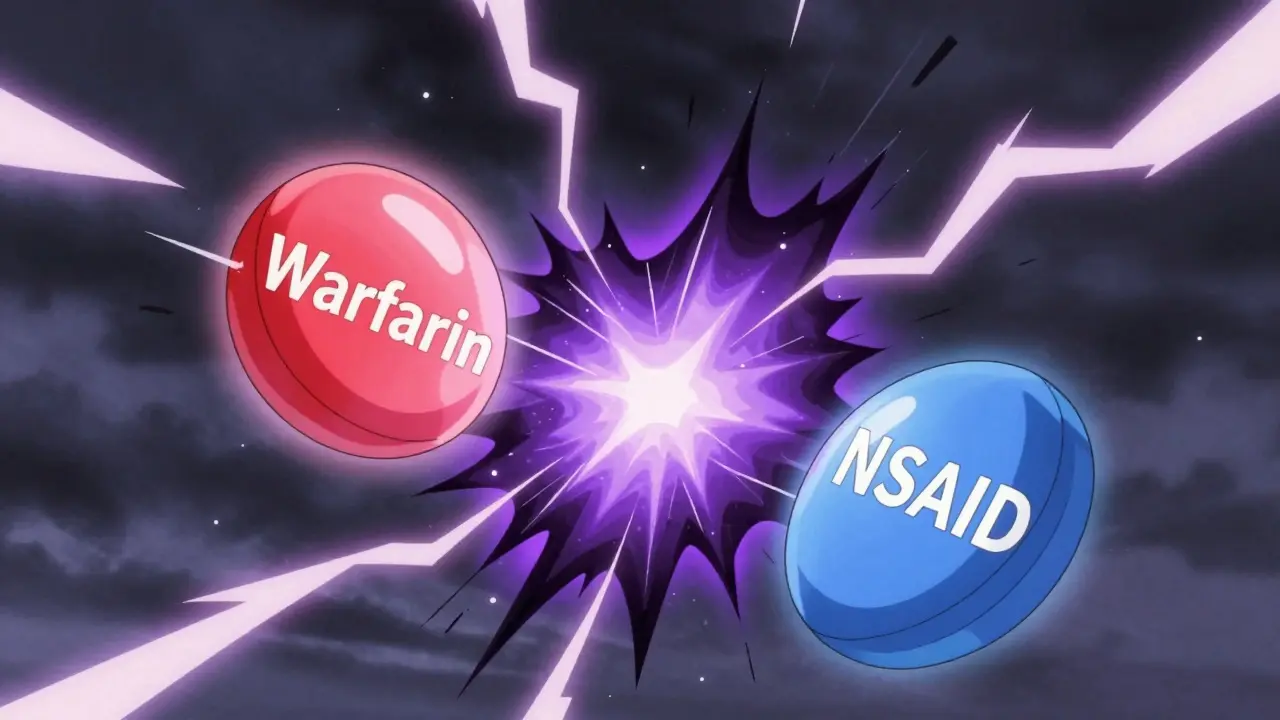
You take Warfarin because you need to prevent clots-maybe from atrial fibrillation or a past stroke. You take a Nonsteroidal Anti-Inflammatory Drug (NSAID) like ibuprofen or naproxen because your knee hurts or you have a headache. On paper, they seem harmless enough individually. Together? They create a dangerous synergy that can lead to severe, life-threatening bleeding. This isn't just a minor interaction; it is one of the most clinically significant drug-drug conflicts in modern medicine.
The Double Whammy: How These Drugs Sabotage Your Clotting
To understand why this mix is so risky, you have to look at how each drug attacks your body’s ability to stop bleeding, but from completely different angles. Think of your clotting system as a two-part security team. Warfarin disables the first part, and NSAIDs disable the second. When both are down, your body has no defense against hemorrhage.
Warfarin works by blocking vitamin K. Without vitamin K, your liver cannot produce active coagulation factors-specifically Factors II, VII, IX, and X-as well as proteins C and S. As explained in a pivotal study by Zapata et al., warfarin essentially depletes your functional vitamin K reserves, slowing down the chemical cascade that forms a stable blood clot. It takes days for these levels to stabilize, which is why we monitor patients with INR tests.
Now enter the NSAIDs. While Warfarin slows the chemistry, NSAIDs attack the physical machinery. According to Chan et al.’s foundational review, all NSAIDs inhibit platelet function. They block an enzyme called cyclooxygenase-1 (COX-1), which stops the production of thromboxane A2. Thromboxane A2 is what tells platelets to stick together and form that initial plug when a vessel is injured. By reducing this signal, NSAIDs prolong bleeding time. Even worse, high-dose aspirin has a direct hypoprothrombinemic effect, further messing with coagulation.
So, you have Warfarin preventing the formation of a strong fibrin mesh, and NSAIDs preventing platelets from sticking together to start the process. The result is a synergistic failure of hemostasis. Your body loses its ability to seal wounds efficiently, whether those wounds are microscopic scratches in your stomach lining or a major injury.
The Bleeding Risk: More Than Just a Stomach Issue
When people hear about bleeding risks with this combination, they usually think of black stools or vomiting blood. While gastrointestinal (GI) bleeding is the most common site, the danger extends far beyond your gut. A comprehensive analysis presented by the European Society of Cardiology, led by Søren Riis Petersen, quantified this risk with startling precision.
The overall risk of any bleed jumps 2.09 times higher when you combine an NSAID with a blood thinner compared to taking a blood thinner alone. But the location matters:
- Gut Bleeding: Increases by 2.24-fold. This is driven by NSAIDs damaging the gastric mucosa while Warfarin prevents the bleed from stopping.
- Brain Bleeding (Intracranial Hemorrhage): Skyrockets by 3.22-fold. This is often fatal or causes permanent disability.
- Urinary Tract Bleeding: Rises by 1.57-fold.
- Lung Bleeding: Increases by 1.36-fold.
Lee et al.’s 2024 meta-analysis confirmed that concurrent use significantly increases the risk of GI bleeding by 2.0 folds compared to Warfarin alone. Battistella et al. added another layer of complexity: even selective COX-2 inhibitors (often marketed as "safer" for the stomach) carry similar risks for upper GI hemorrhage in Warfarin users. There is no "safe" NSAID in this context.
Not All NSAIDs Are Created Equal
If you absolutely must take an NSAID while on Warfarin, knowing which one you pick matters. The data shows significant variation in risk depending on the specific drug. Petersen’s research broke down the relative risks:
| NSAID Type | Relative Bleeding Risk Increase |
|---|---|
| Ibuprofen | 1.79-fold |
| Diclofenac | 3.3-fold |
| Naproxen | 4.1-fold |
Notice that Naproxen carries the highest risk at 4.1 times higher than anticoagulant use alone. Ibuprofen, while still dangerous, poses a relatively lower risk. However, do not mistake "lower" for "safe." A 1.79-fold increase is still a massive jump in probability.
Meloxicam deserves special mention. Choi et al. identified it as an independent risk factor for significant INR elevation (P=0.025). In their study of 98 patients, 39.8% showed an INR elevation of ≥15.0% after adding an NSAID. Those on Meloxicam were particularly prone to these spikes, suggesting it may interfere more aggressively with Warfarin metabolism or clearance.

Who Is Most at Risk?
Some patients walk through fire without getting burned, while others get singed by a candle. Several factors make you much more vulnerable to this interaction. Choi et al. pinpointed four key predictors that drastically increase the chance of your INR spiking dangerously high:
- High Warfarin Dose: If you require more than 40 mg per week, your anticoagulation control is inherently less stable. Adding an NSAID here is playing Russian roulette.
- Polypharmacy: Taking other medications that interact with Warfarin creates a chaotic chemical environment. The more drugs in your system, the harder it is to predict how your INR will react.
- Low Baseline INR: Counterintuitively, if your starting INR is low, you may have less physiological reserve against further anticoagulation effects, leading to erratic spikes.
- Specific NSAID Choice: As noted, Meloxicam stands out as a troublemaker.
Age, kidney function, and history of ulcers also play roles, but these four factors are the red flags clinicians watch closely.
What About Newer Blood Thinners?
You might wonder if switching to a Direct Oral Anticoagulant (DOAC) like dabigatran (Pradaxa) solves the problem. The answer is complicated. Kent et al.’s 2018 study found that while NSAID use did not significantly alter the *relative* risk of major bleeding for DOACs compared to Warfarin, the *absolute* rates of bleeding were still significantly elevated in anyone taking NSAIDs.
In fact, among those using NSAIDs with DOACs, non-GI bleeding represented 60% of major events, while GI bleeding was 40%. So, while DOACs might offer some stability in terms of INR monitoring (since you don’t check INR with them), they do not eliminate the bleeding risk posed by NSAIDs. The dual mechanism of harm-platelet inhibition plus anticoagulation-remains a threat regardless of which blood thinner you use.

Safer Alternatives for Pain Relief
So, what do you do when your joints ache or you have a migraine? You have options that don’t put your life at risk. The American College of Chest Physicians’ 2021 guidelines strongly recommend avoiding NSAIDs whenever possible. Here is a hierarchy of safer strategies:
- Acetaminophen (Tylenol): This is the first-line option. Up to 3,000 mg per day is generally safe for most adults and does not interfere with platelet function or clotting factors. Note: Very high doses can affect the liver, which processes Warfarin, so stay within limits.
- Topical Analgesics: Creams, gels, or patches containing diclofenac or lidocaine applied directly to the skin have minimal systemic absorption. This means very little drug enters your bloodstream to interact with Warfarin. For knee or shoulder pain, this is often the best choice.
- Physical Therapy: Addressing the root cause of pain through exercise and manual therapy reduces the need for medication entirely.
- Opioids (Short-Term): In severe cases, doctors may prescribe short-term opioids. These carry their own risks (addiction, sedation) but do not increase bleeding risk.
If You Must Take an NSAID: Damage Control
Life happens. Sometimes you have acute pain that acetaminophen won’t touch, and your doctor decides an NSAID is necessary. If this is your situation, strict protocols must be followed to minimize harm.
First, use the lowest effective dose for the shortest duration possible. Do not take it daily for weeks. Second, add gastroprotective measures. Proton Pump Inhibitors (PPIs) like pantoprazole 40 mg daily can help protect your stomach lining from NSAID-induced erosion. Third, monitor your INR closely. The FDA labeling for Warfarin recommends frequent INR checks when NSAIDs are introduced. Typically, you should check your INR within 3-5 days of starting the NSAID and weekly thereafter while on both drugs.
Watch for signs of bleeding. Dark, tarry stools, red or brown urine, coughing up blood, unexplained bruising, or headaches that feel different from usual are warning signs. If you see these, seek emergency care immediately. Do not wait for your next scheduled INR test.
The Gap in Care
Despite clear warnings and guidelines, inappropriate co-prescribing remains alarmingly common. A 2022 analysis in the Journal of General Internal Medicine found that 28.7% of Warfarin users received at least one NSAID prescription within a 12-month period. This represents a significant quality gap in medication safety. Many patients self-medicate with over-the-counter ibuprofen without telling their doctor, unaware of the hidden danger.
This is why communication is critical. Always tell every healthcare provider-including dentists and pharmacists-that you are on Warfarin. Ask before buying any over-the-counter pain reliever. The label might say "safe for adults," but it doesn’t account for your specific medication regimen.
Can I take Tylenol (acetaminophen) with Warfarin?
Yes, acetaminophen is generally considered the safest over-the-counter pain reliever for people on Warfarin. It does not affect platelet function or stomach lining like NSAIDs do. However, high doses (above 3,000 mg/day) or chronic use can potentially raise your INR slightly by affecting liver enzymes. Stick to the recommended dose and inform your doctor if you plan to take it regularly.
Is topical ibuprofen gel safe with Warfarin?
Topical NSAIDs like diclofenac gel are much safer than oral pills because very little of the drug enters your bloodstream. However, it is not zero risk. If you are applying it to large areas of skin or broken skin, systemic absorption increases. Consult your doctor before using topical NSAIDs extensively, but they are widely regarded as a preferred alternative for localized joint pain.
How quickly does the bleeding risk increase after taking an NSAID?
The risk begins as soon as the NSAID starts inhibiting platelets, which can happen within hours. However, the impact on your INR (if any) may take a few days to manifest. This is why guidelines suggest checking your INR 3-5 days after starting an NSAID. Do not assume you are safe just because your last INR was normal.
Does aspirin count as an NSAID in this context?
Yes, aspirin is an NSAID, though it is often used differently for heart health. Low-dose aspirin (81 mg) is sometimes prescribed alongside Warfarin for specific cardiac conditions, but this requires extremely careful monitoring. High-dose aspirin for pain is dangerous with Warfarin due to its direct hypoprothrombinemic effect and platelet inhibition. Never take aspirin for pain without explicit approval from your anticoagulation manager.
What should I do if I accidentally took ibuprofen with my Warfarin?
Don't panic, but do act. One accidental dose is unlikely to cause immediate catastrophe, but you should contact your healthcare provider or anticoagulation clinic. They may advise you to check your INR sooner than scheduled. Watch for signs of bleeding like unusual bruising, nosebleeds, or dark stools. Do not stop taking your Warfarin unless instructed by a doctor.