
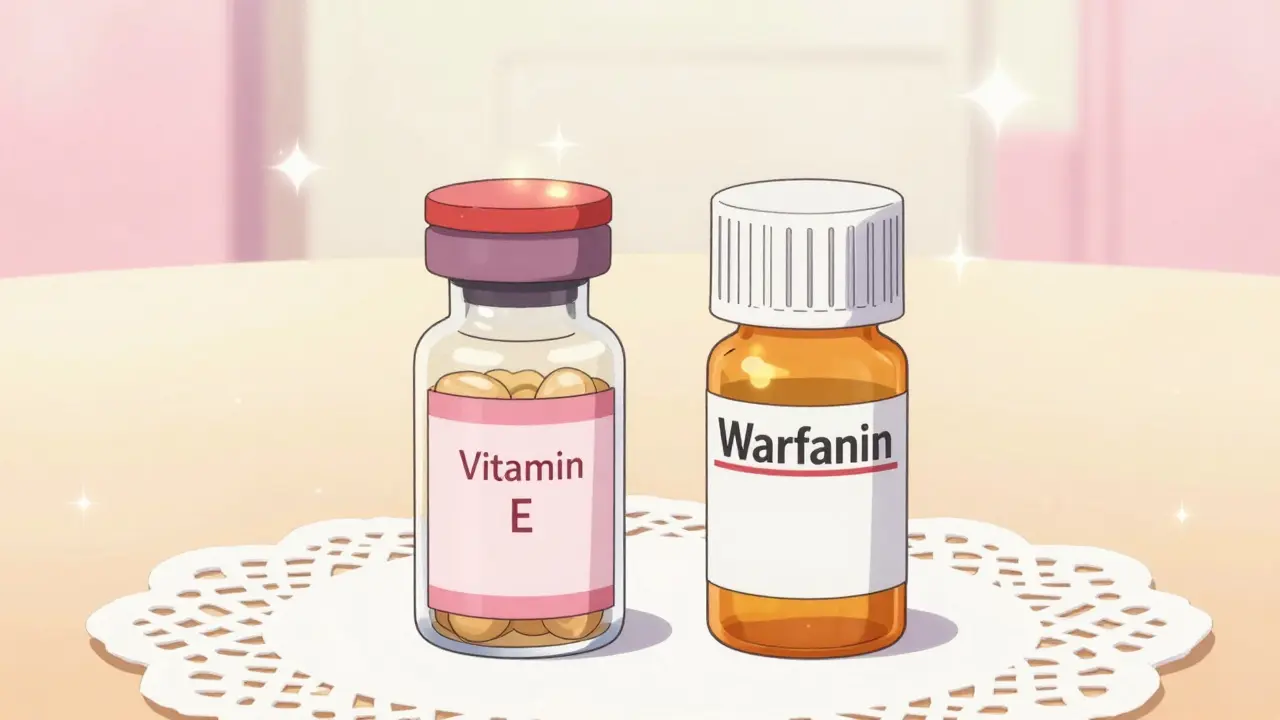
Vitamin E & Warfarin Risk Evaluator
Critical Warning
The "Silent" Risk: Your INR test may appear normal even if you are at high risk for bleeding. Vitamin E affects platelets differently than Warfarin affects clotting factors.
Immediate Actions
- Consult your doctor before changing dosage.
- Watch for unexplained bruising or nosebleeds.
- Request more frequent INR monitoring.
Taking a simple antioxidant supplement might seem harmless, but when you're on a blood thinner, it can turn into a serious medical gamble. If you use Warfarin is a vitamin K antagonist anticoagulant used to prevent blood clots in people with atrial fibrillation or mechanical heart valves, adding high doses of Vitamin E to your routine can either do nothing or significantly increase your risk of a dangerous bleed. The scary part? You might feel perfectly fine for weeks before a sudden, internal hemorrhage occurs.
| Risk Factor | Observation | Action Recommended |
|---|---|---|
| Dosage Threshold | Risks increase significantly above 400 IU daily | Keep intake below 400 IU or avoid entirely |
| Onset of Effect | Bleeding may not appear until week 4 | Don't assume "it's safe" after just a few days |
| Primary Danger | Enhanced antiplatelet activity | Frequent INR monitoring if supplementing |
The Science Behind the Interaction
To understand why this happens, we have to look at how blood clots. Warfarin works by blocking vitamin K, which the body needs to create clotting factors. Enter Vitamin E is a fat-soluble antioxidant, specifically alpha-tocopherol, that possesses mild antiplatelet properties. When you take both, you're essentially hitting the clotting process from two different angles: Warfarin stops the "glue" from forming, and Vitamin E makes the platelets (the "bricks") less likely to stick together.
This cumulative effect can lead to a state of enhanced anticoagulation. While some early studies, like a 1996 trial from the University of California, Davis, suggested that Vitamin E doesn't change the INR is the International Normalized Ratio, a standardized measurement of how long it takes blood to clot, more recent data tells a different story. The problem is that Vitamin E can increase bleeding risk without necessarily moving the INR needle. This means your blood test might look "perfect," yet you could still be at a high risk for a hemorrhagic stroke or internal bleeding because your platelets aren't functioning correctly.
The 400 IU Threshold: Where Safety Ends
Not all doses of Vitamin E are created equal. Most clinical guidelines, including those from the University of California San Diego, pinpoint 400 IU as the critical tipping point. When you stay below this limit, the interaction is generally mild or non-existent. However, once you cross into high-dose territory (800 IU or 1,200 IU), the risk profile shifts dramatically.
Consider a real-world scenario: a patient takes 800 IU of Vitamin E daily for three weeks with no issues. On the fourth week, they suddenly experience unexplained bruising or a nosebleed that won't stop. This delayed reaction is a documented phenomenon. Because the effects are cumulative, the danger doesn't always announce itself immediately, making it a "silent" risk for many patients.

What the Research Actually Says
There is a massive divide in the medical literature. On one side, you have short-term trials that show no additive effect. On the other, you have large-scale observational data. A study published in the Journal of the American Heart Association analyzed over 1,000 patients with non-valvular atrial fibrillation. They found that patients with higher serum levels of Vitamin E-specifically those above 5.56 μmol/mmol cholesterol-had the highest risk of major bleeding, including cerebral hemorrhages.
This suggests that the amount of Vitamin E actually present in your blood is a better predictor of danger than the dose listed on the bottle. Factors like your genetics (specifically polymorphisms in CYP2C9 and VKORC1 genes) can dictate how your body processes both Warfarin and supplements, meaning two people taking the same 400 IU pill could have wildly different reactions.
Managing the Risk in a Clinical Setting
If you or a loved one insist on taking Vitamin E while on Warfarin, you can't just "set it and forget it." Proper management requires a significant increase in medical oversight. According to professional practice analyses, this usually involves 3 to 5 additional clinic visits per year.
A safe management plan typically looks like this:
- Baseline Testing: Get a fresh INR reading before starting any new supplement.
- Intensive Monitoring: Weekly INR checks for the first month to catch any early spikes in anticoagulation.
- Maintenance: Biweekly monitoring if the supplement remains part of the regimen.
- Vigilance: Watching for "red flag" symptoms like blood in the stool, coffee-ground vomit, or severe bruising.
Other Supplements to Watch Out For
Vitamin E isn't the only culprit. Because it shares an antiplatelet mechanism with other natural products, it's often grouped with a "danger list" of supplements that can either increase bleeding or interfere with Warfarin's efficacy. If you're reaching for these, you're playing with the same risks:
- Fish Oil (Omega-3): High doses can thin the blood similarly to Vitamin E.
- Garlic and Ginger: Both have natural anti-clotting properties that can augment Warfarin.
- Ginkgo Biloba: Known to inhibit platelet aggregation.
- Turmeric: Contains curcumin, which may enhance the anticoagulant effect.
The Regulatory Gap and Your Safety
One of the biggest problems is how supplements are regulated. In the US, the Dietary Supplement Health and Education Act of 1994 means the FDA doesn't regulate Vitamin E with the same rigor as a prescription drug. This means the actual concentration of alpha-tocopherol in your supplement might vary from what's on the label, adding another layer of unpredictability to your blood clotting levels.
Because of this, the American Heart Association has explicitly warned that high-dose Vitamin E (≥400 IU/day) can increase the risk of hemorrhagic stroke. When the stakes are that high, the potential "antioxidant benefits" of a supplement rarely outweigh the risk of a brain bleed.
Can I take a low dose of Vitamin E with Warfarin?
Generally, doses below 400 IU daily are considered lower risk, but you must still consult your doctor. Even low doses can have varying effects based on your individual genetics and overall health.
Will my INR test show if Vitamin E is making my blood too thin?
Not necessarily. Vitamin E can increase bleeding risk through an antiplatelet effect, which doesn't always change the INR value. You could have a "normal" INR but still be at a higher risk of bleeding.
What are the signs of an interaction between Vitamin E and Warfarin?
Watch for unexplained bruising, frequent nosebleeds, bleeding gums, or blood in your urine or stool. If you notice any of these, contact your healthcare provider immediately.
How long does it take for Vitamin E to affect Warfarin?
While some effects may be immediate, some clinical reports show that abnormal bleeding may not become apparent until the fourth week of concurrent use.
Should I stop taking Vitamin E immediately?
Do not make sudden changes to your medications or supplements without talking to your doctor. Stopping a supplement abruptly can sometimes cause other shifts in your health; a supervised taper or discontinuation is safest.






8 Comments
Robin Walton
April 12, 2026 AT 15:26This is really important info. It's so easy to assume that natural supplements are always safe, but it's scary how they can interact with prescription meds. I hope everyone checks their labels and talks to their doctors!
danny Gaming
April 12, 2026 AT 18:12typical fda garbage letn them sell u junk then surprise u bleed out lol typical us gov mess up everything while the rest of the world actually monitors stuff properly. its all a scam to make u go to the clinic 5 more times a year just to pay more money to the docs
Danny Wilks
April 12, 2026 AT 23:53It is quite fascinating, in a somber sort of way, how the pharmacological mechanisms of these substances can overlap in such a precise yet unpredictable manner, especially when one considers the latent period of four weeks before symptoms manifest, which suggests that our biological systems often mask danger until it reaches a critical threshold of failure.
Julie Bella
April 13, 2026 AT 09:00I cant beleive some people just ignore these warnings!! 😱 It is literally your responsibilty to your family to not be reckless with your health. If you're taking 800 IU you're basically asking for a trip to the ER and that is just selfish behavior tbh!! 🙄
Rakesh Tiwari
April 15, 2026 AT 07:12Yes, because ignoring medical guidelines is such a brilliant life strategy. I'm sure the 'natural' enthusiasts feel very enlightened while their blood refuses to clot. Absolutely peak wisdom.
Ryan Hogg
April 17, 2026 AT 05:38I've been spiraling since I read this. I actually take a supplement and now I can't stop thinking about a silent bleed happening inside me right now. The way this is written just makes me feel like a ticking time bomb. I can't even breathe properly thinking about the 'coffee-ground vomit' part. It's just too much. I feel like I'm losing my mind over this.
emmanuel okafor
April 19, 2026 AT 03:27life is a balance of many things and we just need to be careful with what we put in our body so we can live in peace with others
kalpana Nepal
April 19, 2026 AT 23:29Health is the only true wealth and if we do not respect the body we are just puppets of nature. My country teaches us that balance is everything and these chemicals only confuse the soul. We must trust the simple way of living over these complex pills that only bring fear.