
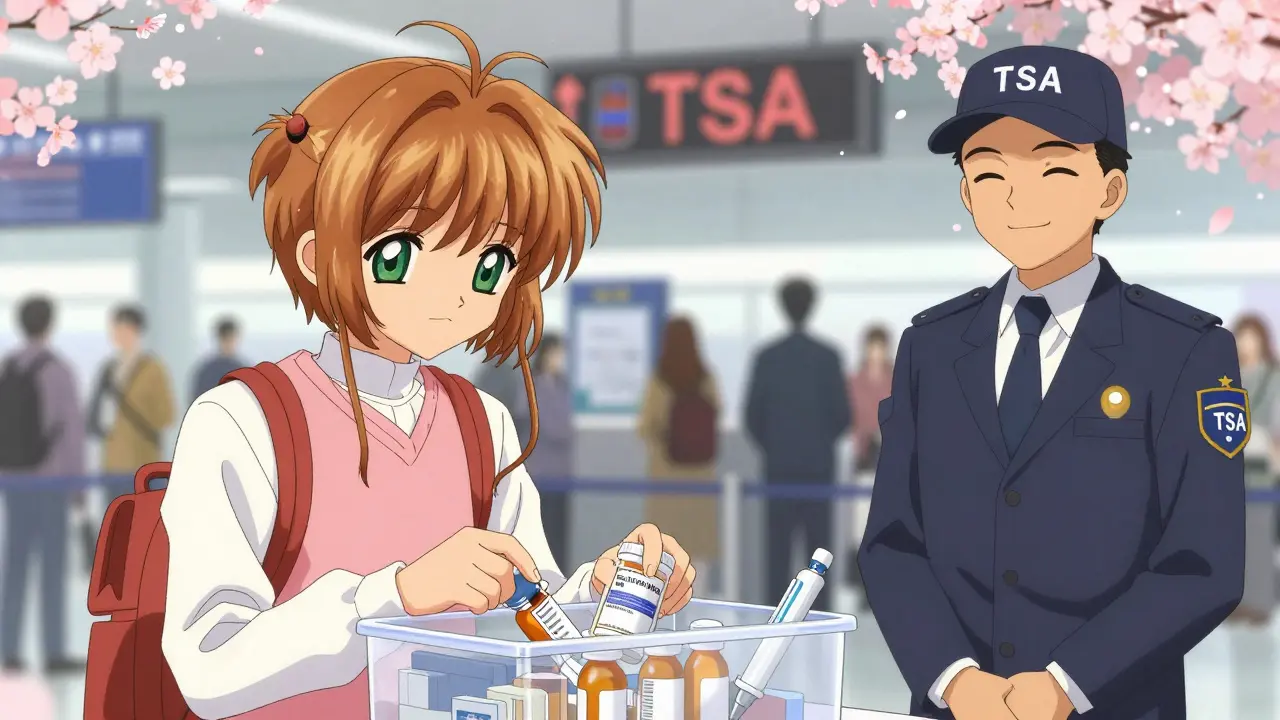
Planning a flight and wondering how to bring your prescription meds through airport security? You're not alone. Every day, millions of travelers carry medications - from insulin pens to heart pills - and the rules can feel confusing. The good news? The TSA lets you bring prescription medications in any quantity, no matter if they're pills, liquids, or creams. But there are key steps you must follow to avoid delays, confusion, or even confiscation.
Prescription Medications Don't Count Against the 3-1-1 Rule
The standard TSA liquid rule - 3.4 ounces (100 ml) per container, all in one clear quart-sized bag - doesn't apply to your prescription meds. That means you can bring a full bottle of liquid painkiller, a tube of steroid cream, or a vial of insulin without squeezing it into your liquids bag. This exemption covers everything approved by the FDA: pills, syrups, injections, eye drops, nasal sprays, and topical treatments like hydrocortisone or Neosporin.
But here's the catch: you still have to declare these items at the security checkpoint. Don't just toss them into your bin with your shoes and laptop. Tell the TSA officer you're carrying medication. They'll likely ask you to remove them from your carry-on bag so they can visually inspect them. It's quick - usually under a minute - but skipping this step can cause a delay or even a secondary screening.
Original Packaging? Not Required - But Highly Recommended
TSA doesn't legally require your meds to be in the original pharmacy bottle. United Airlines, for example, clearly states: 'You can bring any medication with you in your carry-on bag.' But here's the reality: if your pills are in a plastic bag with no label, you're asking for trouble.
Over 78% of medication-related delays at U.S. airports in 2023 happened because the name on the pill bottle didn't match the passenger's ID. Even a missing middle initial or a typo in the dosage can trigger a security hold. A 2024 CDC report found that 34% of international border incidents involving medication were linked to unlabeled containers. Bottom line: keep your meds in their original bottles. If you must repack them for space, bring a copy of your prescription or a doctor's note.
Never Pack Medications in Checked Luggage
It sounds simple, but people still do it. Checked bags get lost. They get crushed. They get left on tarmacs in freezing weather. And if your life-saving medication is in there? You're at serious risk.
United Airlines' policy is clear: never put medication in checked baggage. That advice is now standard across 92% of major U.S. carriers after a 2022 incident where a passenger's insulin pump was destroyed in a lost bag. The CDC and the International Society of Travel Medicine both warn that storing meds in checked luggage increases the chance of loss, theft, or temperature damage. Always keep them in your carry-on - even if you won't need them during the flight.
What About CBD Oil and Marijuana?
This is where things get tricky. Even if your CBD oil says '0.3% THC or less' and you have a doctor's note, TSA still can and will confiscate it. Why? Because under federal law, any cannabis product - including CBD - is illegal unless it's FDA-approved (like Epidiolex). And TSA enforces federal law, not state laws.
Over 14,000 CBD products were confiscated by TSA in 2023 alone - even though they met the legal THC limit. Reddit threads are full of travelers who thought they were safe because their label said 'hemp-derived' or 'legal in California.' It doesn't matter. If you're flying into, out of, or through the U.S., federal rules apply. The same goes for marijuana in any form. Even if you're flying from Colorado to Oregon, you can't bring it on the plane.
International Travel? Check Your Destination First
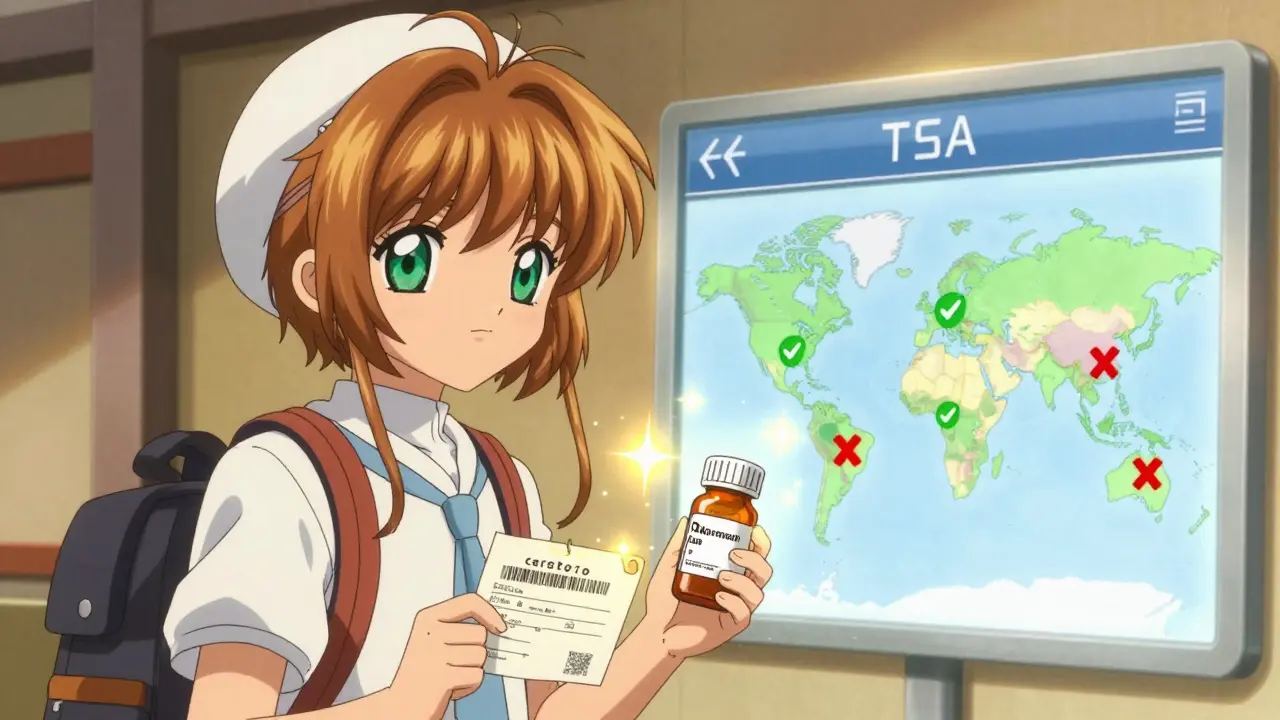
What's legal in the U.S. might be a crime abroad. Take Adderall, Xanax, or even certain painkillers. These are Schedule II-V controlled substances in the U.S. - and completely banned in countries like Japan, South Korea, the UAE, and Singapore. In some places, just carrying them can lead to arrest.
Dr. Jane Chen from Johns Hopkins says this is the most common issue she sees in her travel clinic. Before you leave, check the regulations of your destination country. The CDC's Yellow Book and the International Association for Medical Assistance to Travellers (IAMAT) database - now integrated into the TSA app - can help. If you're unsure, contact the embassy of your destination country. Bring a doctor's letter explaining why you need the medication, and carry no more than a 90-day supply unless you have official documentation for longer stays.
Special Cases: Insulin Pumps, CGMs, and Frozen Gel Packs
If you use an insulin pump, continuous glucose monitor (CGM), or need frozen gel packs for temperature-sensitive meds, you're covered - but you need to plan ahead.
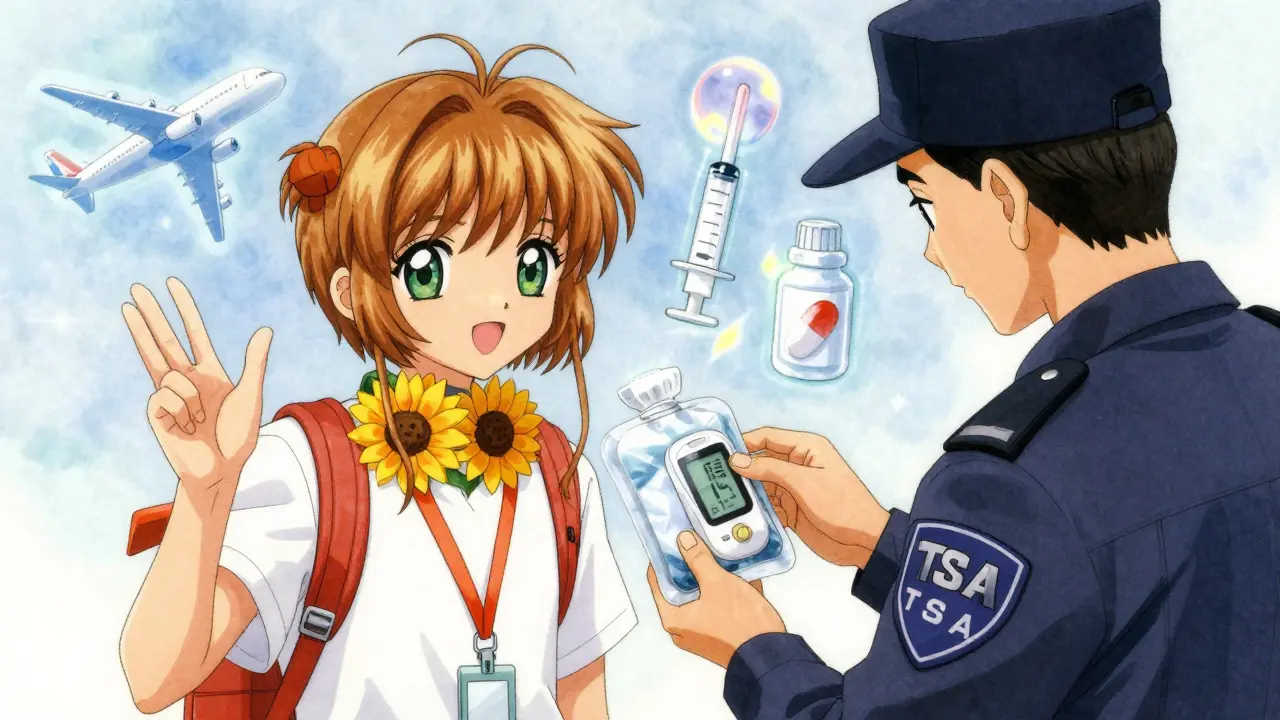
TSA allows frozen gel packs as long as they're completely solid. You can pack them with your meds. Just be ready to show them to the officer. For devices like insulin pumps or CGMs, you have the right to request a visual inspection instead of X-ray scanning. You can also ask for a private screening. If you need special help - like a wheelchair or extra time - TSA's Sunflower Lanyard program (now active in 45 U.S. airports) lets you discreetly signal for assistance.
For complex equipment, contact TSA's Cares program at 1-855-787-2227 at least 72 hours before your flight. They'll assign a specialist to guide you through screening.
TSA PreCheck and Faster Screening
If you're a TSA PreCheck member (over 28 million are), you're in luck. Since October 2024, PreCheck travelers no longer need to remove medications from their carry-on bags. You can leave your pills, liquids, and devices in your bag during screening. This cuts down on delays and makes the process smoother. If you travel often, it's worth the $78 fee - especially if you rely on daily meds.
What to Pack Before Your Flight
- Keep all medications in original labeled containers
- Bring a copy of your prescription or doctor's note
- Carry no more than a 90-day supply unless you have approval
- Put everything in your carry-on - never checked luggage
- Declare all medications to TSA officers at the checkpoint
- For liquids: remove them from your bag and place them in a bin
- For CBD oil: leave it at home
- For international trips: verify legality in your destination country
Common Mistakes and How to Avoid Them
- Mistake: Decanting pills into unlabeled containers. Solution: Use pill organizers only if you keep the original bottles with you.
- Mistake: Assuming state laws override federal rules. Solution: Federal law governs airports. No exceptions.
- Mistake: Not matching ID to prescription name. Solution: If your ID says 'J. Smith' and your script says 'John Smith,' bring a note explaining the discrepancy.
- Mistake: Forgetting international restrictions. Solution: Use the TSA app's IAMAT database to check your destination's rules.
Can I bring liquid prescription meds in any amount on a plane?
Yes. The TSA allows unlimited quantities of prescription liquids, including insulin, syrups, and eye drops. They are exempt from the 3-1-1 liquid rule. But you must declare them at security and remove them from your carry-on for inspection.
Do my meds need to be in original bottles?
TSA doesn't require original bottles, but it's strongly recommended. Over 78% of delays in 2023 happened because names on meds didn't match IDs. Original containers with your name, pharmacy label, and dosage info make screening faster and reduce the chance of confiscation.
Can I bring CBD oil on a plane?
No, not if you're flying in, out of, or through the U.S. Even if it's labeled as '0.3% THC or less,' federal law still classifies it as illegal. TSA has confiscated over 14,000 CBD products in 2023 despite compliant labeling. Leave it at home.
What if I need to carry controlled substances like Adderall or Xanax?
You can carry them in the U.S., but only in your carry-on with original packaging and a prescription. For international travel, check your destination country's rules - many ban these drugs outright. Bring a doctor's letter, and never exceed a 90-day supply without official approval.
Can I bring frozen gel packs for my insulin?
Yes. Frozen gel packs are allowed if they're completely solid. You can pack them with your insulin. Just be ready to show them to the TSA officer at the checkpoint. They may inspect them visually, but they won't be confiscated.
Is it okay to put meds in checked luggage if I'm not using them during the flight?
No. Never put medication in checked luggage. Bags can be lost, delayed, or damaged. Airlines like United and the CDC strongly advise keeping all meds in your carry-on - even if you don't plan to use them on the flight.
If you're traveling with complex medical needs, the TSA app now includes a tool that checks medication legality in over 212 countries. Use it. It’s free. It’s updated daily. And it could save you from a nightmare at customs. Bottom line: know the rules, prepare ahead, and always keep your meds with you.





14 Comments
John Cena
February 20, 2026 AT 09:42I've been flying with my diabetes meds for years, and honestly? The TSA agents I've dealt with have been way more chill than expected. Just tell them what you've got, hand it over, and they'll give you a quick once-over. No drama. No hassle. Keep it simple.
Pro tip: I put my insulin in a small insulated pouch with a cold pack - they never question it. Just say 'medical device' and move on.
aine power
February 21, 2026 AT 14:18Original packaging. Always.
Irish Council
February 22, 2026 AT 17:37They say 'federal law' but what they really mean is 'we don't want to deal with state law conflicts' - so they just ban everything that's not perfectly labeled
And don't get me started on CBD - if it's hemp-derived and under 0.3% THC, why is it illegal federally? That's not law - that's bureaucracy playing catch-up
Also - why do they let you carry 100ml of hand sanitizer but not 50ml of CBD oil? Logic? There is none
Greg Scott
February 23, 2026 AT 06:23I used to repack my pills into a little container for space - until I got pulled aside at O'Hare. Took 20 minutes. Just because my name on the bottle was 'J. Smith' and my ID said 'Jonathan Smith'.
Now I carry the original bottle, even if it's bulky. Worth it. Don't be like me.
Ashley Paashuis
February 25, 2026 AT 06:20Thank you for this comprehensive guide. As someone who manages multiple chronic conditions, I appreciate the clarity on international restrictions and the mention of the TSA app's IAMAT integration.
One thing I'd add: if you're traveling with a caregiver or companion, have them carry a copy of your prescription too. In the rare event you're separated from your bag, having a backup can prevent serious delays.
Oana Iordachescu
February 26, 2026 AT 14:14I don't trust the TSA. Not one bit.
They confiscate CBD because 'federal law' - but they let you bring 300ml of hand sanitizer that's 60% alcohol? That's a controlled substance too, under federal code.
And why do they require original bottles? Because they're afraid someone might be smuggling? Or because they're lazy and don't want to verify anything?
It's not safety. It's control. And they know it. 😒
Davis teo
February 26, 2026 AT 20:38I once had my insulin pump confiscated because I didn't say 'this is a medical device' loud enough. I screamed. I cried. I begged. The officer just shrugged and said 'policy'.
Turns out? The next guy had the same pump. He said 'it's a CGM' and they waved him through.
It's not about the meds. It's about how you say it. I'm never flying again. #Trauma
Michaela Jorstad
February 27, 2026 AT 23:33I always carry my prescription in a small, clear plastic sleeve - right next to my ID. It’s saved me twice. Once at LAX, when the officer asked for proof - I handed it over, and he said, 'You’re lucky you’re prepared.'
Also: if you have a doctor’s note, make sure it’s on letterhead. A printed email doesn’t cut it. I learned that the hard way in Denver.
madison winter
February 28, 2026 AT 21:32I read all of this. Then I just put my meds in my carry-on. Didn’t say anything. Walked right through. Never got questioned.
Maybe the system’s broken. Or maybe everyone’s just overcomplicating it.
I’m not gonna stress about it anymore.
Marie Crick
March 1, 2026 AT 04:59CBD is illegal. Period. End of story. If you’re using it for 'anxiety' or 'sleep' - you’re self-medicating. And that’s not what the law allows. Stop pretending it’s okay.
Maddi Barnes
March 3, 2026 AT 03:17I flew from NYC to Tokyo last month with my antidepressants. Knew Japan bans most SSRIs. So I called the embassy. They said: 'Bring your prescription, a letter from your doctor, and no more than a 30-day supply.'
Did all three. Got through without a single question. I even got a 'thank you for being prepared' from the customs officer.
Point is: if you do your homework, airports aren’t the enemy. Bureaucracy is - but you can outsmart it. 🌏✈️
Benjamin Fox
March 3, 2026 AT 15:19TSA is just a government tax on being sick. You gotta prove you're not a drug dealer just to get your heart pills on a plane?
Meanwhile, people bring guns on planes and they get a high five. But if you have insulin? You get a search.
America is broken. 🇺🇸
Laura B
March 4, 2026 AT 02:53I’m a nurse and I fly every month. I always keep my meds in original bottles - even if I have to carry three of them. One for each week.
And I always say 'I have prescription medication' as I walk up. It’s not about being paranoid - it’s about being smart. You want to get to your destination, right?
Also - if you’re using a pill organizer, keep the original bottles in your carry-on. Just in case.
Amrit N
March 4, 2026 AT 17:51i was flying from mumbai to chicago last year with my thyroid med. i had the bottle but the label was in hindi. the officer looked at it for like 5 mins then just waved me through. he said 'indian meds are always legit' 😅
so maybe they dont always check? maybe its luck? idk. but i didnt get in trouble.