

Thyroid Eye Disease (TED) isn’t just about dry eyes or puffy eyelids. It’s an autoimmune condition that attacks the tissue behind your eyes, causing swelling, pain, and sometimes vision loss. If you have Graves’ disease, you’re at higher risk-up to half of those patients develop TED. But it can also show up in people with normal or low thyroid function. This isn’t rare. About 16 out of every 100,000 people get it each year, and women are far more likely to be affected than men. What makes TED dangerous isn’t just how it looks-it’s how fast it can damage your vision if left untreated.
What Are the Real Symptoms of Thyroid Eye Disease?
Most people notice something’s off before they get a diagnosis. A gritty, burning feeling in the eyes? That’s common-78% of patients report it. Light sensitivity, redness, and excessive tearing follow close behind. But the signs that signal something serious are harder to ignore: eyes that bulge forward (proptosis), double vision when looking side to side, or pain when moving your eyes. These aren’t just annoyances-they’re warning signs of inflammation behind the eyeball.
It usually hits both eyes at once-89% of cases are bilateral. But even if only one eye is affected, don’t wait. The Clinical Activity Score (CAS) is used by doctors to measure how active the disease is. A score of 3 or higher means inflammation is still ramping up. That’s the window when treatment works best. Imaging like CT or MRI scans show which eye muscles are swollen. The bottom muscle (inferior rectus) is most often involved, followed by the inner muscle (medial rectus). When these muscles swell, they push the eye forward and restrict movement, causing double vision.
Why Steroids Are Still a First-Line Treatment
For moderate-to-severe TED, steroids are the go-to starting point. But not all steroids are the same. Oral prednisone is cheaper and easier to take, but it comes with heavy side effects: weight gain, high blood sugar, and bone thinning. About one in four patients relapse after stopping it. That’s why most specialists now prefer intravenous (IV) methylprednisolone.
The standard IV protocol? 500 mg once a week for six weeks, then 250 mg weekly for another six weeks. This approach works for 60-70% of people, reducing swelling and double vision significantly. The European Group on Graves’ Orbitopathy (EUGOGO) recommends capping the total dose at 4.5-5.0 grams to avoid liver damage, which happens in about 2.3% of patients on higher doses. Timing matters too. Starting IV steroids within two weeks of symptom onset gives you a 65% response rate. Wait eight weeks, and that drops to 42%.
For mild cases, artificial tears and selenium supplements help. Selenium-200 mcg daily-has been shown to improve quality of life slightly, though it doesn’t reverse bulging eyes. It’s not a cure, but for someone with just redness and grittiness, it can make a real difference. Prisms in glasses fix double vision for many, but only if the muscle misalignment is under 15 prism diopters. Beyond that, surgery is the next step.
Biologics: The Game-Changer in TED Treatment
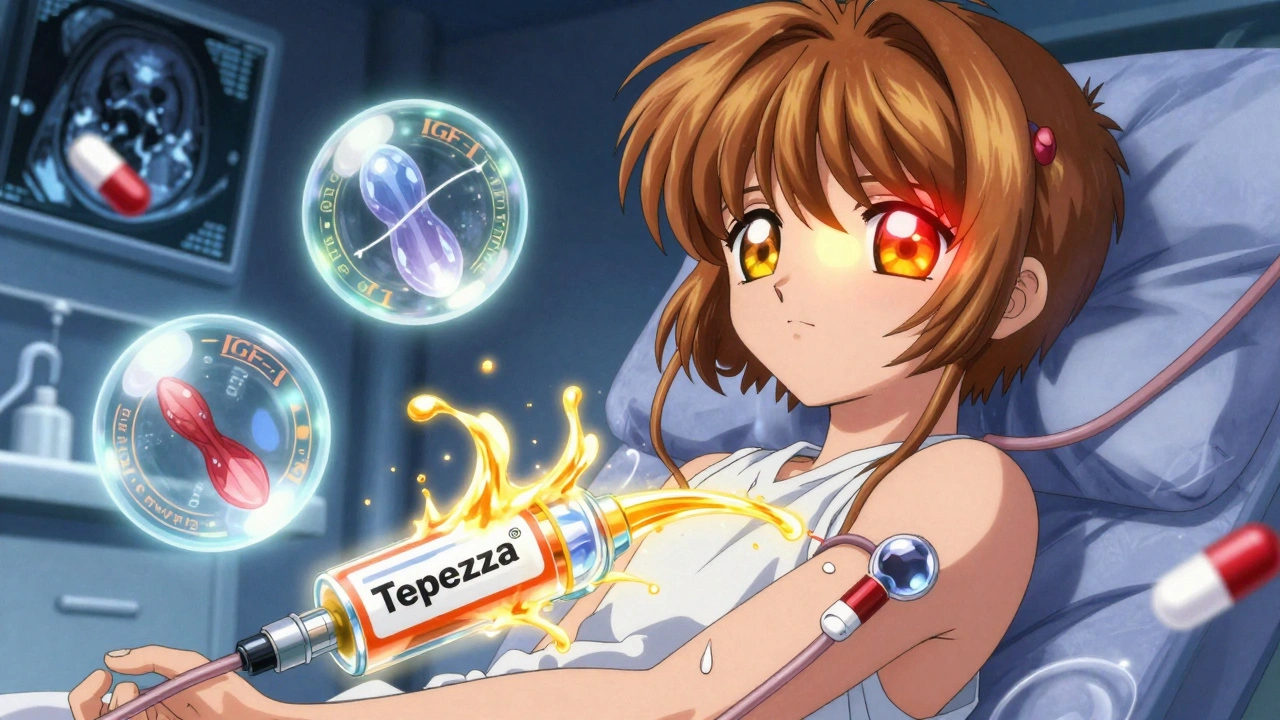
In 2020, everything changed with the FDA approval of teprotumumab (Tepezza®). This isn’t just another steroid. It’s the first drug designed to target the root cause of TED. It blocks the IGF-1 receptor, which is overactive in the fat and muscle tissue behind the eyes. In the OPTIC clinical trial, 71% of patients saw their eyes pull back by at least 2 millimeters-compared to only 20% on placebo. Double vision improved in 59% of those on teprotumumab versus 26% on placebo. That’s not just symptom relief-it’s structural change.
The treatment involves eight infusions over 24 weeks. Each dose starts at 10 mg/kg, then increases to 20 mg/kg every three weeks. The cost? Around $360,000 for the full course in the U.S. Insurance approvals take an average of 47 days, and 42% of patients get denied at first. Medicaid patients face even steeper barriers-67% report access issues versus 28% of those with private insurance.
Side effects are real but usually manageable. Muscle spasms happen in 24% of patients. Hearing changes and high blood sugar occur in 11% and 8% respectively. The FDA added a boxed warning for these risks in 2021. Still, patient satisfaction is higher than with steroids: 74% report being satisfied with biologics versus 58% with steroids, mainly because there’s less weight gain and no risk of prediabetes.
What’s Coming Next in TED Treatment?
Tepezza isn’t the end of the story. Satralizumab (Enspryng®), an anti-IL-6 drug, was approved in 2023 as a subcutaneous option for steroid-resistant cases. Early data shows a 54% response rate for eye bulging. Researchers are also testing combinations-like teprotumumab plus selenium-and early results suggest even better outcomes. The TOPAZ trial showed 82% improvement at 24 weeks when both were used together.
Cost is the biggest hurdle. Amgen, which bought Horizon Therapeutics for $28 billion in 2023, is working on a biosimilar version of teprotumumab. It could cut the price by 30-40% by 2025. Meanwhile, genetic research is moving fast. Scientists at Cardiff University are hunting for biomarkers that predict who will get TED-and who will respond to which drug. Within five years, we may be able to test someone’s DNA and know exactly what treatment to start.
When Surgery Becomes Necessary
Not everyone responds to medication. About 35% of patients still end up needing surgery, even after steroids or biologics. That’s because TED doesn’t just cause swelling-it causes scarring. Once the inflammation calms down (usually after 1-3 years), the tissue hardens. That’s when orbital decompression surgery helps. It removes bone from behind the eye socket to give the eye more room. On average, it reduces bulging by 2-5 millimeters.
But surgery isn’t risk-free. About 15% of patients develop new or worse double vision afterward. Sinus infections happen in 8%, and vision loss occurs in 0.5%. That’s why surgeons wait until the disease is inactive. No one wants to operate while the eye is still swelling. Strabismus surgery to fix eye alignment comes next, often months later. And eyelid surgery? That’s usually last, to correct retraction and make the eyes look more natural.
What You Can Do Right Now
If you’ve been diagnosed with TED, act fast. The first six months are critical. Quit smoking-smokers have nearly eight times the risk of severe TED. Get your thyroid levels checked regularly. If your TRAb antibody level is above 15 IU/L, your risk of developing TED is almost five times higher. Ask your endocrinologist for a referral to an ophthalmologist who specializes in TED. Don’t wait for symptoms to get worse.
For mild symptoms: use preservative-free artificial tears. Take selenium if your doctor recommends it. Wear sunglasses outdoors. Sleep with your head elevated to reduce swelling. For moderate-to-severe symptoms: insist on a CAS score and imaging. Push for IV steroids or a referral to a biologic specialist. If you’re told you’re not a candidate for teprotumumab, ask why. Insurance denials happen-but appeals often succeed with proper documentation.
TED changes how you see the world-literally. But it doesn’t have to define your life. With the right treatment at the right time, most people regain their vision, their comfort, and their confidence.
Can thyroid eye disease go away on its own?
Yes, but only after the active phase ends, which can take 1 to 3 years. During that time, inflammation can cause permanent damage to eye muscles and vision. Waiting for it to "go away" without treatment increases the risk of needing surgery later. Early intervention with steroids or biologics can stop progression and reduce long-term complications.
Are steroids the only treatment for thyroid eye disease?
No. While IV steroids are still a first-line option for moderate-to-severe cases, teprotumumab (Tepezza®) is now the preferred treatment for many patients because it targets the disease at its source. Other biologics like satralizumab are also emerging. For mild cases, selenium and artificial tears may be enough. Surgery is reserved for the inactive phase when structural changes remain.
How long does it take for teprotumumab to work?
Most patients start noticing improvements in eye bulging and double vision within 6 to 10 weeks. The full effect is usually seen after all eight infusions, which take about six months. In clinical trials, patients saw an average reduction of 2-3 millimeters in eye protrusion by the end of treatment.
Is thyroid eye disease the same as Graves’ disease?
No. Graves’ disease is an autoimmune disorder that causes the thyroid to overproduce hormones. Thyroid Eye Disease (TED) is a separate autoimmune condition that affects the tissue behind the eyes. About 50% of people with Graves’ develop TED, but TED can also occur in people with normal or underactive thyroid function. They’re related but distinct.
Can I still get TED if my thyroid levels are normal?
Yes. About 10-15% of TED cases occur in people with euthyroid (normal thyroid) function. The key driver isn’t thyroid hormone levels-it’s the presence of TSH receptor antibodies (TRAb) that attack orbital tissue. That’s why testing for TRAb is critical, even if your thyroid looks fine.
What’s the best way to prevent TED if I have Graves’ disease?
Quit smoking-this is the single biggest modifiable risk factor. If you’re planning radioactive iodine treatment for Graves’, talk to your doctor about taking oral steroids at the same time to reduce TED risk. Monitor your TRAb levels regularly; levels above 15 IU/L mean you’re at high risk. Early detection and intervention can prevent severe eye damage.
What to Watch Out For
Don’t ignore sudden vision changes. If you start seeing double, feel pressure behind your eyes, or notice your vision becoming blurry or dim, seek help immediately. These could be signs of optic nerve compression-a medical emergency. Also, be aware that stress and smoking can trigger flare-ups. Even after treatment, TED can relapse. Regular follow-ups with both an endocrinologist and an ophthalmologist are essential.
TED is no longer a condition you just live with. With better understanding, better drugs, and better access, most people can avoid long-term damage. The key is knowing the signs, acting early, and demanding the right care.



15 Comments
Larry Lieberman
December 9, 2025 AT 13:30This is wild. I had no idea TED could hit people with normal thyroid levels. 🤯 Just got diagnosed last month and my endo said my TSH was fine. Now I'm googling TRAb like my life depends on it.
Sabrina Thurn
December 11, 2025 AT 04:31The Clinical Activity Score (CAS) is underutilized in primary care. Most patients get dismissed as 'dry eyes' until they're in the ER with optic nerve compression. I'm an ophthalmology resident and we push for CAS + orbital imaging at first sign of proptosis. Early intervention = avoid surgery. This post nails it.
Courtney Black
December 11, 2025 AT 14:52So we're telling people to spend $360k on a drug that causes muscle spasms and hearing changes just to get their eyes back a few millimeters? And the insurance denials are worse than trying to get a prescription for Adderall in rural Kansas? I mean... I get it's science, but this feels like pharmaceutical theater. Are we really saving vision or just selling hope?
Asset Finance Komrade
December 12, 2025 AT 00:29While the clinical data on teprotumumab is compelling, one must consider the broader geopolitical context of pharmaceutical monopolies. The acquisition of Horizon Therapeutics by Amgen for $28 billion suggests a market-driven agenda rather than a patient-centric one. The biosimilar projection of 30-40% cost reduction by 2025 remains speculative without regulatory intervention.
Raja Herbal
December 12, 2025 AT 02:08Americans spend $360k on eye medicine but can't afford insulin. Meanwhile, my cousin in Mumbai gets selenium supplements and a prayer. Guess which one’s still walking? 😌
Ruth Witte
December 12, 2025 AT 20:31YOU ARE NOT ALONE. I was told it was 'just allergies' for 18 months. Then I found a TED specialist. Tepezza changed my life. I can see my kids' faces again. 💪👁️❤️
Iris Carmen
December 13, 2025 AT 21:55i legit thought my eyes were just tired from scrolling. then i looked in the mirror and was like... wait why does my face look like a frog? 😅
Tiffany Sowby
December 15, 2025 AT 12:25So the rich get miracle drugs and the rest of us get 'try selenium' and 'sleep with your head up'? Typical. You want to cure disease? Fix the system. Not just the eyeballs.
Delaine Kiara
December 16, 2025 AT 06:40I've had TED for 7 years. I've had 3 surgeries. I've been denied Tepezza twice. I've cried in waiting rooms. And now I'm watching some influencer post 'Tepezza changed my life' like it's a yoga retreat. You don't get it. This isn't a TikTok trend. It's a slow-motion nightmare.
Andrea Beilstein
December 17, 2025 AT 15:27The body is a landscape of invisible wars. Behind every bulging eye is a silent rebellion of antibodies, a betrayal from within. We treat symptoms like they're surface scratches, but the wound is in the soul of the immune system. We need not just drugs, but a new metaphysics of healing - one that doesn't reduce the human to a set of receptors to be blocked.
Katherine Rodgers
December 18, 2025 AT 19:39so like... 71% of people get their eyes pulled back 2mm... but the drug costs more than a tesla? and you're supposed to be grateful? wow. what a time to be alive. #capitalismpain
Lauren Dare
December 20, 2025 AT 18:09The CAS score is clinically validated, but its implementation is fragmented. If you're not in a tertiary center, you're essentially playing Russian roulette with your vision. And the fact that Medicaid patients face 67% denial rates isn't a system flaw - it's a policy choice. We're prioritizing cost over consent.
Ronald Ezamaru
December 22, 2025 AT 16:09I work with a lot of patients who come in terrified after being told they need surgery. The truth is, most don't need it - if they catch it early. I wish more doctors would say: 'Get a CAS score. Get an MRI. Don't wait.' This post should be required reading for every endocrinology and ophthalmology resident.
Anna Roh
December 24, 2025 AT 12:43meh. i've seen this before. someone gets rich off a drug and everyone acts like it's a miracle. next thing you know, we're all taking 12 pills a day just to look normal.
Noah Raines
December 24, 2025 AT 13:11I'm a smoker. I have Graves'. I just got my TRAb test back - 22 IU/L. I'm quitting today. If you're reading this and you're smoking? Stop. It's not about willpower. It's about survival. 🚭👁️