

After losing 50 pounds, Sarah thought she’d finally beat her metabolism. She dropped from 210 to 160, ate clean, lifted weights, and tracked every calorie. But then the scale stopped moving. No matter how little she ate, the pounds wouldn’t budge. She tried cutting more, then fasting, then keto. Nothing worked. She wasn’t lazy. She wasn’t cheating. Her body had just adapted.
This isn’t rare. It’s biology. When you lose weight, your body doesn’t just adjust to a smaller frame-it fights back. That’s adaptive thermogenesis. It’s not a myth. It’s not a conspiracy. It’s your body’s ancient survival system kicking in, slowing your metabolism so you don’t starve. And it’s the main reason most people regain every pound they lost.
What Is Adaptive Thermogenesis?
Adaptive thermogenesis is when your body burns fewer calories than it should based on your new weight. Let’s say you lose 20 pounds. Your metabolism should drop by a certain amount because you’re lighter. But adaptive thermogenesis makes it drop even more-sometimes by hundreds of calories a day. That’s not because you lost muscle (though that helps). It’s because your body thinks you’re in danger of starvation.
This isn’t just theory. A 2016 study tracked participants from The Biggest Loser six years after their dramatic weight loss. Most had regained nearly all their weight. Why? Their metabolisms hadn’t bounced back. They were burning 500 fewer calories per day than expected for their size. That’s like eating a whole extra meal every day without gaining weight-except now, they were eating normally and gaining anyway.
It happens to everyone. Lean people. Obese people. Men. Women. Even after bariatric surgery, the body tries to pull you back to your old weight. The only exception? People who lose weight through surgery like gastric bypass-because the surgery changes how the gut talks to the brain, blunting this survival response. For everyone else, adaptive thermogenesis is real, measurable, and stubborn.
How Your Body Slows Down
Your metabolism isn’t just about how much you weigh. It’s about hormones, nerves, and even your brown fat. When you cut calories, your body responds in three big ways:
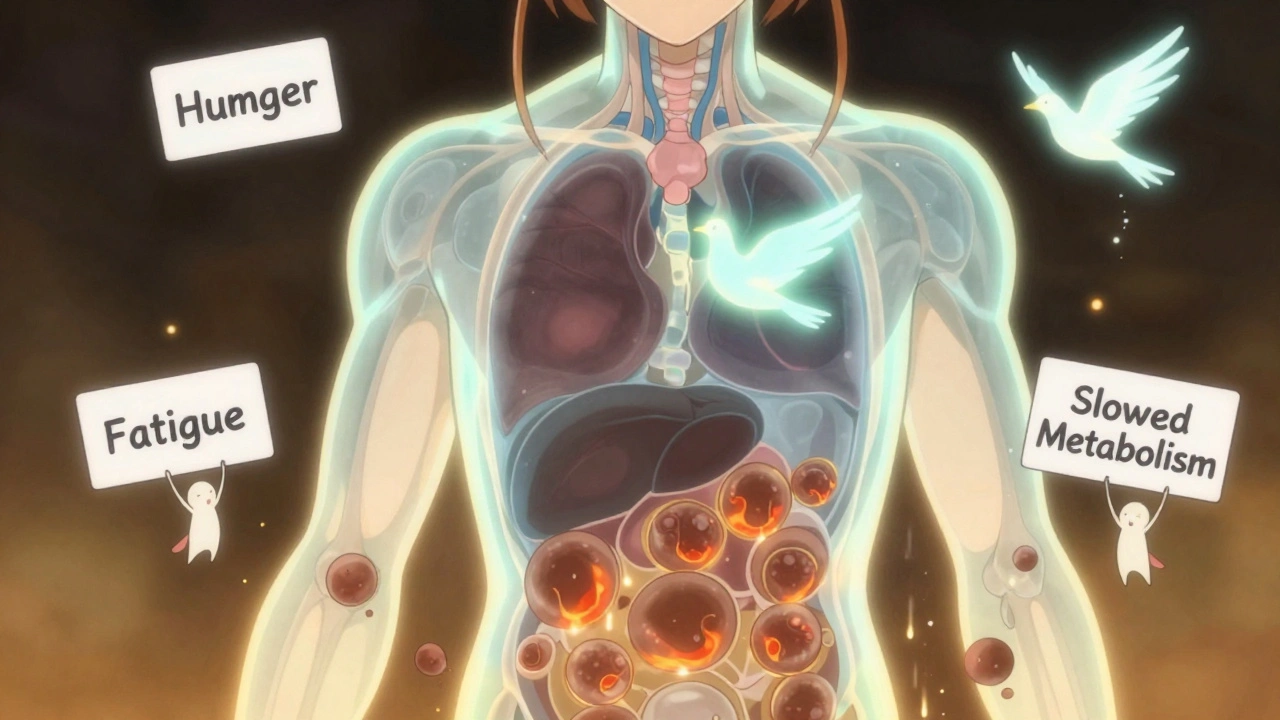
- Leptin drops. This is the hormone that tells your brain you’re full. When you lose fat, leptin plummets. Your brain thinks you’re starving. Hunger spikes. Energy crashes.
- Thyroid slows. Your thyroid gland reduces production of active thyroid hormones. That lowers your resting metabolic rate-the calories you burn just sitting there.
- Brown fat quiets down. Brown fat burns calories to make heat. After weight loss, it becomes less active. Research shows that even 25 grams of brown fat going from “on” to “off” can account for a big chunk of your lost metabolism.
One study found that after just one week of dieting, people burned an average of 178 fewer calories per day-not because they moved less, but because their bodies got more efficient. That’s like losing a free 1,250-calorie weekly buffer. No wonder people hit plateaus.
And it doesn’t go away fast. One study followed people for 44 weeks after weight loss. Their metabolisms stayed suppressed. Even after a year, they were still burning fewer calories than expected. This isn’t temporary. It’s long-term.
Why Reverse Dieting Isn’t Magic-But It Works
Reverse dieting is the opposite of dieting. Instead of cutting calories, you slowly add them back. The goal? Rebuild your metabolism without gaining fat.
Here’s how it works:
- After your weight loss phase, stop cutting calories.
- Gradually increase your daily intake by 50-100 calories every 1-2 weeks.
- Monitor your weight. If it stays stable or increases by less than 0.5 pounds per week, keep going.
- If you gain more than that, pause for a week, then try a smaller increase.
Why 50-100 calories? Because that’s the sweet spot. Too fast, and you gain fat. Too slow, and you waste months. Studies show that increasing calories too quickly-more than 150 per week-leads to regain. Too slow, and you never fully recover your metabolism.
It’s not about eating more to get fat. It’s about eating more to reset your body’s thermostat. Think of it like warming up a cold engine. You don’t floor the gas. You ease into it.
People who try reverse dieting report better energy, less hunger, better sleep, and improved mood. One survey of 1,200 dieters found 73% felt more energetic and 65% had less cravings after reverse dieting. That’s not just placebo. It’s your hormones coming back online.
What Actually Makes Reverse Dieting Work
Reverse dieting isn’t just about eating more. It’s about how you eat more.
- Protein is non-negotiable. Aim for 1.6-2.2 grams per kilogram of body weight. Protein protects muscle, keeps you full, and requires more energy to digest. If you’re 70 kg, that’s 112-154 grams of protein a day.
- Strength training is essential. Muscle burns more calories at rest than fat. A 2023 analysis showed that preserving muscle during weight loss cuts adaptive thermogenesis by 15%. Lift weights 2-3 times a week. Squats, deadlifts, push-ups-keep it simple.
- Don’t ignore sleep and stress. High cortisol from poor sleep or chronic stress makes your body hold onto fat and slows metabolism. Get 7-8 hours. Manage stress. It’s not optional.
Some people track their morning body temperature and resting heart rate. A drop of 5-10% in either can signal your metabolism is still suppressed. It’s not perfect, but it’s a useful tool.
And yes, it takes time. Most people need 3-6 months to reverse diet successfully. Rushing it defeats the purpose.
What Doesn’t Work
There are a lot of scams out there. “Metabolic reset” supplements. Juice cleanses. 3-day fasts. None of them fix adaptive thermogenesis.
Neither does extreme cardio. You can’t out-exercise a slowed metabolism. Running 10 miles a day after weight loss just makes you hungrier and more tired. It doesn’t fix the root problem.
And reverse dieting isn’t a guarantee. One Reddit user lost 100 pounds and reverse dieted for a year-only to regain 30. Why? Because adaptive thermogenesis doesn’t always fully reverse. Some people’s metabolisms stay slower than others. Genetics matter. Hormonal history matters. Your body remembers.
But even if you don’t get back to your pre-diet metabolism, you can still get close. And that’s enough to maintain your weight without constant hunger and exhaustion.

The Bigger Picture
Only 20% of people keep off 10% of their lost weight after a year. That’s not because they lack willpower. It’s because biology is stacked against them.
The weight loss industry wants you to believe the solution is more restriction. More willpower. More detoxes. But the science says otherwise. The real solution is understanding your body’s natural response-and working with it, not against it.
That’s why companies like Zoe and Levels are now testing metabolic response tools. They use continuous glucose monitors and indirect calorimetry to measure your personal adaptive thermogenesis. In beta tests, they can predict your risk of regain with 85% accuracy. This isn’t science fiction. It’s the future of weight management.
For now, the best tools are simple: eat more slowly, lift weights, sleep well, and give your body time. Reverse dieting isn’t glamorous. It doesn’t make headlines. But it’s the only strategy backed by real science that helps you not just lose weight-but keep it off.
What Comes Next?
Research is moving fast. Scientists are testing drugs that activate brown fat. Others are studying gut bacteria to see if certain probiotics can reverse metabolic slowdown. One NIH study is testing whether a high-protein reverse diet (40% protein) helps recover metabolism faster than standard plans.
But none of that matters if you don’t first give your body a chance to heal. You can’t fix your metabolism with a pill if you’re still starving it.
The next time you hit a plateau, don’t blame yourself. Don’t cut more. Don’t panic. Ask: Is my body trying to protect me? If the answer is yes, then the next step isn’t more restriction. It’s reverse dieting.
It’s not about getting back to where you started. It’s about building a metabolism that can handle real life-without hunger, without exhaustion, without fear.
Is adaptive thermogenesis real, or just a myth?
Yes, it’s real. Multiple peer-reviewed studies, including long-term tracking of participants from The Biggest Loser, confirm that metabolism slows significantly after weight loss-beyond what’s expected from weight and body composition changes alone. This is called adaptive thermogenesis, and it’s a well-documented biological response to energy deficit.
How long does adaptive thermogenesis last after weight loss?
Research shows it can last for at least 44 weeks after weight loss, and in some cases, up to six years. One study found that even after a year of maintaining weight, participants were still burning hundreds of fewer calories per day than expected. This isn’t temporary-it’s a long-term physiological adaptation.
Can reverse dieting fully restore my metabolism?
It can restore a large portion of it, but not always 100%. Genetics, age, how much weight was lost, and how long the diet lasted all play a role. Many people recover 80-90% of their original metabolic rate with proper reverse dieting, protein intake, and strength training. Complete recovery isn’t guaranteed, but significant improvement is.
How fast should I increase calories during reverse dieting?
Increase by 50-100 calories per week, every 1-2 weeks. Go slower if you notice weight gain over 0.5 pounds per week. Going faster than 150 calories per week increases the risk of fat gain. The goal is to rebuild metabolism without gaining significant fat.
Do I need to lift weights during reverse dieting?
Yes. Resistance training helps preserve and build muscle, which burns more calories at rest. Studies show muscle preservation during weight loss reduces adaptive thermogenesis by about 15%. Even two sessions a week of squats, deadlifts, or push-ups can make a measurable difference.
Why do I feel hungrier after reverse dieting?
That’s normal. As you increase calories, your leptin levels rise, signaling your brain you’re no longer in starvation mode. This brings back natural hunger cues. It means your metabolism is waking up. Don’t panic-this is progress, not failure.
Can I reverse diet if I never lost weight?
Reverse dieting is designed for people who have been in a prolonged calorie deficit. If you’ve never dieted or lost weight, your metabolism is likely still normal. Focus on balanced eating and strength training instead. Reverse dieting isn’t for everyone-it’s a recovery tool.






13 Comments
Kylee Gregory
December 4, 2025 AT 12:08It's wild how our bodies are basically ancient survival machines trying to keep us alive while we're over here stressing about bikini season. I used to think willpower was the answer, but now I see it's more like negotiating with a very stubborn roommate who refuses to turn the heat down.
There's something deeply human in this-our biology doesn't care about Instagram goals. It just wants us to survive. Maybe the real win isn't the number on the scale, but learning to listen to what our bodies are whispering instead of screaming at them to be quieter.
Chris Brown
December 6, 2025 AT 02:29One must question the scientific rigor of studies funded by supplement companies that profit from perpetuating metabolic myths. The notion that adaptive thermogenesis is somehow ‘real’ and not just a convenient narrative for those who fail to adhere to strict caloric discipline is, frankly, an abdication of personal responsibility.
It is not the body that has failed-it is the individual who lacks the fortitude to endure. The Biggest Loser study, for instance, was riddled with methodological flaws, including extreme caloric restriction over short durations, which cannot be extrapolated to sustainable lifestyle changes.
Stephanie Bodde
December 7, 2025 AT 04:08YES. THIS. 😭 I lost 40 lbs and felt like my body was broken. Then I started reverse dieting-slowly, like the article said-and my energy came back. I slept better. I stopped obsessing over food. I didn’t gain weight. I just… felt human again.
Stop punishing yourself. Your body isn’t the enemy. It’s trying to help. Give it a chance to heal. You’ve earned it 💪❤️
Philip Kristy Wijaya
December 7, 2025 AT 13:33Adaptive thermogenesis is a euphemism for biological surrender to the modern diet industrial complex. They want you to believe your metabolism is broken so you’ll keep buying their supplements their protocols their apps their protein powders their keto gummies their metabolic reset teas
Meanwhile the truth is simpler you eat too little too long your body slows down you panic you eat more you gain you blame your genes you go back to the same cycle
Stop overcomplicating it. Eat enough. Move. Sleep. Repeat. No magic. No resets. Just basic human biology
Jennifer Patrician
December 7, 2025 AT 15:42THIS IS A GOVERNMENT COVERUP. The CDC knows adaptive thermogenesis is real but they don’t want you to know because if people realized how easy it is to regain weight after dieting, they’d stop trusting the whole weight loss industry. That’s why they push ‘just eat less and move more’-it keeps people buying diets forever.
And don’t get me started on how Big Pharma is testing drugs to manipulate brown fat. They’re trying to patent your metabolism. Wake up.
I’ve seen people on forums who reverse dieted and still gained. That’s not coincidence. That’s manipulation. The system is rigged.
Mellissa Landrum
December 8, 2025 AT 11:57reverse dieting is just a fancy way of sayin u was too weak to stick to ur diet. if u couldnt handle 1200 cals u probly shouldnt have started in the first place. now u wanna eat more like a normal person? lol. ur body didnt change. u just got lazy.
also brown fat? what next? aura cleansing for metabolism? i heard ur thyroid needs crystals now
Mark Curry
December 10, 2025 AT 00:18I think this makes sense. I lost weight and felt awful. Then I started eating more-just a little-and slowly, I felt better. Not because I was trying to gain weight. Just because I stopped starving myself.
It’s like your body was on emergency rations and you finally gave it a full meal. Of course it takes time to adjust.
Also, lifting weights helped more than I expected. Not because I got huge. Just because I didn’t feel like a ghost anymore.
aditya dixit
December 11, 2025 AT 02:46Very thoughtful piece. The biological mechanisms described are well-supported, and I appreciate the emphasis on patience. In India, we often see weight loss as a race, but recovery of metabolism is more like tending a slow-burning fire.
One thing missing: the role of circadian rhythm. Eating at consistent times, especially early in the day, may help regulate leptin and thyroid function post-weight loss. Not magic-but helpful.
Mark Ziegenbein
December 11, 2025 AT 12:33It is profoundly disconcerting to observe the contemporary cultural obsession with metabolic optimization as a moral imperative rather than a physiological reality. The very notion that one must ‘reverse diet’ to restore a state that was artificially and violently disrupted by caloric deprivation betrays a fundamental misunderstanding of homeostasis
Our ancestors did not engage in reverse dieting. They ate when food was available and fasted when it was not. The modern human, in their pathological fixation on quantification and control, has constructed a labyrinth of self-imposed suffering from which they now seek an algorithmic escape
Perhaps the true revolution is not in increasing calories but in relinquishing the illusion of mastery over biology altogether
Ada Maklagina
December 12, 2025 AT 00:49My metabolism still feels slow after 3 years. I reverse dieted for 8 months. Got my calories back up. Still don’t eat like I used to before weight loss. But I don’t hate food anymore. That’s the win.
Harry Nguyen
December 13, 2025 AT 04:17Of course your metabolism slowed down you let the government’s dietary guidelines convince you to eat low fat and high carb garbage for years then you starved yourself for a year thinking that was ‘clean eating’
Now you’re surprised your body hates you
Try eating real food. Stop tracking. Stop dieting. Just eat until you’re full. Then wait a week. See what happens. Probably nothing. Because your body’s not broken. Your mindset is
Ali Bradshaw
December 14, 2025 AT 19:30I’ve been coaching people through this for years. The most common mistake? They reverse diet too fast because they’re scared of gaining. But the gain isn’t fat-it’s glycogen, water, and the return of normal hunger. That’s a good sign.
Don’t panic at 0.5 lbs. Wait a week. Your body is recalibrating. You’re not failing. You’re healing.
an mo
December 15, 2025 AT 05:11Adaptive thermogenesis is not a biological phenomenon-it’s a statistical artifact of confounding variables in energy expenditure modeling. The studies cited rely on indirect calorimetry with high margins of error, and the ‘500-calorie deficit’ is often within the error range of measurement devices.
Furthermore, the ‘reverse dieting’ protocol has never been validated in a double-blind RCT. The anecdotal reports of improved energy are likely attributable to placebo effect and increased dietary variety-not metabolic recovery.
Until peer-reviewed, controlled trials confirm causality, this remains pseudoscientific narrative dressed in metabolic jargon.