
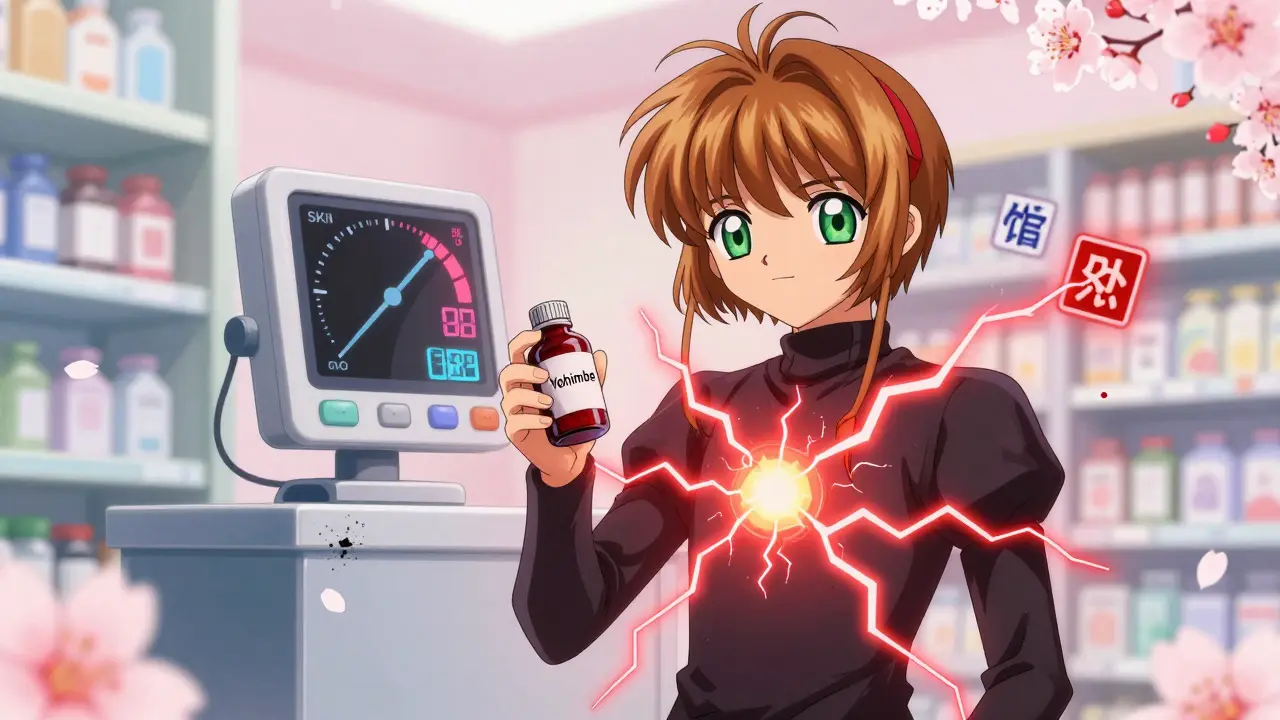
Yohimbe Medication Interaction Checker
This tool helps you understand if your blood pressure medication could have dangerous interactions with yohimbe supplements. Remember: combining yohimbe with blood pressure medications can cause life-threatening spikes in blood pressure.
Important Safety Information
DANGER: Yohimbe Interaction Risk
Yohimbe can cause dangerous spikes in blood pressure when combined with blood pressure medications. This is not theoretical - there are documented cases of hospitalizations and hypertensive crises.
Yohimbe blocks alpha-2 receptors, which are crucial for regulating blood pressure. When combined with medications like clonidine or beta-blockers, it can cause blood pressure to spike by 30-50 mmHg or more.
These spikes can push your blood pressure into the hypertensive crisis range (systolic over 180 mmHg), potentially leading to stroke, heart attack, or organ damage.
If you're taking blood pressure medication and thinking about trying yohimbe for weight loss, energy, or sexual performance, stop. This isn't a risk worth taking. Yohimbe, a supplement derived from the bark of an African tree, can cause dangerous spikes in blood pressure-sometimes to life-threatening levels-when mixed with common heart medications. It's not a matter of "maybe" or "sometimes." The science is clear: combining yohimbe with blood pressure drugs can trigger hypertensive crises, heart palpitations, and even hospitalizations.
What Exactly Is Yohimbe?
Yohimbe comes from the bark of the Pausinystalia yohimbe tree, native to parts of Central and West Africa. Its active ingredient, yohimbine, has been studied since the 1890s. In 1989, the FDA approved a purified form called Yocon for erectile dysfunction. But today, it's mostly sold as an unregulated dietary supplement-often labeled as a "male enhancement" or "fat burner."
Here’s the problem: these supplements don’t contain consistent amounts of yohimbine. A 2015 analysis found that out of 49 U.S. brands, some had no yohimbine at all, while others had more than six times the labeled dose. Thirty percent even contained synthetic yohimbine, not the natural compound. That means you never know how much you’re actually taking. One pill might be safe. The next could push your blood pressure into emergency territory.
How Yohimbe Affects Your Blood Pressure
Yohimbine works by blocking alpha-2 receptors in your nervous system. These receptors normally help keep your blood pressure in check by limiting the release of norepinephrine-a hormone that tightens blood vessels and speeds up your heart. When yohimbine blocks them, norepinephrine floods your system. Your heart races. Your arteries constrict. Your blood pressure spikes.
Studies show yohimbine can raise systolic blood pressure by 20 to 30 mmHg in people who are sensitive to it. That’s the difference between a controlled 130/85 and a dangerous 160/95-or worse. In some cases, especially when combined with other stimulants like clenbuterol, the increase jumps by 300%. The California Poison Control System recorded that 58% of yohimbe-related emergency calls involved systolic blood pressure above 140 mmHg. For someone already on medication to keep their pressure low, that’s a recipe for disaster.
Deadly Interactions With Common Blood Pressure Drugs
Yohimbe doesn’t just raise blood pressure-it actively fights against the medications designed to lower it. The Mayo Clinic lists 12 major classes of blood pressure drugs that interact dangerously with yohimbine:
- Clonidine (Catapres): This drug works by activating alpha-2 receptors to calm your nervous system. Yohimbine blocks those same receptors. The result? A blood pressure spike of 30 to 50 mmHg. This isn’t theoretical-dozens of cases have been documented.
- Guanabenz and Guanfacine: Similar to clonidine, these drugs are also alpha-2 agonists. Combining them with yohimbe can reduce their effectiveness by 25-40%.
- Beta-blockers (metoprolol, atenolol): These slow your heart rate. Yohimbine speeds it up. The clash can cause irregular rhythms or force your heart to work too hard.
- ACE inhibitors (lisinopril, enalapril): These relax blood vessels. Yohimbine tightens them. One Reddit user on r/HighBloodPressure reported a systolic reading of 210 after taking yohimbe while on lisinopril.
- Calcium channel blockers (amlodipine, diltiazem): These help blood vessels widen. Yohimbine does the opposite.
- Diuretics (hydrochlorothiazide): These remove fluid to lower pressure. Yohimbine can cause fluid retention and increased heart strain.
Even worse, yohimbe interacts with antidepressants like amitriptyline and venlafaxine, which also affect norepinephrine. A 2022 study found 17 cases of severe hypertension (systolic over 180 mmHg) requiring emergency care because of this combo.
Real People, Real Consequences
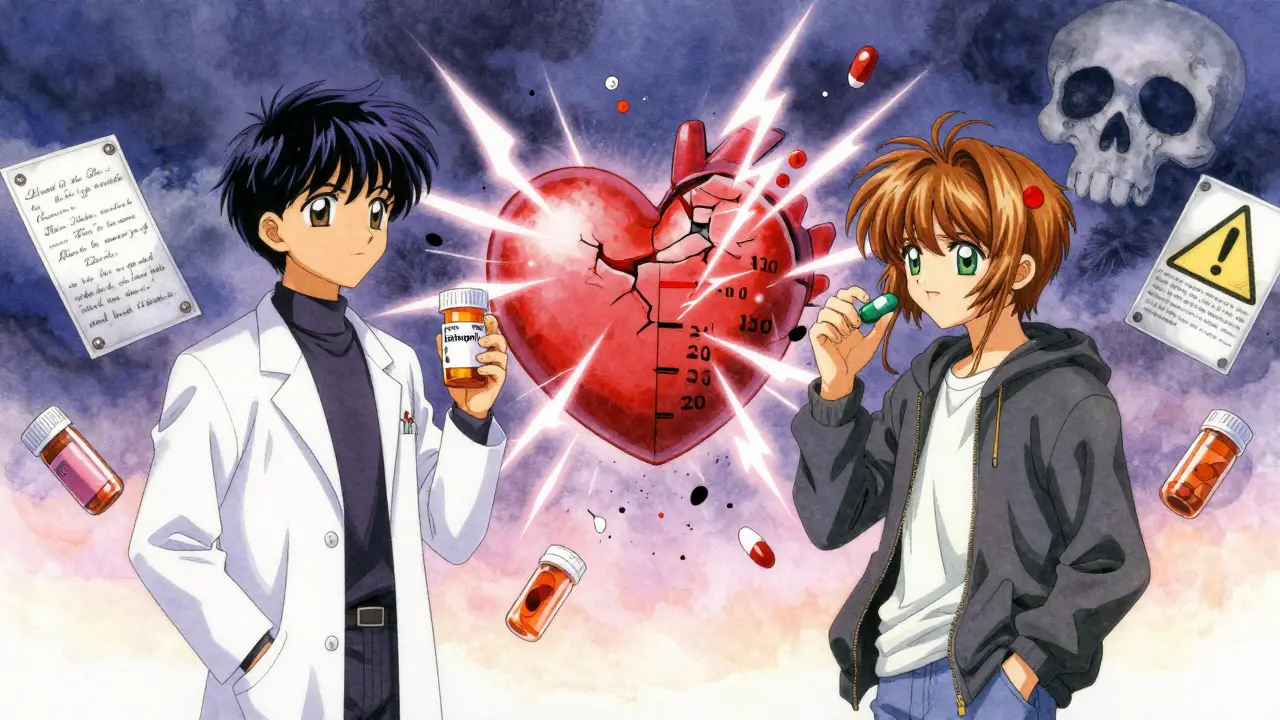
The data isn’t just numbers. Real people are ending up in emergency rooms because of yohimbe.
On WebMD, 87% of 214 reviews from people with hypertension reported negative effects. Over 60 of them described sudden, scary spikes in blood pressure. One woman wrote: "I took one capsule for energy and felt like my heart was going to explode. My BP hit 198/112. I called 911."
A 2022 Reddit thread titled "Yohimbe nearly killed me while on lisinopril" had 147 comments. Thirty-two users shared similar stories-some with readings over 200 mmHg. The average age of people who had yohimbe-related emergencies? 37. That’s younger than most people diagnosed with chronic high blood pressure. These aren’t elderly patients with complex medical histories. These are healthy-looking people who thought they were just taking a "natural" boost.
Why Supplements Like This Are So Dangerous
Unlike prescription drugs, supplements aren’t required to prove safety before they hit the market. The FDA doesn’t test them. Manufacturers don’t have to prove they work. And labeling? Often wrong.
ConsumerLab.com tested 15 yohimbe products in 2022. Sixty-eight percent mislabeled the yohimbine content. Some had less than half the stated dose. Others had more than four times as much. One product labeled as 5 mg per capsule contained 28.7 mg. That’s more than five times the amount used in clinical trials-and far beyond any safe threshold.
And here’s the kicker: 78% of these products didn’t even mention the risk of high blood pressure on the label. You’re not just risking your health-you’re being misled.
What the Experts Say
The American Heart Association calls yohimbe a "high-risk" supplement for people with heart conditions. Their 2022 report documented 43 cases of dangerous blood pressure spikes between 2015 and 2021. The Memorial Sloan Kettering Cancer Center explicitly warns: "Do not use if you have high blood pressure."
Dr. David Kiefer from the University of Arizona told JAMA Internal Medicine: "Yohimbe represents one of the most dangerous herbal supplements for patients with hypertension due to its unpredictable dose-response relationship and significant interaction potential with nearly all major antihypertensive classes."
The FDA has issued two public health warnings since 2010. In March 2021, they cited 127 adverse event reports-including 19 hospitalizations for hypertensive crisis. In January 2023, they recalled 17 brands after finding wildly inconsistent yohimbine levels.
Global Bans and Growing Restrictions
Canada banned yohimbe supplements in 2020. Australia did the same. The European Medicines Agency banned them in 2018. Yet, in the U.S., sales hit $38.7 million in 2021. Why? Because they’re still sold online, in gas stations, and supplement shops with no warning labels.
The FDA’s 2023-2025 enforcement plan lists yohimbe as a "high-risk supplement"-meaning they’re watching it closely. Draft guidance released in August 2023 proposes mandatory labels that read: "WARNING: May cause dangerous increases in blood pressure, especially when taken with blood pressure medications. Not for use by persons with heart disease or hypertension."
Meanwhile, the American College of Cardiology now recommends that doctors ask every patient with high blood pressure: "Are you taking any herbal supplements?"-specifically naming yohimbe.
What Should You Do?
If you’re on blood pressure medication: Do not take yohimbe. Not even once. Not even "just to try." The risk isn’t worth it.
If you’ve already taken it: Monitor your blood pressure closely. If you feel your heart racing, your head pounding, or you get dizzy or short of breath, stop immediately and check your BP. If it’s above 180/110, seek medical help.
If you’re considering it: Ask yourself why. Are you trying to lose weight? There are safer, proven ways. Trying to improve performance? Talk to your doctor. There are FDA-approved treatments with known safety profiles. You don’t need to gamble with your heart.
And if you’re a caregiver or family member: Watch for unlabeled bottles in medicine cabinets. Many people don’t think of supplements as "medications." But yohimbe is just as dangerous as a prescription drug when mixed with the wrong pills.
What Are the Alternatives?
If you’re looking for natural support for energy, weight loss, or sexual health, there are safer options:
- Exercise: Even 30 minutes of brisk walking daily improves circulation and helps lower blood pressure.
- Weight management: Losing just 5-10% of body weight can significantly reduce BP.
- Behavioral changes: Stress reduction, sleep quality, and reducing sodium intake all have strong evidence.
- Prescription alternatives: For erectile dysfunction, medications like sildenafil (Viagra) or tadalafil (Cialis) are proven, regulated, and safe when used under medical supervision.
There’s no shortcut that justifies risking your heart. The supplement industry thrives on hope. But your heart doesn’t respond to hope-it responds to biology. And biology doesn’t forgive mistakes with yohimbe.




12 Comments
Jake Kelly
January 11, 2026 AT 00:18Yohimbe is one of those things that sounds like a quick fix but turns into a nightmare real fast. I’ve seen friends try it for energy and end up in the ER with heart palpitations. No supplement is worth that kind of risk, especially when you’re already managing blood pressure.
Ashlee Montgomery
January 12, 2026 AT 03:37The inconsistency in dosing is the real kicker. You think you're getting 5mg but it's actually 28mg. That’s not a supplement-it’s Russian roulette with your cardiovascular system. And the fact that labels don’t even warn you? That’s not negligence, that’s exploitation.
lisa Bajram
January 12, 2026 AT 17:20Oh my god, I just read this and my jaw dropped. I had no idea yohimbe was this dangerous. I thought it was just another ‘natural’ energy boost-like green tea or something. But this? This is straight-up medical malpractice disguised as a fitness trend. People need to wake up. Your heart doesn’t care if it’s ‘herbal’-it just knows when it’s being pushed past its limits.
I’ve got a cousin on lisinopril who was considering this for ‘fat loss.’ I just sent her this article. No more guessing games with supplements. If it’s not FDA-approved and labeled with real warnings? Skip it.
neeraj maor
January 13, 2026 AT 06:49Let’s be real-this isn’t about yohimbe. This is about the FDA being bought off by Big Supplement. You think they don’t know about the 28mg capsules? Of course they do. They just don’t care until someone dies. And then they issue a recall and pretend they’re heroes. Meanwhile, the same companies just relabel and relaunch. This is a controlled demolition of public health. The real villain? Profit.
And don’t get me started on how they market this to young guys as ‘male enhancement.’ It’s not enhancement-it’s a chemical trap. They’re selling anxiety disguised as confidence.
Michael Marchio
January 13, 2026 AT 13:21Look, I get it-you want to feel stronger, leaner, more ‘alpha.’ But here’s the truth: if you need a botanical extract from an African tree to feel like a man, you’re already lost. Real strength isn’t found in a capsule. It’s in discipline, sleep, and consistency. Yohimbe isn’t a shortcut-it’s a surrender. You’re outsourcing your health to a company that doesn’t even know how much active ingredient is in their own product. And you’re fine with that? Really?
And let’s not pretend this is just about blood pressure. The mental toll is worse. That constant dread of ‘what if I took too much?’ That paranoia that your heart’s gonna give out? That’s not a boost-it’s a cage. You traded freedom for a false promise. And now you’re paying for it with every heartbeat.
People don’t realize how much of their identity is tied to these supplements. ‘I’m not fit enough without yohimbe.’ ‘I can’t perform without it.’ That’s not physiology-it’s psychological dependency dressed up as biohacking. You’re not optimizing your body. You’re numbing your self-worth.
And the worst part? The people who sell this stuff aren’t even the ones taking it. They’re sitting in their McMansions, sipping matcha lattes, laughing while you’re in the ER with a systolic of 210. That’s the real horror story.
There’s a reason Canada and Australia banned it. There’s a reason the American Heart Association calls it high-risk. And there’s a reason the FDA’s been warning people since 2010. But you? You’re still scrolling through Amazon reviews like it’s a beauty product. You’re not being reckless. You’re being manipulated.
Wake up. Your body isn’t a lab experiment. It’s your only one. And you don’t get to reset it.
Paul Bear
January 13, 2026 AT 20:55Statistically, the risk-benefit ratio is catastrophically skewed. The pharmacokinetic variability of yohimbine in unregulated supplements creates a coefficient of variation exceeding 200% in some formulations-far beyond the therapeutic window established in clinical trials (0.2–0.4 mg/kg). This isn't 'natural'-it's pharmacological chaos. The alpha-2 adrenergic antagonism induces unopposed sympathetic outflow, triggering catecholamine surges that directly counteract the mechanism of action of clonidine, guanfacine, and even beta-blockers. In patients with pre-existing endothelial dysfunction (common in hypertension), this precipitates acute vasoconstriction, myocardial ischemia, and arrhythmogenic potential. The data is unequivocal: no safe threshold exists for co-administration with antihypertensives. Period.
Kunal Majumder
January 15, 2026 AT 19:00I used to take this stuff in college-thought it was cool. One day I felt like my chest was being crushed. Turned out my BP was 190/105. Scared the hell out of me. Stopped cold. No regrets. If you’re thinking about trying it, don’t. Just don’t.
Ritwik Bose
January 16, 2026 AT 21:45Thank you for this incredibly detailed and responsible breakdown. 🙏 As someone from India where these supplements are sold openly at roadside stalls, I’ve seen too many young men collapse after taking ‘herbal energy boosters.’ The lack of awareness is terrifying. We need public health campaigns-not just warnings, but real education. Maybe even ban these from gas stations and gyms. Lives are at stake.
Aurora Memo
January 18, 2026 AT 01:14I work in a clinic and see this every month. Someone comes in panicked because they took ‘one capsule’ and now their heart won’t stop. They didn’t even know it was yohimbe-just saw ‘natural testosterone booster’ on the label. We need better labeling, yes-but we also need doctors to ask about supplements the same way we ask about smoking or alcohol. It’s not optional. It’s part of the history.
Dwayne Dickson
January 19, 2026 AT 22:51Oh, so now we’re treating dietary supplements like they’re regulated pharmaceuticals? How quaint. Let’s not forget that people have been using yohimbe for centuries in traditional medicine. Maybe instead of fear-mongering, we should be asking why the FDA lets Big Pharma monopolize treatments while demonizing natural alternatives. The real danger isn’t yohimbe-it’s the lack of access to affordable, effective medicine.
Also, 78% of products don’t warn about BP? So the solution is to ban them? Or to fix the labeling? You’re conflating corporate negligence with inherent danger. That’s lazy.
Ted Conerly
January 20, 2026 AT 11:12So many people think ‘natural’ means ‘safe.’ Nope. Poison ivy is natural. Botulinum toxin is natural. Yohimbe? It’s a potent neuroactive alkaloid. It doesn’t care if you call it ‘herbal.’ It’s going to do what it does-raise your BP, race your heart, and possibly kill you if you’re on meds. Don’t romanticize it. Just don’t take it. Period.
And if you’re looking for energy or performance? Train. Sleep. Eat real food. Those are the real supplements. Everything else is just noise.
chandra tan
January 20, 2026 AT 12:22My uncle took this in India and ended up in ICU. He was 42, healthy, thought he was being smart. Now he’s on three meds and can’t lift his grandkids. Don’t be him. Just say no.