
Imagine your joints are slowly filling with microscopic shards of glass. That is essentially what happens when you have gout, a form of inflammatory arthritis caused by the buildup of monosodium urate crystals. For decades, doctors treated the pain but ignored the root cause. Today, the standard of care has shifted dramatically toward a "treat-to-target" approach. This means we don't just prescribe medication; we aim for specific urate targets in your blood to dissolve existing crystals and prevent new ones from forming.
If you have been diagnosed with gout, understanding these targets and how drugs like Allopurinol and Febuxostat work to lower serum urate levels is critical. Getting this right can mean the difference between living pain-free and suffering chronic joint damage. Let's break down exactly what those numbers mean, which drug is right for you, and why patience during the titration phase is non-negotiable.
The Magic Number: What Are Urate Targets?
To understand gout treatment, you first need to understand saturation. Think of your blood like a cup of water and uric acid like sugar. If you add too much sugar, it stops dissolving and settles at the bottom as grit. In your body, that "grit" forms sharp crystals in your joints. The saturation point for uric acid is approximately 6.8 mg/dL (0.40 mmol/L). Above this level, crystals form. Below it, they dissolve.
Major health organizations, including the American College of Rheumatology (ACR), NICE (National Institute for Health and Care Excellence), and EULAR (European Alliance of Associations for Rheumatology), agree on a clear goal: keep your serum urate levels below 6 mg/dL (360 micromol/L or 0.36 mmol/L). This buffer zone ensures that any existing crystals begin to melt away over time.
However, if you have severe gout-characterized by visible lumps called tophi, chronic joint pain, or radiographic damage-the target gets stricter. Guidelines recommend aiming for below 5 mg/dL (300 micromol/L or 0.30 mmol/L) in these cases. Why? Because higher concentrations require a steeper gradient to force the stubborn crystals to dissolve. Conversely, there is no benefit to dropping below 3 mg/dL (180 micromol/L), and doing so may carry unknown risks. Your doctor will monitor your levels to keep you safely within the therapeutic window.
Allopurinol: The First-Line Standard
Allopurinol is the most widely used urate-lowering therapy (ULT) globally. It works by inhibiting xanthine oxidase, the enzyme responsible for producing uric acid. Despite its age, it remains the gold standard for several reasons: it is highly effective, inexpensive, and has a long track record of safety.
The biggest mistake patients make with Allopurinol is starting at the wrong dose. Many providers still prescribe 100 mg daily as a starting point, but real-world data shows this is often insufficient. The ACR guidelines strongly recommend starting low-typically ≤100 mg/day (or ≤50 mg/day if you have moderate to severe chronic kidney disease)-and then titrating up gradually. You should increase the dose every 2 to 5 weeks until you hit your target. Don't be surprised if you end up needing 300 mg, 400 mg, or even 600-800 mg daily. Studies show that 75-80% of patients with normal kidney function reach their target only after exceeding the old "standard" dose of 300 mg.
Safety is paramount. Before starting Allopurinol, especially for individuals of Han Chinese, Korean, or Thai descent, testing for the HLA-B*5801 gene variant is crucial. Carrying this gene increases the risk of a rare but severe hypersensitivity reaction by up to 25 times. If you test positive, Allopurinol is generally avoided.
Febuxostat: The Alternative Strategy
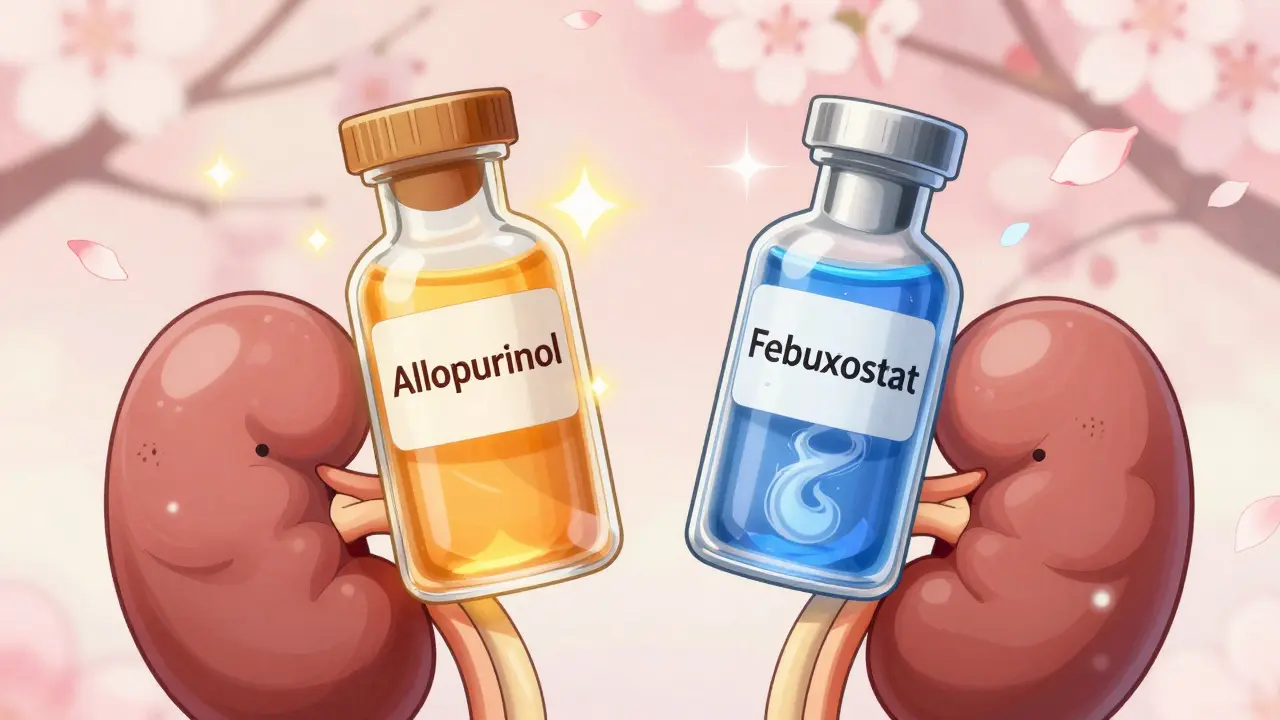
When Allopurinol isn't an option-due to intolerance, allergy, or failure to reach targets despite maximum dosing-Febuxostat becomes the primary alternative. Like Allopurinol, it inhibits xanthine oxidase, but it is a non-purine selective inhibitor. This chemical difference matters because Febuxostat is processed differently by the liver and kidneys.
For patients with chronic kidney disease (CKD), Febuxostat can be particularly advantageous. A 2023 meta-analysis published in *Rheumatology* found that Febuxostat achieved target urate levels 15% more often than Allopurinol in patients with severe CKD. This is because Febuxostat does not require dose adjustment based on kidney function, whereas Allopurinol doses must be carefully reduced to avoid toxic buildup of metabolites.
However, Febuxostat comes with caveats. It is significantly more expensive than generic Allopurinol (often $30-$50/month versus $4-$12/month in the US). Additionally, while earlier studies raised concerns about cardiovascular risks, subsequent large-scale trials have largely alleviated these fears, though patients with a history of heart disease should still discuss risks with their cardiologist. NICE guidelines in the UK allow Febuxostat as a first-line option equal to Allopurinol, depending on patient preference and comorbidities, whereas EULAR and ACR still prefer Allopurinol unless contraindicated.
| Feature | Allopurinol | Febuxostat |
|---|---|---|
| First-Line Status | Preferred by ACR/EULAR | Alternative or Equal (NICE) |
| Kidney Adjustment | Required for CKD ≥ Stage 3 | Not required |
| Starting Dose | ≤100 mg/day | ≤40 mg/day |
| Max Effective Dose | Up to 800 mg/day | 80 mg/day (sometimes 120 mg) |
| Cost (US Generic) | $4 - $12 / month | $30 - $50 / month |
| Key Risk | Hypersensitivity (HLA-B*5801) | Potential CV risk (debated) |
The Titration Process: Why Patience Pays Off
Reaching your urate target is rarely a one-and-done event. It is a process called titration. You start with a low dose, wait for your body to adjust, check your blood levels, and then increase the dose slightly. This cycle repeats until you are consistently below 6 mg/dL (or 5 mg/dL for severe cases).
This phase requires discipline. The ACR implementation toolkit notes that monthly serum urate monitoring increases target achievement by 31% compared to quarterly checks. Yet, many patients see their doctor only once or twice a year. Without frequent monitoring, you might stay on a sub-therapeutic dose for years, allowing crystal deposition to continue silently.
You must also prepare for the "flare paradox." When you first start ULT or increase the dose, you may experience *more* gout flares. This happens because shifting urate levels dislodge existing crystals, triggering inflammation. This is a sign the medication is working, not failing. To manage this, doctors prescribe prophylactic anti-inflammatory medication (like colchicine or NSAIDs) for the first 3 to 6 months of treatment. Never stop your ULT during a flare; continuing it helps stabilize levels faster.

Real-World Challenges and Disparities
Despite clear guidelines, implementation gaps remain significant. Data from New Zealand’s BPAC (2025) reveals that only 42% of patients achieve target serum urate levels within the first 12 months. Barriers include cost, side effects, and lack of provider education. Alarmingly, systemic disparities exist: Māori and Pacific populations in New Zealand experienced 23% lower target achievement rates compared to European/Other ethnicities, despite higher dispensing rates. Similar gaps exist in the US, where CDC data shows only 28% of gout patients receive appropriate ULT dosing.
Patient advocacy groups highlight frustration with inadequate provider education. Many patients report being told "this is just part of aging" rather than receiving a structured titration plan. Community feedback indicates that 78% of patients take longer than six months to reach their target, and 43% require Allopurinol doses above 400 mg/day. If your doctor refuses to titrate beyond 300 mg due to outdated beliefs about toxicity, seek a second opinion from a rheumatologist.
Future Directions: Precision Medicine
The future of gout management lies in precision dosing. Emerging research, such as the 2024 GOUT-PRO study, explores genotype-guided dosing. By analyzing genetic markers like ABCG2 and SLC22A12 polymorphisms, doctors can predict how efficiently your kidneys transport uric acid. This approach increased target achievement from 61% to 83% in early trials. While not yet standard practice, genetic testing may soon become routine for patients who fail to respond to standard titration.
Newer drugs like verinurad, a uricosuric agent that helps kidneys excrete uric acid, are in development. These could offer alternatives for patients who cannot tolerate xanthine oxidase inhibitors. Until then, sticking to the proven treat-to-target strategy with Allopurinol or Febuxostat remains the best path to a pain-free life.
What is the ideal serum urate level for gout?
The general target for most gout patients is below 6 mg/dL (360 micromol/L). For patients with severe gout, including those with tophi or joint damage, the target is stricter: below 5 mg/dL (300 micromol/L). Levels should never drop below 3 mg/dL.
Can I switch from Allopurinol to Febuxostat?
Yes, switching is common if Allopurinol causes side effects, fails to reach targets, or if you have severe kidney disease. However, Febuxostat is more expensive. Always consult your doctor before switching, as you may need to adjust other medications.
Why do I get more flares when I start treatment?
This is known as the "flare paradox." Lowering urate levels rapidly can dislodge existing crystals, causing inflammation. This is temporary. Taking preventive anti-inflammatory meds like colchicine for the first 3-6 months can help reduce these flares.
How often should I check my urate levels?
During the titration phase, you should check your serum urate levels every 2 to 5 weeks to guide dose adjustments. Once you reach your target, annual monitoring is usually sufficient to ensure you stay on track.
Is Allopurinol safe for people with kidney problems?
Yes, but the dose must be adjusted. For patients with moderate to severe chronic kidney disease (CKD stage 3+), doctors typically start with a very low dose (e.g., 50 mg/day) and titrate up slowly. Febuxostat is often preferred in severe CKD as it doesn't require renal dose adjustment.