

Kidney Protection Hydration Calculator
How much fluid do you need?
This calculator determines your personalized hydration needs based on your weight and kidney function to protect your kidneys during contrast imaging procedures.
When you’re scheduled for a CT scan, angiogram, or other imaging test that uses contrast dye, most people worry about the needle, the noise, or the claustrophobia. But few think about how that dye might affect their kidneys-until it’s too late. Every year, millions of people get contrast dye for medical imaging. For some, especially those with existing kidney problems, that dye can cause serious, sometimes permanent, kidney damage. This isn’t rare. It’s called contrast-induced acute kidney injury (CI-AKI), and it’s preventable-with the right hydration plan.
Why Contrast Dye Can Hurt Your Kidneys
Contrast dye isn’t poison. But your kidneys have to filter it out. And if they’re already working hard-because of diabetes, high blood pressure, or chronic kidney disease-they can get overwhelmed. The dye makes the blood vessels in the kidneys narrow, reduces blood flow, and creates oxidative stress. The result? Kidney cells start to die. This isn’t just a theoretical risk. Studies show CI-AKI happens in up to 22% of high-risk patients who get no prevention. That’s more than 1 in 5 people.And the consequences aren’t small. People who develop CI-AKI stay in the hospital an extra 3.2 days on average. Their bills jump by about $7,500. Some need dialysis. Others never fully recover kidney function. The good news? You can cut that risk by more than half-just by drinking or receiving the right fluids at the right time.
How Hydration Helps: The Science Behind It
Hydration works because it keeps your kidneys flushed. More fluid means better blood flow through the kidneys. It dilutes the dye so it’s less concentrated. And it helps your body get rid of the dye faster-before it has time to cause damage. Think of it like rinsing a coffee pot after brewing. If you leave the grounds in, they stain. If you rinse right away, it stays clean.Research from 2020, analyzing over 21,000 patients, showed that simple IV saline (salt water) given before and after the scan reduced CI-AKI by 26%. That’s significant. But even better results came from smarter approaches. One system, called RenalGuard, uses real-time data to match fluid input with urine output. If you’re peeing 150 mL an hour, it gives you exactly enough fluid to keep you there. This system cut CI-AKI by 68% in high-risk patients. That’s not luck-it’s precision.
Standard Hydration Protocols: What Works for Most People
Not everyone needs high-tech solutions. For many, a simple plan works just fine.- Standard IV saline: 3-4 mL per kg of body weight per hour, given 4 hours before and 4 hours after the procedure. For a 70 kg person, that’s about 840-1,120 mL total per session.
- Long hydration: 1 mL per kg per hour for 12 hours before and 12 hours after. Used for very high-risk patients or those with advanced kidney disease.
- Sodium bicarbonate: A slightly alkaline IV solution (154 mmol/L) given at 3 mL/kg/hr for 1 hour before, then 1 mL/kg/hr for 6 hours after. Some studies suggest it’s better than saline alone, especially for patients with diabetes.
These aren’t guesses. They’re based on decades of clinical trials. The American College of Radiology, the National Kidney Foundation, and the VA/DOD all endorse these protocols.
Oral Hydration: A Simpler, Often Just as Effective Option
If you’re healthy enough and not on IV fluids for other reasons, drinking water can be just as good as an IV.A 2018 study compared oral hydration (500 mL of water 2 hours before the scan, then 250 mL every hour during the procedure) with IV saline. The CI-AKI rate? 4.7% for oral, 5.1% for IV. No meaningful difference. And patients preferred it-no needles, more freedom, less hospital time.
But here’s the catch: oral hydration only works if you can drink and keep it down. If you’re nauseous, dizzy, or have heart failure, drinking too much water can be dangerous. Your doctor will decide if this is safe for you.

Who Needs the Advanced Stuff? Who Doesn’t?
Not everyone needs the same level of care. One of the biggest mistakes in medicine is giving everyone the same treatment. That’s why risk stratification matters.High-risk patients: Those with an eGFR below 60 mL/min/1.73m² (Stage 3 or worse kidney disease), diabetes, heart failure, or who are over 75. These people benefit most from IV hydration-preferably with RenalGuard or hemodynamic monitoring if available.
Low-risk patients: If your eGFR is above 29 mL/min/1.73m² and you have no other kidney issues, you likely don’t need any prophylactic hydration at all. One study showed CI-AKI rates were the same-1.8% with no hydration, 2.1% with IV saline. That’s not a difference worth the cost, time, or discomfort.
The 2025 VA/DOD guidelines say it clearly: hydration should be tailored to your kidney function, not handed out like candy. If your kidneys are working fine, skip the IV. If they’re struggling, go all in.
What About Heart Failure Patients?
This is where things get tricky. Hydration helps kidneys-but too much fluid can drown your heart.If you have heart failure, especially with a low ejection fraction, aggressive hydration can trigger pulmonary edema. Even 500 mL extra can make you gasp for air. That’s why doctors now use hemodynamic-guided hydration for these patients. Instead of giving a fixed volume, they monitor your central venous pressure or use ultrasound to see how full your heart is. Then they adjust fluids in real time. It’s not common in every hospital-but it’s becoming the gold standard in major centers.
If you have heart failure and need contrast imaging, ask: “Will my fluid intake be monitored closely? Will you check my heart’s response?” If the answer is no, push for a safer plan-or ask if there’s an alternative test that doesn’t need dye.
Real-World Impact: What Happens When Hospitals Do It Right
The Mayo Clinic didn’t just read the guidelines-they changed their system. Before 2022, their CI-AKI rate was 12.3%. After standardizing hydration protocols across cardiology, radiology, and nursing teams, they dropped it to 5.7% in just 12 months.How? They made hydration part of the workflow. Nurses checked kidney function before scheduling scans. Patients got written instructions. IV hydration was pre-scheduled. Post-procedure creatinine levels were tracked. It wasn’t magic. It was coordination.
And it saved money. Preventing one CI-AKI case saves about $4,200 in avoided hospital stays and dialysis. Even if RenalGuard adds $1,200 to the cost of a procedure, it pays for itself in less than one prevented case.
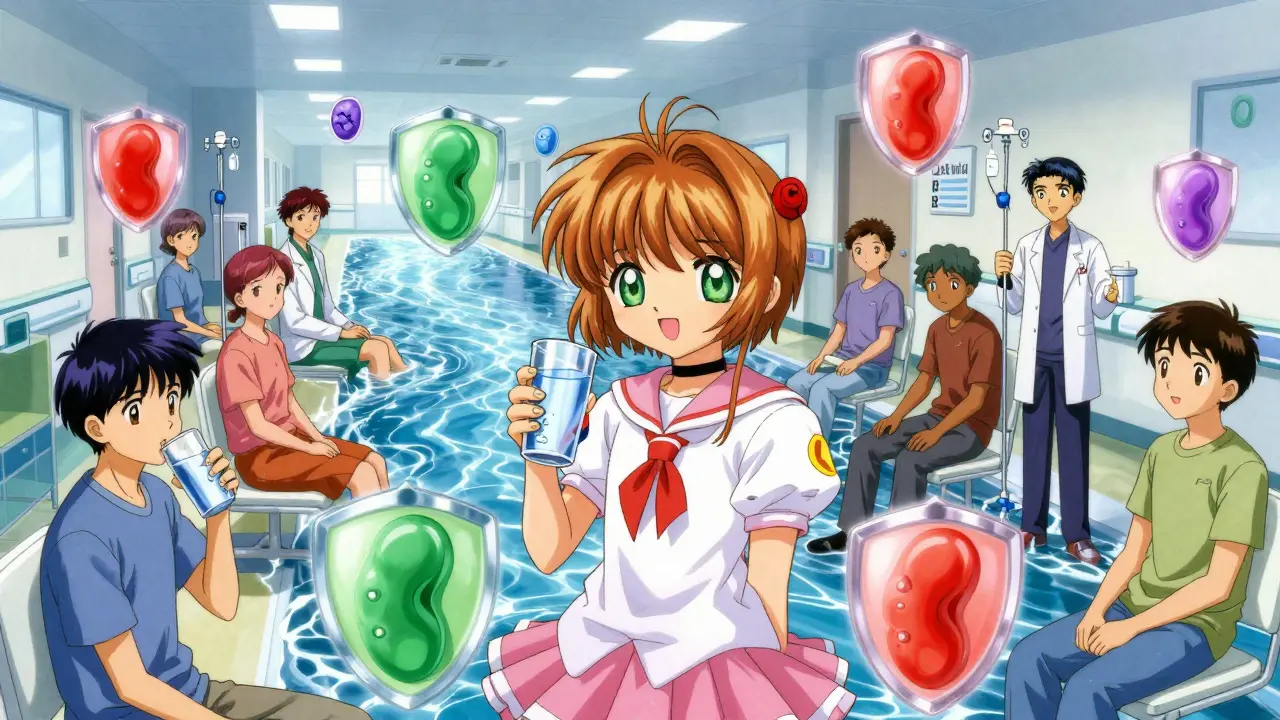
What You Can Do: A Simple Action Plan
If you’re scheduled for a scan with contrast dye:- Check your last kidney test (eGFR). If you don’t know it, ask your doctor. If it’s below 60, you’re at higher risk.
- Ask: “Do I need IV hydration? Or is drinking water enough?”
- If you’re told you need IV fluids, ask if they use RenalGuard or hemodynamic monitoring-especially if you have heart failure.
- If you’re allowed oral hydration, drink water steadily. Don’t chug it all at once. Aim for 250 mL every hour before and during the procedure.
- After the scan, keep drinking. Don’t stop just because the procedure is over. Your kidneys are still clearing the dye.
- Get a creatinine blood test 48-72 hours later. This is the only way to know if your kidneys were affected.
What Doesn’t Work
Lots of people think N-acetylcysteine (NAC), an antioxidant, helps protect kidneys. But the 2020 meta-analysis showed it doesn’t add any benefit when you’re already well-hydrated. Same with caffeine, diuretics, or herbal supplements. Stick to water or saline. Nothing else has proven value.The Future: Personalized Hydration Is Coming
Hospitals are moving toward AI-driven fluid systems. At Johns Hopkins, pilot programs use real-time data-urine output, blood pressure, kidney biomarkers-to adjust hydration automatically. Early results show another 15-20% drop in CI-AKI. These systems won’t be everywhere by 2026-but they’re coming.For now, the best thing you can do is be informed. Ask questions. Know your numbers. Don’t assume hydration is one-size-fits-all. Your kidneys aren’t. Neither should your plan be.






8 Comments
Renee Stringer
January 19, 2026 AT 11:57It’s disturbing how many hospitals still treat hydration like a checkbox instead of a medical imperative. I’ve seen patients with eGFRs of 42 get sent in for contrast without a single question asked-no pre-screening, no protocol, just ‘oh, you’re fine.’ This isn’t negligence; it’s systemic laziness wrapped in bureaucratic inertia. If your kidneys are already compromised, you don’t get a free pass to ignore the science. The data is clear. The guidelines are published. The cost of inaction is measured in dialysis bills and lost quality of life. Why is this still so hard to implement?
Crystal August
January 20, 2026 AT 10:09So let me get this straight-you’re saying drinking water is just as good as an IV for most people, but only if you’re not nauseous, dizzy, or have heart failure? That’s like saying ‘eating vegetables is healthy’ but only if you’re not allergic, pregnant, or currently in a coma. The real problem isn’t hydration-it’s that doctors still don’t know how to assess risk properly. They’re either overtreating the healthy or under-treating the vulnerable. Either way, it’s a mess.
Nadia Watson
January 22, 2026 AT 00:44I work in a rural clinic where we don’t have RenalGuard or hemodynamic monitoring-sometimes we don’t even have a nephrologist on call. But we do have nurses who remember patients’ names, and we do have access to basic labs. We started asking every patient over 65 for their last eGFR before scheduling any contrast study. We gave them printed hydration instructions in plain language. We followed up with a call 72 hours later. Our CI-AKI rate dropped from 14% to 5.3% in nine months. It’s not fancy. It’s not high-tech. But it’s human. And it works. Maybe the future isn’t AI-it’s just consistency, care, and a little bit of courage to ask the right questions.
Thomas Varner
January 23, 2026 AT 15:34Wait-so NAC doesn’t work? I’ve been taking it for years because my cousin’s cardiologist swore by it… and now you’re telling me it’s useless? That’s… a lot. I mean, I’ve got a whole bottle of it in my medicine cabinet, labeled ‘Kidney Protector’ in Sharpie. I guess I’m just… out of luck? Also, why does everyone keep saying ‘eGFR below 60’ like it’s some magical threshold? My last one was 58. Am I suddenly in the danger zone? What if it was 59.9? Do I get an IV? Do I get a medal? This whole system feels like it was designed by accountants who took a single statistics course.
Art Gar
January 25, 2026 AT 12:06The assertion that hydration reduces CI-AKI by 26% is misleading. The meta-analysis cited does not control for baseline hydration status, comorbidities, or timing of fluid administration. Furthermore, the RenalGuard study had a small, highly selected cohort-likely excluding patients with arrhythmias, hypotension, or advanced age, which are precisely the populations most in need of protection. The real takeaway? Medicine is still chasing silver bullets instead of acknowledging complexity. Fluids are not a panacea. Risk stratification is not a protocol-it’s a clinical judgment. And clinical judgment is being replaced by algorithmic dogma disguised as evidence.
Edith Brederode
January 26, 2026 AT 08:20Thank you for this. 🙏 I’m a nurse who’s seen too many patients get contrast without any prep-and then come back in with creatinine spikes. I’ve started handing out little cards to patients: ‘Drink 8 oz every hour before and after. No chugging. No skipping. Your kidneys will thank you.’ One woman cried because no one had ever told her to do this before. This isn’t rocket science. It’s basic care. And it’s being ignored. Please share this with your doctor. Seriously. It matters.
Arlene Mathison
January 27, 2026 AT 19:38Let’s make this simple: if you’re getting contrast, drink water like it’s your job. Sip it all day. Don’t wait until the day of the scan. Start two days before. Your kidneys don’t care about your schedule-they care about your hydration. And if your doctor says you don’t need it? Ask them to show you the study that says so. If they can’t? Then you’re not being overcautious-you’re being smart. Your body isn’t a vending machine. Don’t let it get clogged.
Emily Leigh
January 28, 2026 AT 08:47So… we’re spending thousands on machines to monitor pee output… but we still can’t get people to drink water? I mean, really? We have AI that can predict cancer from a retina scan… but we can’t automate ‘drink 8 oz of H2O’? This is like inventing a self-driving car that still needs you to manually turn the key. The real innovation isn’t RenalGuard-it’s convincing people that their kidneys aren’t indestructible.